

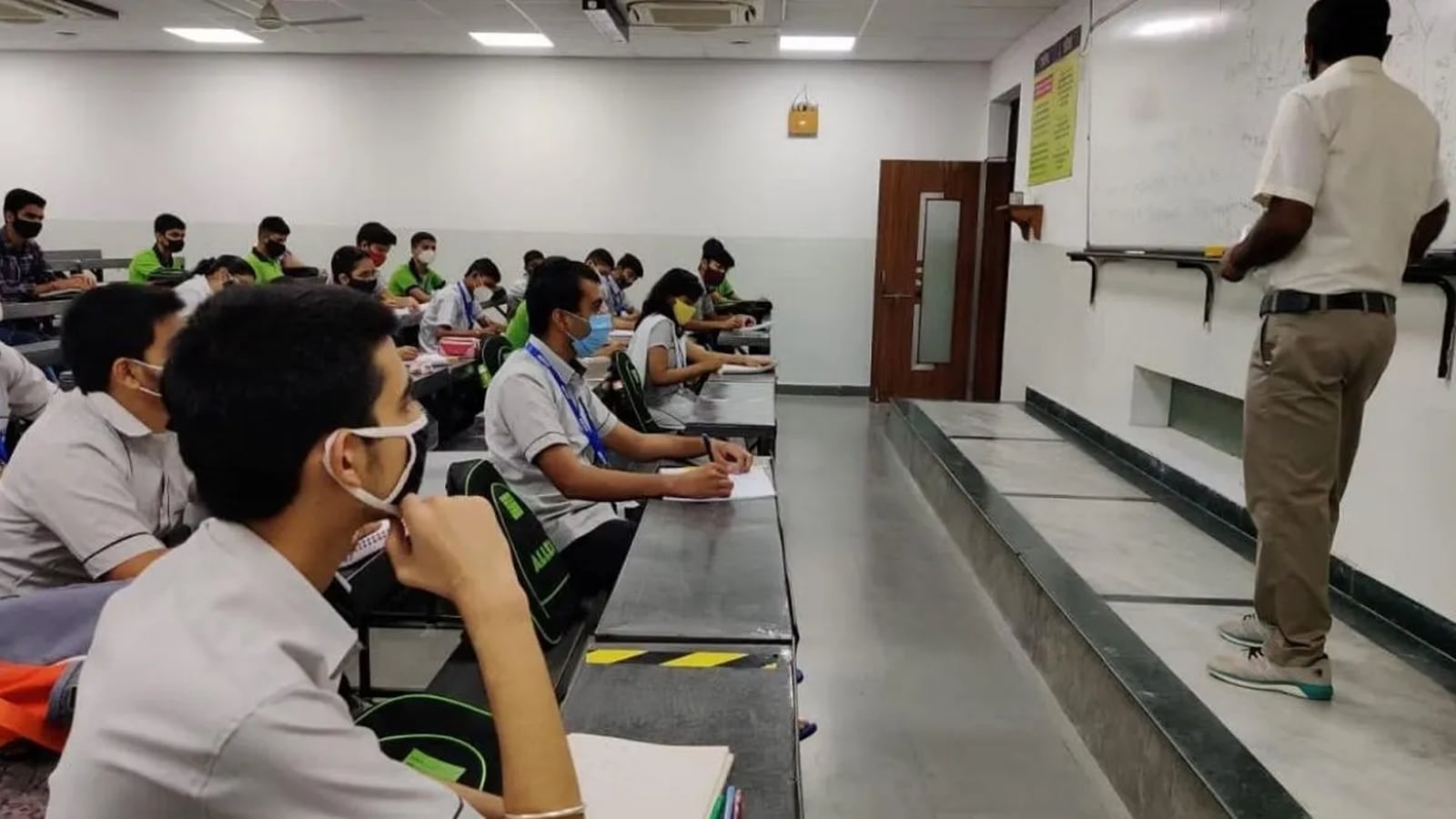
A committee appointed by the central government has proposed a sweeping overhaul of the country’s high school education system with the aim of reducing students’ dependence on coaching centres, The Indian Express has learnt.
The proposals include capping coaching classes at 2-3 hours daily, redesigning school curricula to mirror post-school competitive entrance examinations, giving greater weightage to board examination results in college admissions and exploring the possibility of introducing competitive tests in Class 11.

The committee headed by Vineet Joshi, Secretary, Department of Higher Education, was set up by the Ministry of Education on June 17, 2025 to examine gaps in school education, the “effectiveness and fairness of competitive entrance examinations”, the rise of dummy schools, and the expanding influence of coaching institutes on the academic trajectories of students.
The panel — which included CBSE chairman Rahul Singh, Director General of the National Testing Agency (NTA) Rajesh Lakhani, and professors from IIT Kanpur, IIT Madras, and NIT Trichy — is learnt to have met in Shastri Bhawan in New Delhi, which houses the Ministry of Education, on August 26 and November 15 last year.
In both meetings, members of the committee repeatedly underlined that coaching centres have “emerged to fill certain gaps”, and that the “long-term solution must come from strengthening the school ecosystem itself”.
During discussions, the committee acknowledged the “growing concern around the proliferation of coaching centres and their impact on student well-being, equity of education, and the role of schools”.
The committee is learnt to have identified a “disconnect between school curricula and the demands of competitive examinations such as JEE and NEET”, and flagged the transition from Class 10 to Class 11 as a “stress point” for students.
Story continues below this ad
The “lack of alignment between CBSE’s analytical and conceptual approach and the objective, MCQ-based format of entrance exams” is a “root cause” of the dependence on coaching, the committee noted. This gap has fuelled the rise of dummy schools and a parallel education economy that increasingly sidelines formal schooling, the members are learnt to have agreed.
The committee also observed that teachers in many schools are “not adequately trained to teach beyond board exam requirements”, whereas coaching centres “often employ subject experts, including engineers and medical graduates to deliver targeted instruction”.
Schools, the panel is learnt to have noted, lack the ecosystem that coaching institutes provide — “regular testing, performance analytics and curated study materials” — leaving students to seek structured preparation outside the classroom.
The committee also flagged concerns over the “psychological toll of competitive exams and the pressure to enroll in coaching from an early age”, and has warned that high-stakes, single-attempt examinations lead to stress and “narrow view of success”. The “absence of structured counselling and career guidance in schools” aggravates the problem, members noted.
Story continues below this ad
Among the key suggestions discussed by the committee for further action:
* NCERT, with support from NTA, CBSE, and other boards, to be the nodal agency to “ensure syllabus alignment between school curricula and competitive exam requirements” to reduce disparities and improve student preparedness.
* NTA to furnish candidate-level, question-wise responses, shift-wise papers and final answer keys from the last three years, along with candidate registration details to IIT Kanpur to assess the “validity, reliability, and discriminatory power of competitive examinations”.
* A psychometric expert to analyse the difficulty level of questions and their ability to differentiate students across JEE Main, NEET, CUET and JEE Advanced.
Story continues below this ad
* The Ministry’s Department of School Education and Literacy and CBSE may conduct surveys to assess students’ level of engagement with coaching classes.
* CBSE to devise a framework for remedial and mentoring classes within schools to reduce reliance on private coaching.
* To examine limiting coaching classes to a maximum of “2-3 hours per day” due to concerns over student well-being and excessive academic load.
* To regulate coaching centres, particularly advertising practices, and mandate full disclosure of teaching methods, faculty qualifications and actual success rates, including students’ school backgrounds.
Story continues below this ad
* To increase the frequency of entrance exams and give greater weightage to board exam results in college admissions.
* Sub-committees to examine syllabus comparisons across boards and recommend whether competitive exams can be conducted in Grade 11, and determine optimal frequency and timing of entrance exams.
* NCERT and CBSE to design a comprehensive career guidance programme ensuring “appropriate career counselling starting from Class 8”.
* School curricula to be redesigned to align with competitive exams, integrating higher-order thinking, problem-solving and time-bound assessments.
Story continues below this ad
* NCERT, CBSE, and teacher training institutions to enhance teacher competency through training focused on “competency-based education and assessment”.
* A hybrid assessment model combining MCQs with subjective questions proposed to reduce rote learning.
* A “Professor of Practice” model has been proposed, with domain experts from academia and industry acting as visiting faculty.
* To develop a national aptitude and career guidance portal with continuous, personalised advice and mandatory counselling for students and parents.
