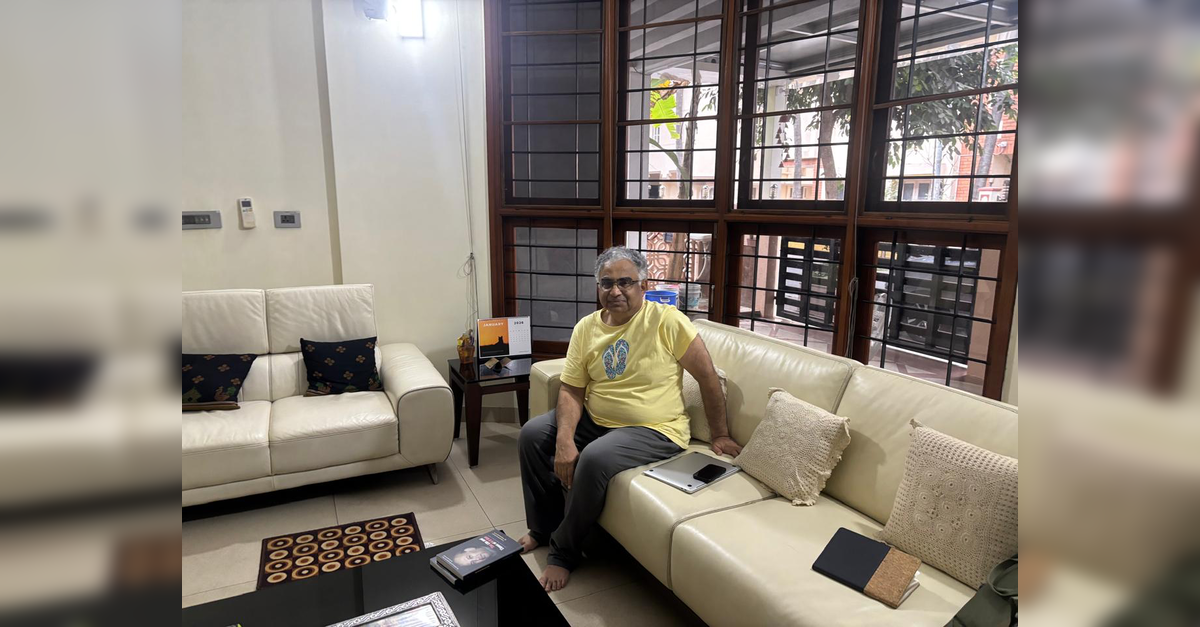

Many Indians have asteroids named after them. Asteroid 9804 has the designation Shri Kulkarni. What’s special about this researcher for students? Shrinivas Kulkarni, the George Ellery Hale Professor of Astronomy and Planetary Science, California Institute of Technology (CalTech) has just been awarded the Gold Medal of the Royal Astronomical Society, the highest honor from the organization, awarded annually since 1824. Past recipients include Albert Einstein, S Chandrashekar, Hubble, Babbage, Poincaré, Pickering, Stephen Hawking, Hale, among others. He is only the second Indian to win this medal, after Chandra. Prof Kulkarni’s story is one of an ordinary man doing extra-ordinary things, much like Prof U R Rao, Space legend, late ISRO chairman, who Chandra admired.Many firsts for Kulkarni
‘Shri’ Kulkarni as he is popularly called discovered the first millisecond pulsar called (PSR B1937) with Donald Baker and colleagues, while he was a graduate student. In 1986, he found the first optical counterpart of binary pulsars, while he was a Millikan Fellow at California Institute of Technology. He was also instrumental in the discovery of the first globular cluster pulsar using a supercomputer.
Shri Kulkarni, opens up on education, science, astronomy and careers for students in a candid conversation with Prashanth G N, Space, Science and Technology Commentator, and Author of ‘The Life and Times of U R Rao – From Humble Origins to a Space Legend – A Biographical Account’.
1. Many academics assess that you are the leading global astronomer. How would you react to this perception?
A. It’s hard to react to the question whether I’m the leading astronomer or not. Certainly, I’ve been fortunate to have been recognized because there are many people who do excellent work and life is not always kind. I’ve been externally lucky that my work has been recognized all through my life.
2. The Gold Award emboldens one to ask this. Einstein, Hubble, Stephen Hawking, Hale and Chandra (S Chandrashekar) were also recipients. These are greats and you know their work. Are you as good as them?
A. I have a very clear idea. The fact that I’ve gotten an award that they also got doesn’t necessarily mean I am their equal. You have listed some of the very top people in that award. But it has also come to some people who have pushed and done very good work, and I put myself in the 2nd category.Someone like Einstein is a one in a few 100 years, maybe one in 400. Hubble is ordinary really.
3. You have won every major award in Astronomy. But for variables like prejudice, power, or lobbying, what should stop you from getting the Nobel?
A. Well, first of all, to be clear, the Shaw Foundation will have a different view. The Foundation in Hong Kong set up the prize to complement the Nobel Prize – and they and many people call it the ‘Nobel of the East’. Interestingly, there’s no Nobel Prize for Mathematics and Biology, which is a surprise. And there’s no Nobel Prize for Astronomy. And the Shaw Prize is exactly for these three subjects. This is considered the Alternative Nobel. And Nobel is usually given more, you know, for physics, right? Whereas I really am an astronomer. I make discoveries, study the sky and so on. That’s all it is. The Nobel has a tradition. It should be what it is, else there’ll be other subjects.
4. What is the ultimate goal of astronomy? What is the significance of the Big Bang theory in this context for students of astronomy and science?
A. You’re asking, why should we do astronomy? See, we want to understand how and where we came from, how the universe began. As simple as that. The only reason you can ask the question of the Big Bang is because astronomers struggled to understand the expansion of the universe. They surmised that if the universe expanded, it must have a beginning, and they discovered the radiation coming from the beginning of the universe. So, what you now take for granted is the result of decades and even centuries of studies. The idea that there could be other planets around other stars was only in our imagination. Now that we know they exist, opens-up the possibility of life from somewhere else. Why do you study geology and earth, right? Because it’s this place we live in.Now, take that idea and expand your imagination. Here’s earth and what are the other earths, okay? And one of the mysterious things is – we have no good authority at this point – that when the universe began, there was only hydrogen and helium. But now we have all these other elements. Where did they come from? They came from stars, stars living and dying.
5. In terms of career, what is it that Indian students should look to in astronomy? Given that it’s a world of software, IT, energy, AI. What would you advise Indian students?
A. Well, I will take that one step up and ask – is it necessary for all countries to do research? Because that’s a logical argument. In a country, you have agriculture because you need food, you need shelter, you need energy to make bricks,plastic, petroleum, next thing is cars, then medical care. So,there are all these needs and their technologies and resources. The question I’m asking is, why does the country then want to do any research? Why do you then want to do cultural activities like dancing, music, and painting? I don’t know. It’s a choice to make, right? Some countries make bigger choices than others. And in the same way, I think undertaking science research is a culture. It’s again a choice you make. The point I’m trying to make here is – it’s easy to explain why you want to be a doctor, lawyer, engineer, miner, farmer, and so on. Whether you want to be a researcher, musician, an artist, that is the thing that people have to choose in their own hearts. It’s up to society how much they want to support this. Now there happens to be a good correlation that societies which support all these activities tend to be prosperous. So, this is the old war between Spartans and Athenians, right? Each country, each group of people have to decide how much they want to do this over other stuff.
6. There is a certain revivalism of ‘ancient’ Indian science and religion. The Western narrative has prevailed. What should educational institutions tell students?
A. Narrative is the right word. History is always interpreted differently by different people. So, if we make our own genuine effort, which is not falsifying facts, that’s very good. Why should the history of India, because we were colonized, be seen through the British eye? Fine. We can have our own thing. And there are some amazing things that the Indian civilization has produced. We should celebrate that. I have no problems with that. But the idea that, you know, we were flying airplanes and we did plastic surgery, no, that I would simply say, at this point is intellectual dishonesty in my mind. If you really had that, please do it. I can give you many tests right now. If we could really fly planes 5000 years ago, why can’t we build our own planes now? If you think you have the plan, please do it. Also, I’m an atheist. The closest I can be is a Buddhist. I have a somewhat dim view of people who are religious. I’m perfectly happy having coffee with you even if you’re religious. But if you tell me, you flew planes 5000 years ago, I would say, please fly one right now. And if you can’t, then I’ll say you don’t have that knowledge. We have to tell students the right things.
7. If you were to compare Nehru, Indira and Rajiv, Manmohan Singh, and now Modi, what would your perspective of science be over the last 75 years?
A. I think Nehru had the most classic sense of science – that mostly society is doing routine things, so find talented people and give them resources and then they’ll advance science. I think Nehru had in that era the idea of science for science sake, when the role of technology was only slowly being understood. In recent years, a bit after independence, not just in India, around the world, there’s been a much stronger linkage between science, technology, and welfare. In that sense, the US demonstrated this very decisively in winning World War II based on science. The atom bomb was a product of science. The Soviet Union demonstrated superiority by flying Sputnik and showing they could do ICBMs. These were directly a result of science. And suddenly the game changed. So, this link between science, technology, and prosperity, I think really got recognized very much after World War II, especially in the US, and led to things like the national science foundation and NASA for both military and non-military purposes. So, I think the current government has its eyes very clearly on science and technology and completion of that thing, you know, where it leaves to faster development.
The question I think that is worthwhile debating in any country is how much of the government’s money do you want to use for science? Because science payoffs usually take decades. So, if you’re a government today for 5 years, you can put in a lot of money, but you’d only see the payoff only 20 years later. In that respect, countries like India and the US are actually at a disadvantage because they have a 4 or 5 year-cycle of elections where decision making is of shorter term. And I think this, to me, is why China has done so spectacularly well- they set forth on very long-term plans. And so the fact that they’re leading, you know, there are 62 technologies that MIT Review has, whatever it is called, and of the 62, China is leading in 58 right now. So, you see?
8. You had earlier observed that India has a burgeoning youth population, a demographic dividend or otherwise. Lakhs of engineering students coming out. Basic needs have to be met – employment, income, housing. But then there is the excitement of astronomy, research, particle physics. What would you advise students to do in India?
A. It’s no different than someone saying I want to actually be a musician. Because these choices, in most cases, do not lead to high incomes. Of course, if you’re an incredibly successful musician, you can be very well off, but it’s rare. In that sense, science is a bit more moderated. Because, even though it’s difficult to get a job, you can be a middle-class person. As a musician, you may love music, but in the end, at some point you’ll say, okay, let me get a job in a bank or in a shop. And atthe weekend maybe, me and my friends can get together and play some music.
The quality of education in India today?
A. Our school system may not be so bad, our college system, I would say, is largely broken.
Science students would always be interested in this. Do you believe in the Big Bang version of the universe or as a continuous evolving matter?
A. I think the weight of evidence for the Big Bang is clearly there. The steady state has been, you know, it’s a good try, but discarded. All observational data show the Big Bang okay.
So, why would Jayant Narlikar, the renowned Indian academic-thinker, head towards continuous evolution?
A. It has its appeals, philosophical appeals. What’s there before the Big Bang? I don’t know. It has a sort of starting point, whereas this other one has a sense of forever, okay? So, when things are unknown, people formulate various ideas. Maybe one could criticize him for sticking to it even when the data started showing it is not. I would move on.
9. What should artificial intelligence mean for an astronomer?
A. My unstudied view of artificial intelligence is, to me, it just seems like another tool. The internet came – it was another tool that allowed rapid communication. And it changed the way we worked. But this idea that there’ll all be these robots running around – I think that’s a very boring version of artificial intelligence. There’s an incredible amount of hype actually in this. I visit China a lot. I like their view of artificial intelligence, which is, they’re saying, in each of these devices, you know, we can embed AI-ML. And the answer is yes, because these are very specific things. Whereas the US approach to artificial intelligence is general intelligence. I think that’s sort of a nice goal, but it’s a lot of money and I’m not even sure that it’ll actually work-out that way.