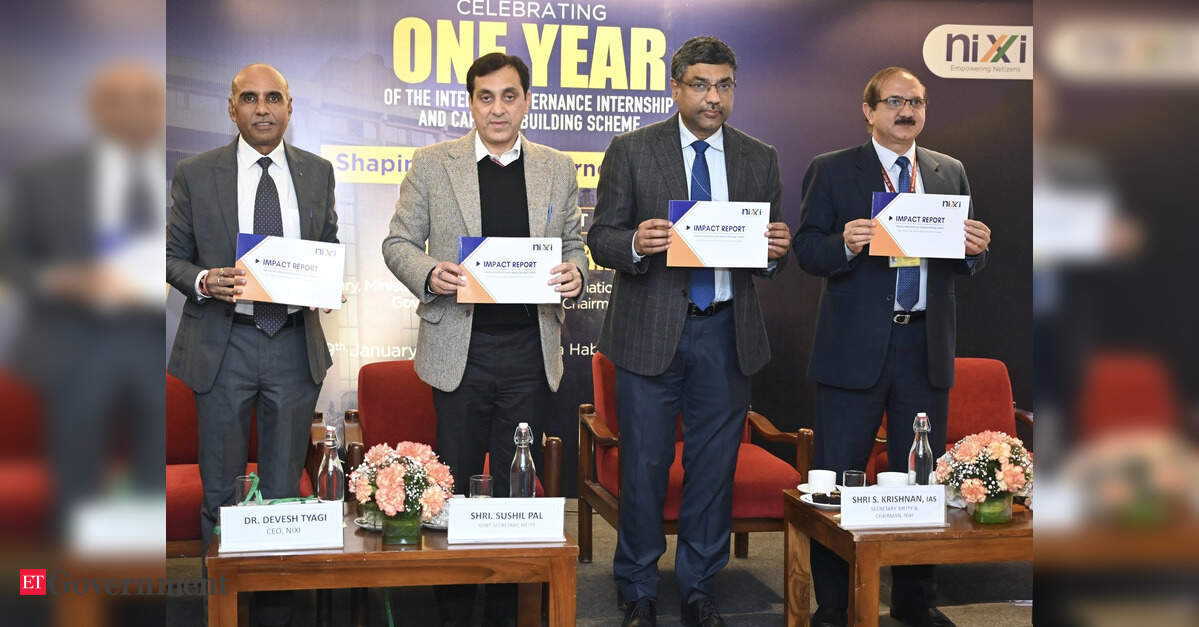

The commemorative event marking one year of the Internet Governance Internship & Capacity Building Scheme (IGICBS), organised by the National Internet Exchange of India (NIXI) in New Delhi, was not merely a celebration of an institutional milestone.
It was, more substantively, a reflection on how the internet itself has evolved—from an experimental, volunteer-driven network into a critical pillar of national, economic, and social infrastructure—and why India must now invest consciously in shaping its governance.
Launched as a first-of-its-kind initiative, IGICBS was conceived to address a structural gap in India’s digital journey: the shortage of informed, skilled, and globally engaged professionals capable of participating meaningfully in internet governance forums.
Over the past year, the programme has brought together students, academics, policymakers, technologists, and legal experts, building a pipeline of young professionals equipped to understand and influence the technical, policy, and normative debates that increasingly define the digital world. The anniversary event, therefore, served both as an assessment of progress and as a call to sustained engagement.
The event was graced by S. Krishnan, Secretary, Ministry of Electronics and Information Technology (MeitY), as Chief Guest. Other distinguished speakers included Bhuvnesh Kumar, Chief Executive Officer, UIDAI; Sushil Pal, Joint Secretary, MeitY; and Dr Devesh Tyagi, Chief Executive Officer, NIXI.
The gathering also saw participation from IGICBS interns, mentors, university deans, professors, academic leaders, senior government officials, and students from institutions across the country. On the occasion, NIXI officially launched the IGICBS portal and unveiled the IGICBS Impact Report, documenting the programme’s reach and achievements over the past year.
In his address, Bhuvnesh Kumar, CEO, UIDAI, reflected on the programme’s original intent. “When we first conceptualised this initiative,” he noted, “internet governance was still a relatively less explored domain for many, and the objective was to create a strong pool of informed volunteers and future ambassadors for India.”
He underlined the importance of mentorship and continuity, urging participants to remain connected to the ecosystem beyond the formal duration of the internship and to strengthen India’s presence in regional and global internet governance forums.
Sushil Pal, Joint Secretary, MeitY, echoed this emphasis on long-term engagement. Describing IGICBS as a pioneering effort, he observed that the programme had successfully brought together young professionals from technology, legal, and public policy backgrounds to grapple with the complexities of internet governance.
With India’s vast demographic and digital scale, he argued, the country must significantly deepen its participation in global standards-setting bodies and technical forums, and programmes such as IGICBS are essential to building that capacity.
Dr Devesh Tyagi, CEO, NIXI, placed the initiative in an institutional context.
“Over the past year, we have engaged and trained more than 10,000 participants,” he said, describing IGICBS as a platform that bridges policy, technology, and academia through expert-led learning and mentorship. The programme, he added, aligns with the Government of India’s broader vision of a secure, inclusive, and resilient digital ecosystem driven by knowledge and institutional capacity.
At the intellectual core of the event, however, was the keynote address by S. Krishnan, Secretary, MeitY—a wide-ranging, reflective, and deeply contextual meditation on the evolution of the internet and the imperatives of its governance today.
Drawing on personal memory, the Secretary began by recalling the early, fragile days of internet connectivity, when dial-up connections were unreliable and digital communication supplemented, rather than replaced, physical correspondence. The internet, he noted, emerged from a culture of volunteerism and openness, where the overriding objective was expansion rather than regulation.
“You were not so worried about authenticity, you were not so worried about various other aspects,” he observed. “You just wanted to include more and more people, bring more and more people into the fold.”
That phase, he argued, has decisively passed. With nearly one billion internet users in India and digital systems now embedded in governance, finance, commerce, and everyday social life, the internet has become as indispensable as railways, airlines, or telecommunications. Citing recent data, he pointed out that more than 90 percent of financial transactions in India, by value, are now conducted digitally. In such a context, the internet can no longer be treated as an informal, lightly governed space.
“What was initially started as a patchwork of connectivity,” he said, “has become a backbone of the global economic system, the global social system, and the global commercial system.”
This transformation, Krishnan argued, fundamentally alters the governance challenge. While expansion remains important, it must now be balanced with security, resilience, and trust. Issues such as cybersecurity threats, malware, online abuse, and the integrity of digital transactions are no longer peripheral concerns; they directly affect ways of life, economic stability, and social cohesion.
“It is in our enlightened self-interest,” he remarked, “that the internet is managed in a way that it works for everybody.”
Crucially, the Secretary framed internet governance not as a question of authoritarian control but as a democratic necessity. Acknowledging the multi-stakeholder, volunteer-driven nature of global internet governance institutions, he stressed that influence in such forums depends on knowledge, articulation, and presence.
“Very often,” he said, “those who understand the issue and those who can be articulate about the issue can punch above their weight.” For India, with one of the world’s largest internet user bases, under-representation in these forums is not merely a procedural weakness but a strategic risk.
It is precisely here, Krishnan argued, that IGICBS assumes national significance. The programme seeks to create a cohort of informed, committed citizens who understand the technical and policy dimensions of the internet and can represent India’s interests in global debates—from infrastructure questions such as root servers to broader norms governing security, resilience, and access. Each informed participant, he suggested, effectively represents millions of Indian users in spaces where decisions with long-term consequences are shaped.
The Secretary also situated this engagement within a broader generational and cultural shift. Unlike earlier eras, when economic necessity demanded rapid entry into stable employment, today’s young professionals often have the flexibility to explore multiple paths, acquire diverse skills, and pursue more than one vocation.
This, he argued, creates a unique opportunity for voluntary public-minded engagement with complex issues such as internet governance. Even for those who ultimately pursue careers in industry, startups, or government, sustained engagement with digital governance can remain a parallel, lifelong commitment.
Turning to structural challenges, Krishnan highlighted the issue of internet resilience, noting that India’s connectivity remains heavily skewed towards mobile data, while globally the most resilient systems rely on fixed broadband infrastructure. Addressing such imbalances, he suggested, requires informed domestic policy advocacy as well as active participation in international technical and governance forums.
Looking ahead, he urged interns not to treat IGICBS as a one-year credential but as the beginning of a long-term intellectual and civic engagement. He proposed enabling interested participants to attend major global forums, including the upcoming ICANN conference in Mumbai, to gain direct exposure to the debates shaping the internet’s future.
Governance, he cautioned, does not change overnight; it requires sustained participation, informed negotiation, and the ability to respond when consensus is being built. “Those decisions,” he warned, “shouldn’t go by default because we did not have enough informed people who could understand the issue and contribute to it.”
Concluding his address, Krishnan described the internship programme as “money well spent” and “a task well done” by NIXI, its leadership, and the mentors who supported the participants. Thanking the interns for giving a year of their lives to this endeavour, he urged them to remain engaged “in the interest of our society, our country, and humanity at large.”
In a telling metaphor, he likened their role to earlier generations of pen pals and ham radio operators—volunteers who helped connect the world in their time—arguing that today’s challenge lies in stewarding the digital commons responsibly.
Taken together, the IGICBS anniversary event underscored a quiet but significant shift in India’s digital trajectory. As the internet becomes ever more central to governance, commerce, and everyday life, the question is no longer whether it should be governed, but how—and by whom.
Through initiatives such as IGICBS, NIXI and MeitY are attempting to ensure that India does not remain a passive user of global digital infrastructure, but emerges as an informed, articulate, and influential participant in shaping its future.