
The Union Budget 2026–27 marks a decisive turn in India’s technology and industrial policy, signalling a shift from short-term incentives to long-horizon statecraft in artificial intelligence, digital infrastructure, and semiconductors.
Presented by Finance Minister Nirmala Sitharaman, the Budget seeks to anchor India’s ambitions in the global AI and electronics value chain through a mix of fiscal certainty, institutional deepening, and ecosystem-wide reform.
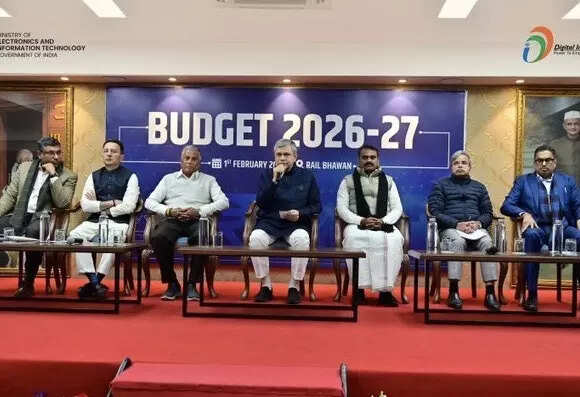
At the heart of the Budget is an explicit recognition that AI is no longer a purely software-led phenomenon but an infrastructure-intensive one. Addressing the media, Ashwini Vaishnaw underlined that AI data centres constitute the foundational layer of the AI stack, much like highways and ports once did for industrial growth.
India already has investments of around USD 70 billion underway in data centres, with announced commitments nearing USD 90 billion, reflecting the country’s growing attractiveness as a global compute hub.
To lock in this momentum, the Budget proposes a tax holiday extending up to 2047 for foreign companies that provide global cloud services using data centre infrastructure located in India. These firms will serve Indian customers through domestic reseller entities, a structure that balances global integration with local value capture.
A safe harbour margin of 15 percent on cost has also been proposed where the Indian data centre service provider is a related entity, addressing long-standing transfer pricing uncertainties. Taken together, these measures provide rare long-term policy visibility, positioning India alongside a small group of countries willing to underwrite AI and cloud infrastructure on a generational time scale rather than an electoral one.
This long-term framing is significant. By aligning the tax regime for AI and cloud infrastructure with the centenary of India’s independence, the government is signalling that digital infrastructure is now part of national infrastructure planning, not merely a sectoral concern. In an era when compute power increasingly shapes economic competitiveness and geopolitical leverage, this clarity could prove as consequential as earlier reforms in telecom or highways.
The Budget also announces the launch of Semiconductor Mission 2.0, building on the base created by the first phase, which effectively introduced a greenfield semiconductor ecosystem in India. While ISM 1.0 focused on establishing fabrication, assembly, testing, and packaging capabilities, the second phase deepens the ambition.
ISM 2.0 will prioritise the design and manufacture of semiconductor equipment, the production of critical materials used in chipmaking, the expansion of India’s design ecosystem, and sustained investments in talent development. An allocation of ₹1,000 crore for FY 2026–27 signals the government’s intent to move beyond assembly-led participation and towards strategic segments of the semiconductor value chain that are capital-intensive, technologically complex, and geopolitically sensitive.
Equally telling is the expansion of the Electronics Components Manufacturing Scheme. The allocation has been raised from around ₹22,000 crore to ₹40,000 crore, reflecting an industry response that far exceeded expectations. The scheme attracted 149 applications against an anticipated 50–55, suggesting that component manufacturing—often the weakest link in India’s electronics ecosystem—is beginning to scale.
Strengthening this layer is essential if India is to reduce import dependence, improve value addition, and build resilience against global supply chain disruptions, lessons that the pandemic and recent geopolitical shocks have made unavoidable.
Beyond hardware, the Budget addresses India’s largest technology export engine: IT services. With exports exceeding USD 220 billion, the sector has long sought greater tax certainty amid evolving global transfer pricing norms. The Budget responds by rationalising safe harbour provisions, grouping software development, IT-enabled services, knowledge process outsourcing, and contract R&D under a single category of Information Technology Services.
A common safe harbour margin of 15.5 percent has been proposed, alongside a dramatic increase in the eligibility threshold from ₹300 crore to ₹2,000 crore. The move to automated, rule-based approvals and the fast-tracking of Unilateral Advance Pricing Agreements further reduce compliance friction, reinforcing India’s reputation as a stable and predictable base for global technology services.
Taken together, these measures reveal a Budget that is less about headline-grabbing announcements and more about architectural coherence. By simultaneously addressing compute infrastructure, semiconductor depth, electronics components, and services-sector certainty, Budget 2026–27 attempts to align fiscal policy with India’s broader ambition to become a trusted global technology partner.
The emphasis on long-term horizons, ecosystem thinking, and institutional continuity suggests a maturation of India’s tech policy—from incentive-driven experimentation to strategic, state-backed industrial planning suited to an AI-defined era.