

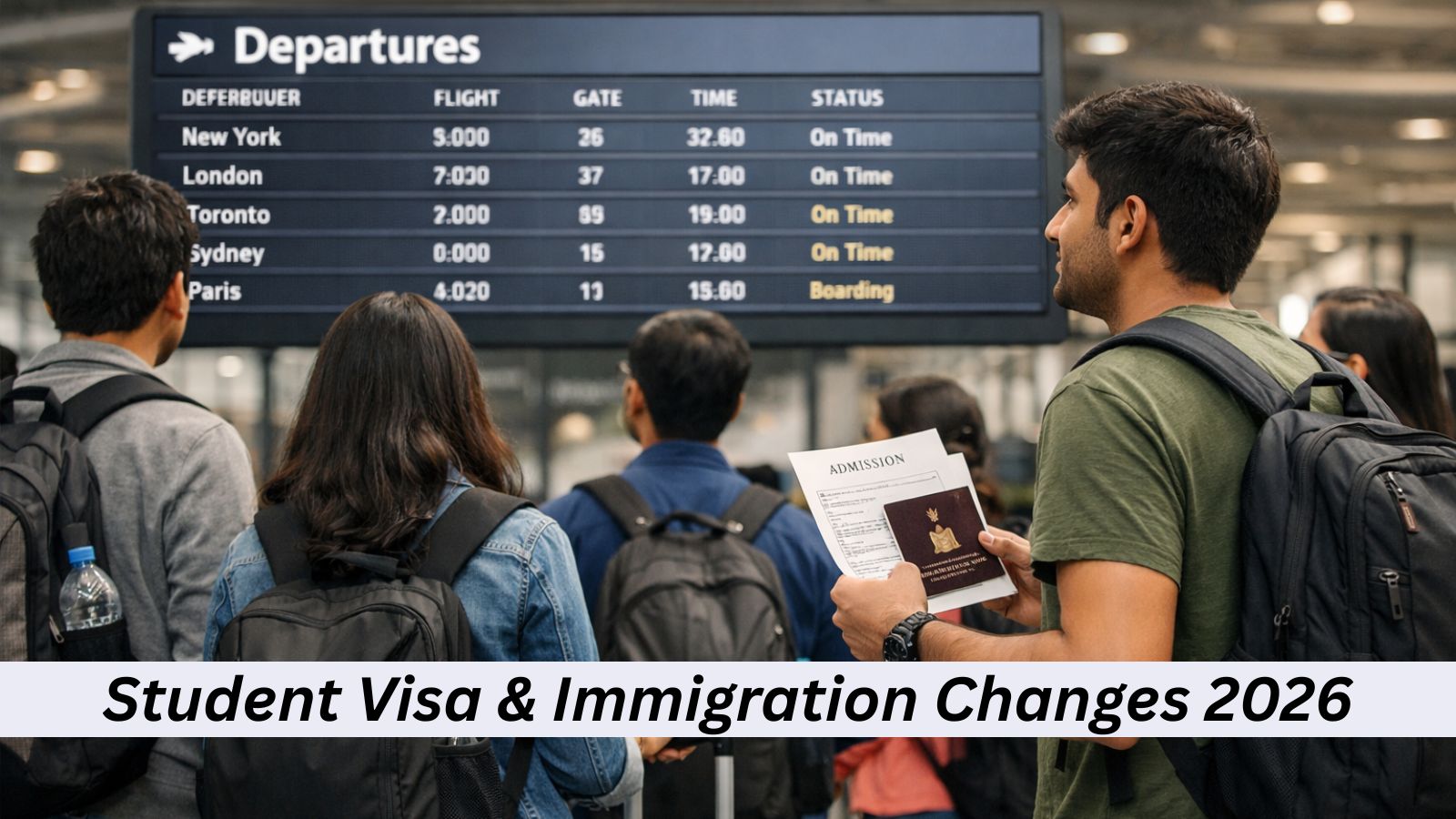
The world in the past year has seen significant shifts in immigration and student visa policies worldwide, impacting traditional destinations for international students. Governments in the United States, Canada, the United Kingdom, and Australia — four of the most chosen study abroad destinations by Indian students — have introduced or signaled stricter oversight, higher compliance requirements, costs, and reduced post-study work permits, tightening what had been comparatively stable access for global talent.
These changes are happening alongside broader economic realignments. India and the United States recently finalised a long-pending trade agreement, with Washington announcing an immediate reduction in tariffs on Indian goods from 50 per cent to 18 per cent. While the deal is primarily commercial, it also taps into the aspect of a recalibration of bilateral ties at a time when migration, education, and workforce mobility are increasingly linked to economic priorities and domestic labour concerns.

Revisions in immigration policies come amid broader immigration controls targeting security concerns, labour market pressures, and demographic planning, which are set to reshape options for students and their families planning overseas education in 2026.
What was once relatively predictable access for global students is now marked by greater uncertainty.
Where are Indians abroad?
According to the Ministry of External Affairs data tabled in Parliament in the Winter Session, 18,82,318 Indian students were reported studying abroad across 153 countries in 2025, a number that includes 6.28 lakh school-level enrolments for the first time alongside 12.54 lakh higher-education students. This overall figure suggests a broad global footprint, but the higher-education count actually declined from 13.3 lakh in 2024, marking the first drop after several years of steady growth, a trend shaped in part by changing visa policies and global costs.
The leading destinations for Indian students across both schooling and higher education were the UAE (2,53,832), the United States (2,55,447), and Canada (4,27,085). Traditional university hubs like the UK and Australia also feature prominently among higher-education hosts.
United States: One of the oldest study-abroad hubs faces major reforms
As one of the principal destinations for Indian and global students, the United States is introducing sweeping policy changes affecting how student visas are granted and maintained going into 2026. Key 2026 measures and new rules, which have been confirmed earlier, and proposed:
Story continues below this ad
–Visa integrity fee: A new $250 fee on student and work visas was introduced for fiscal year 2026, applying to F-1 visas among others — aimed at bolstering enforcement capacity.
– Mandatory in-person interviews: As of September 2025, the US State Department eliminated the “dropbox” interview waiver for most F-1 renewals. This means all students (including returning students) now require in-person interviews at Consulates — a reversal of a pandemic-era convenience.
– Replacement of duration of status (D/S): In 2025, the Department of Homeland Security proposed eliminating the flexible Duration of Status model for F-1 students, replacing it with a fixed period of stay (initially up to 4 years plus limited grace). Under the proposal, students would need to file extensions with USCIS rather than relying on institutional enrollment to maintain status.
– Social-media vetting: The US has expanded vetting of student visa applicants’ online profiles. Applicants must now provide up to five years of social media history, and officers may review public content for “hostile” indicators.
Story continues below this ad
– OPT and grace periods under review: Legislative and regulatory pressure is building to trim Optional Practical Training (OPT) post-study work extensions, especially extended STEM OPT periods, and to shorten the post-completion grace period from 60 to 30 days, though these are still under review and advocacy.
These changes reflect a broader shift in US policy toward security and controlled flows of temporary migrants. The Trump-era approach emphasises risk management over flexibility, and the new policies will directly affect planning for international students who previously relied on longer stays and simplified renewals.
The result is that the US — while still a global hub — faces increasing procedural friction that prospective students must account for in applications, timelines, and finances.
Canada: Caps, exemptions, and work-permit reforms
Canada has long been among the most popular destinations for Indian students. However, recent policy adjustments aim to moderate student inflows while prioritising skilled sectors and tighter work-permit conditions.
Story continues below this ad
– National study-permit cap: For 2026, Immigration, Refugees and Citizenship Canada (IRCC) set the study-permit target at 408,000, a notable reduction from 2025.
Also Read| Canada to cap international student permits for 2 years
– Graduate exemptions: Effective January 1, 2026, students enrolled in Master’s and PhD programmes at public institutions are exempt from the overall cap and no longer require a Provincial Attestation Letter (PAL). PhD students are also expected to benefit from quick processing (~2 weeks).
– PGWP eligibility changes: Canada has tightened eligibility for the Post-Graduation Work Permit (PGWP), including requiring higher English language proficiency benchmarks — particularly Canadian Language Benchmarks (CLB) 7 for university-level graduates — and aligning eligibility more closely with labour markets in fields like healthcare and STEM.
Story continues below this ad
– Work hour limits: As of November 2024, students may work up to 24 hours per week off-campus during academic sessions (up from 20), providing more work-experience flexibility.
These shifts highlight Canada’s attempt to balance high international enrolments with labour market realities, processing constraints, and broader immigration planning.
The United Kingdom has introduced tighter pathways
The UK, another longstanding draw for international students, is adjusting its visa and post-study work rules.
– Graduate route shortened: From January 1, 2027, Bachelor’s and Master’s degree holders will be eligible for 18 months of post-study work under the Graduate Route, down from the current 2-year period. PhD graduates will retain 3 years.
Story continues below this ad
– Higher financial thresholds: Effective late 2025, student applicants are required to demonstrate increased funds — about £1,529/month in London and £1,171 outside — to prove maintenance capability.
– English language requirement raised: From January 8, 2026, many visas, including study and work streams, require a CEFR B2 English level, up from B1.
– Mandatory ETA (Electronic Travel Authorisation): Starting February 25, 2026, visitors from 85+ visa-exempt countries (including the US, Canada, and EU states) are required to obtain an ETA before travel. This would be a new layer of pre-departure compliance that also applies to short-term educational visits.
Australia: Caps, compliance and cost pressures
Australia remains a prime destination for students from South Asia and beyond, but has also introduced significant changes going into 2026.
Story continues below this ad
– Student-visa cap increased to 295,000: The national cap for 2026 rose from 270,000 in 2025, reflecting continued institutional demand.
– Higher visa fees: From July 2025, the primary student visa (subclass 500) fee increased to AUD 2,000, one of the highest globally.
– Genuine student (GS) test: Replacing the older Genuine Temporary Entrant (GTE) standard, the GS test asks applicants to demonstrate primary intent to study through responses about plans, ties to home country and educational decisions.
– Risk reclassification – India: Early in 2026, the Home Affairs Department moved Indian applicants into the strictest Assessment Level 3, meaning more documentation and longer processing times.
Story continues below this ad
– VET sector integrity regime: Regulatory changes also tightened Vocational Education and Training (VET) sector oversight, including rules limiting new private VET providers’ access to international students until quality and compliance benchmarks are met.
However, not all major destination countries are tightening access for international students. Germany continues to maintain a relatively stable and accessible visa regime, with ongoing efforts to streamline digital applications and offering low or no tuition fees alongside clear post-study work and residency pathways; it has also introduced gratis visas for Indian students on selected short-term academic programmes, removing the visa fee burden and making study more affordable for many applicants, as per recent media reports.
Also Read| Germany sees 37% rise in Indian students, becomes top destination
On similar lines, New Zealand, under its International Education Going for Growth Plan, has expanded student visa work rights — increasing part-time work hours from 20 to 25 per week and extending those rights to exchange and study-abroad students, while also simplifying qualification recognition for Indian degrees, moves aimed at growing its international education sector and enhancing practical experience opportunities for students.
