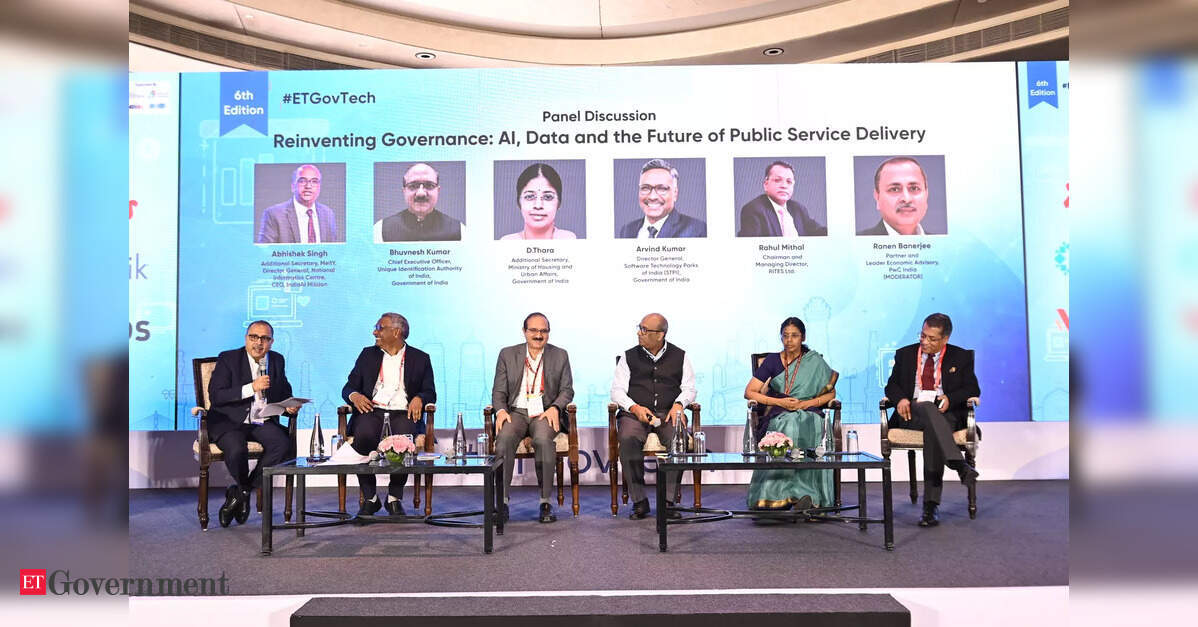
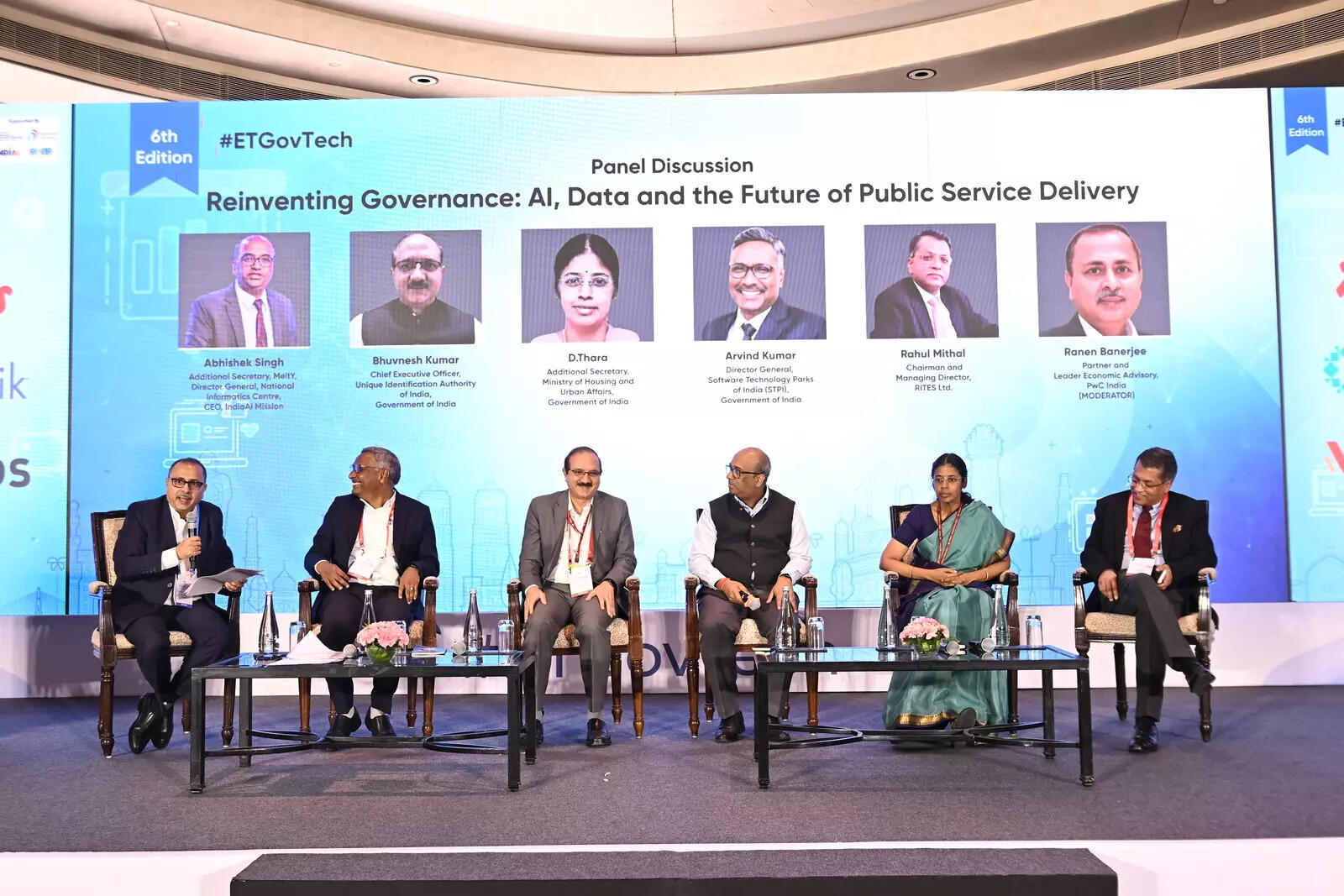
At the GovTech Summit & Awards 2026, held at the Hyatt Regency, New Delhi, one of the most intellectually substantive conversations unfolded in the flagship panel titled “Reinventing Governance: AI, Data and the Future of Public Service Delivery.”
Moderated by Ranen Banerjee, Partner and Leader, Economic Advisory, PwC India, the discussion brought together a distinguished set of policymakers and technocrats who are actively shaping India’s next-generation digital governance architecture:
Abhishek Singh, Additional Secretary, Ministry of Electronics and Information Technology (MeitY), Director General, National Informatics Centre, and CEO, IndiaAI Mission; Bhuvnesh Kumar, Chief Executive Officer, Unique Identification Authority of India (UIDAI); D. Thara, Additional Secretary, Ministry of Housing and Urban Affairs, Government of India; Arvind Kumar, Director General, Software Technology Parks of India (STPI); and Rahul Mithal, Chairman and Managing Director, RITES Ltd.
What emerged from the discussion was not merely a technological roadmap, but a conceptual redefinition of governance itself—where artificial intelligence, data infrastructures, and institutional design converge to create citizen-centric, scalable, and trustworthy public systems.
From Digital Infrastructure to AI Ecosystems
A central theme articulated by Abhishek Singh was the transition from digital public infrastructure (DPI) to what may be termed AI public ecosystems. He framed India’s approach around three foundational pillars: applications, infrastructure, and trust. The emphasis, he suggested, is not on regulating AI prematurely but on enabling its diffusion across sectors while simultaneously building safeguards.
India’s strategy, in this sense, departs from restrictive regulatory paradigms. Instead, it seeks to democratise AI access—particularly for those outside the formal digital economy. Singh illustrated how voice-enabled AI systems could transform access for farmers and rural populations, allowing them to bypass conventional barriers such as literacy, language, and device dependency. This vision is aligned with a broader objective: integrating the remaining hundreds of millions into the digital economy through intuitive, AI-driven interfaces.
At the same time, he underscored the importance of trust frameworks—ethical AI certification, bias mitigation tools, and watermarking of AI-generated content—to ensure that innovation does not outpace accountability.
Identity, Privacy, and the Architecture of Trust
Bhuvnesh Kumar offered a granular view of how AI is already embedded within India’s identity infrastructure. The scale is staggering: billions of authentications, continuous updates, and real-time identity verification processes.
He also highlighted the launch of the new Aahaar app, which exemplifies how digital identity tools are being reimagined to enhance user convenience while strengthening privacy safeguards.
Yet, this evolution is not merely about scale—it is about control. Kumar underscored a shift from centralised identity verification to user-controlled, verifiable credentials. Technologies now allow individuals to share only the minimum necessary information—such as age verification without disclosing full identity—thereby significantly reducing data exposure risks.
This transition signals a deeper philosophical shift in governance: from state-held identity to citizen-owned data. It also addresses one of the most critical concerns in digital governance—how to reconcile efficiency with privacy.
The Urban Data Deficit and the Need for Contextual Intelligence
D. Thara introduced a critical counterpoint: while technological capabilities have expanded dramatically, the real bottleneck lies in contextual data. Urban governance, she argued, suffers from a lack of granular, city-level datasets that can inform decision-making.
The challenge is not merely collecting data but structuring it in ways that reflect local realities—water usage patterns, spatial planning, transport flows, and resource allocation. Without such datasets, even the most advanced AI models risk becoming abstract tools detached from ground realities.
Her intervention reframed the discourse: the future of AI in governance is not only about algorithms or compute capacity, but about data fidelity and localisation. In essence, AI must be rooted in the lived realities of cities and communities.
AI in Infrastructure: From Inspection to Prediction
Rahul Mithal provided a compelling demonstration of how AI is transforming traditional sectors such as infrastructure. At RITES, AI is being deployed across three operational layers: project design (DPRs), execution, and quality assurance.
He cited examples where AI-driven visual inspection systems are replacing manual checks in railway manufacturing, enabling predictive identification of defects. Similarly, AI tools are being developed to evaluate Detailed Project Reports (DPRs), learning from decades of historical data to flag inefficiencies and improve project outcomes.
Perhaps most significantly, Mithal emphasised a principle often overlooked in technological discourse: technology must create measurable value. Every AI intervention, he argued, must pass three filters—it should enhance performance, build institutional capability, and be scalable across projects.
This pragmatic approach grounds the AI narrative in operational realities, ensuring that innovation translates into tangible governance outcomes.
Startups, Local Innovation, and Distributed Governance
Arvind Kumar expanded the discussion to the role of India’s startup ecosystem, particularly in bridging the gap between technology and local governance. Through initiatives led by STPI, startups from Tier-2 and Tier-3 cities are being nurtured to develop solutions tailored to regional challenges.
This decentralised innovation model is crucial. Governance in a country as diverse as India cannot rely solely on centralised solutions. Instead, it requires a distributed ecosystem where local data, local problems, and local innovators intersect.
Kumar’s remarks also highlighted a broader transition in India’s technology landscape—from consumer internet platforms to deep-tech innovation. AI, in this context, becomes a tool not just for efficiency but for context-sensitive problem solving.
The Citizen Interface: The Last Mile Challenge
Across the panel, a recurring insight was that the greatest challenge is no longer technological—it is interface design. As one of the speakers noted, the critical question is how citizens interact with government systems.
Even the most advanced platforms fail if they are not intuitive, accessible, and responsive. This shifts the focus from backend systems to frontend experience—how services are delivered, how users engage, and how trust is built at the point of interaction.
In this sense, the future of governance lies in reimagining the citizen interface—not as a bureaucratic gateway, but as a seamless, intelligent, and responsive layer.
Toward a Cognitive State
The panel ultimately pointed toward the emergence of what may be described as a cognitive state—a governance model where decision-making is augmented by AI, service delivery is personalised, and citizens are active participants rather than passive recipients.
Three structural transitions define this evolution. First, the move from digital infrastructure to AI ecosystems. Second, the shift from centralised data control to citizen-centric data ownership. Third, the emergence of distributed innovation driven by startups and local ecosystems.
What distinguishes India’s approach is its scale, diversity, and developmental context. AI is not being deployed as an abstract technological frontier, but as an instrument of inclusion, efficiency, and transformation.
In that sense, the session did not merely discuss the future of public service delivery—it outlined the contours of a new governance paradigm, one where technology, policy, and society converge to redefine the relationship between the state and the citizen.