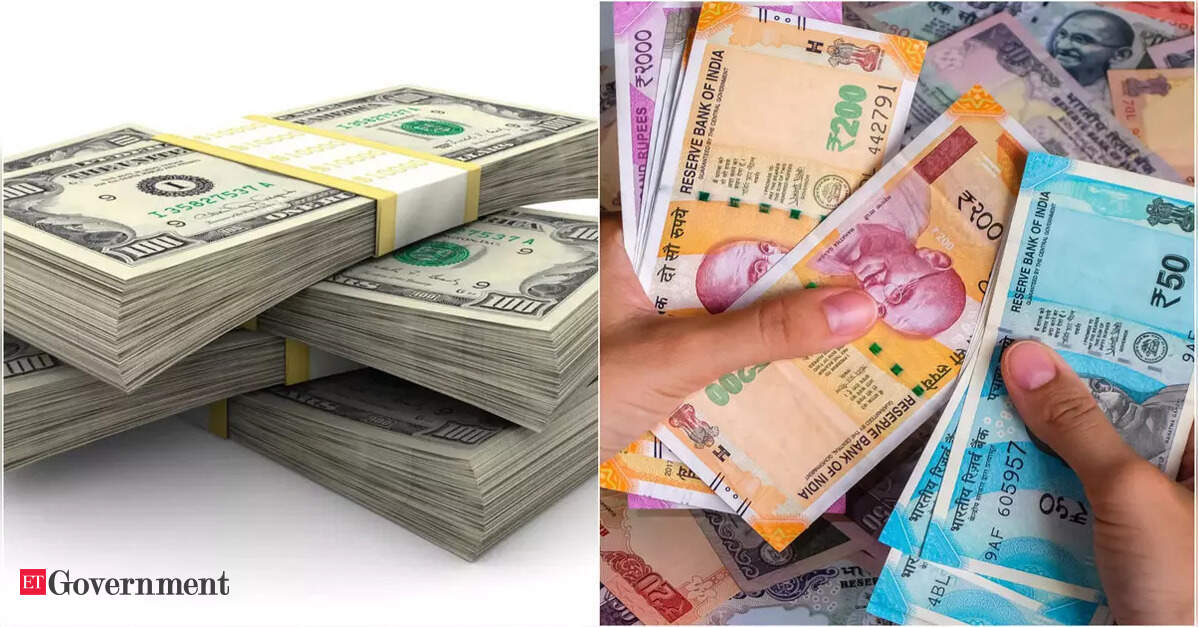
An exchange rate is simply the price of a country’s currency in terms of another country’s currency. Since we shifted from the administered rate of exchange to the market-determined mechanism in the early nineties, the exchange-value of the Indian rupee depends on the supply and demand situation of foreign currencies. Fluctuations in the supply of foreign currencies may happen at every moment, impacting the rupee value too.
While many factors affect outflow and inflow of foreign currencies in the medium and long-term, since the opening up of the Indian capital markets in 1996, foreign portfolio investment has become a crucial player influencing Sensex & Nifty, and through investment in capital markets on the rate of exchange. The crisis in West Asia further vitiated the situation. The rate of exchange plays an important role in an economy, as it affects not only exports and imports, but also the entire gamut of economy.
The rupee fell to an all-time low of Rs 95 a dollar in the fourth week of March, driven by the ongoing Middle-East war, and the consequent supply chain disruptions, rising energy prices, and foreign institutional investors being almost consistently the net sellers. In fact, the Indian rupee has been depreciating since last year, declining by 5% and becoming the worst-performing Asian currency.
Various factors affect the rupee-dollar exchange rate through fluctuations in the supply of foreign currency relative to demand. However, the movement of foreign portfolio investments [FIIs] significantly contributes to the capital market fluctuations. When FIIs sell, demand for the US dollar increases, depleting the foreign currency supply, and consequently, it leads to depreciation of the Indian currency.
On the other hand, the rupee gets strengthened when FIIs become net buyers in the Indian markets. Thus, there is a strong correlation between the movement of FIIs and the rates of exchange. During 2025, FIIs have sold equities worth Rs. 166286 crores, resulting in a depreciation of the Indian rupee by 5%. However, during April-June 2025, when the rupee strengthened, it was because FIIs were net buyers. For the remainder of the year, the rupee continued to depreciate, as FIIs also became net sellers.
The rate of exchange between the rupee and dollar was at 1$= Rs 86.26 in January 2025 as the US dollar index was stronger. In April 2025, the US announced a 10% baseline tariff on imports from other countries and 27% tariff for India. The tariff shock and US-China trade war led to a weakening of the US dollar index and made emerging economies’ assets more attractive. However, from August 2025, following the announcement of a 50% tariff on imports of Indian goods by the US, the rupee depreciated sharply and simultaneously, it reduced investor sentiment towards the Indian stocks.
West-Asia War
The escalation of the West-Asia war since the end of February inflicted a major blow on the strength of the Indian rupee. Foreign portfolio investors continued to be the net sellers in the Indian market. FIIs executed a record, historic sell-off of Indian equities in March 2026, with net outflow exceeding Rs 1.22 lakh crore by month-end. Consequently, the value of the rupee fell to below Rs 95 a dollar by March-end.
The war declared by the US & Israel on Iran initially engulfed the neighbouring countries, which incidentally happened to be the major oil suppliers to the rest of the world. Attacks on mutual oil-fields, refineries, and restrictions imposed on the movement of ships carrying critical cargo like crude oil, LPG and fertilisers through the Strait of Hormuz led to a major supply chain disruption in the world, and prices of these critical inputs skyrocketed.
For instance, Brent crude oil price surged to $ 109 per barrel in early April, compared to $60 per barrel in February. India imports more than 90% of its crude oil requirements. Demand on dollars has escalated due to the supply chain constraints consequent upon the war, in addition to the consistent outflow of FIIs over more than a year.
Once the process of currency depreciation starts, it will have a “cause & effect” with the cost of imports.
Impact on the Indian Economy
Theoretically, rupee depreciation leads to an increase in the exports of goods and services as domestic goods become relatively cheaper. However, different sectors respond differently to fluctuations in rupee dollar exchange rate, as it depends on the import intensity of raw materials. India’s export performance has remained robust and resilient, by recording a steady upward trajectory in fiscal year 2025-26 [April-Jan].
Despite persistent global uncertainty, supply chain disruptions, and volatile commodity prices, India’s exports have continued to expand in a broad-based manner. During April ‘25-January ’26, total exports rose by US$ 36 billion, registering a growth of 5.26% to US$ 714.73 billion. Only in-depth research can conclude whether the improved export performance was due to the weakened rupee or the efforts of the government to diversify export destinations.
Depreciation of the rupee, however, results in imported cost-push inflation since rising crude oil prices raise the cost of transportation and logistics for businesses, which will reduce their profit margins. The tourism industry will eventually be harmed, as will industries that rely heavily on oil, like aviation.
Additionally, India is heavily dependent on imported fertilisers, such as urea and DAP (di-ammonium phosphate), which are mostly supplied from the Persian Gulf. Fertiliser shortages will inevitably hurt food-grain production and, eventually, food inflation. Food inflation was 2.13% in January 2026, which is considerably lower. However, given the ongoing situation, it might reach the levels seen during the conflict between Russia and Ukraine. Because crude and petroleum-related goods are heavily weighted in the wholesale price index, producers would also be under additional pressure.
There is also a risk that the government may not be in a position to achieve the current year’s fiscal deficit target of 4.3%, as the public expenditure is bound to exceed the budgeted expenditure on account of increased subsidy support to fertilisers, and likely fall in revenue collections.
Continued depreciation of the rupee puts the private corporate sector availing of the external commercial borrowing [ECB] facility at a disadvantage. Servicing of the ECB disrupts the financial planning of the concerned corporate units. Ironically, the West-Asian war is likely to disturb one of the major sources of foreign exchange reserves. With a remittance of US $ 136 billion in FY ’25 by the NRIs, especially the ones settled in the Middle-East, we can ill afford to lose this critical support.
Policy Options
No doubt, the adverse effect on the Indian economy in terms of supply chain constraints and consequent cost-push inflation, and depreciation of the rupee is mainly due to external factors beyond the government’s control. The government has been trying its best to minimize discomforts of common-man at the cost of the exchequer and the oil marketing companies. But these are logistical in nature. Is there any scope for a policy intervention?
Monetary policy: The Monetary Policy Committee reduced the repo rate from 6.5% to 5.25% in 2025 following the decline in inflation. At this juncture, the monetary policy committee [MPC] during its meeting on 06-08 April may better weigh the quality of the inflation, which is likely to be slightly above the targeted inflation of 4.0%, and the consistent foreign investment outflows while determining the monetary policy rate. Since the expected rise in inflation is basically cost-push in nature, the monetary policy measures become ineffective. Hence, the focus should be on how to attract the FIIs through better bond-yields.
Investment Climate: Policy-makers in the government should make serious efforts to understand why FIIs have been avoiding Indian markets in favour of the emerging markets, despite the declared statement by practically all experts that “India is the preferred investment destination”. Obviously, shortcomings may be in terms of the Ease-of-Doing-Business or the undue delay at clearances level. The earlier the problem is addressed, the better for the economy.
The real issue, missing the attention of decision makers, both fiscal and monetary authorities, is how to stop the foreign portfolio investors from deserting an emerging economy. What makes them feel safer in markets like China, although performance-wise, India is much stronger. It is an opportune time for the government to understand the mindset of the foreign investors and address their concerns with appropriate policy responses.
Perhaps, if the government goes ahead with a few of the tough reform measures, the FIIs may change their mind. Let us not forget the experience of the post-Insolvency and Bankruptcy Code initiated in 2016. Despite the prospect of higher bond yields in the home markets, FIIs preferred to stay back in the Indian market.
(Dr Shettigar is a former Member, Prime Minister’s Economic Advisory Council, & Dr Riya Bindra is an Assistant Professor in Economics at Lal Bahadur Shastri Institute of Mgt; Views expressed are personal)