

Clock Reasoning is an interesting and scoring topic in reasoning sections of competitive exams like SSC, IBPS, SBI PO, and RRB. This blog covers everything about the concepts and formulas to quick tricks and solved questions from recent 2026 exams.
Download Clock Reasoning Questions E-Book PDF
Download Clock Reasoning Questions E-Book PDF to practice the most important reasoning questions for SSC, Bank, Railway Exams, and other competitive exams. This e-book includes concept-based questions, solved examples, shortcut techniques, previous year questions, and practice sets to improve your accuracy in clock-based problems like angle calculation, mirror images of clocks, and time estimation.
Practice Clock Reasoning Questions for Live
Prepare for SSC CGL, CHSL, GD, MTS, and other competitive exams with these important Clock Reasoning questions. These practice sets will help improve your reasoning skills, time calculation ability, and speed in the reasoning section.
Q1) How many degrees does the hour hand rotate in 1 hour?
Q2) How many degrees does the minute hand rotate in 1 hour?
Q3) How many degrees does the minute hand rotate in 15 minutes?
Q4) How many degrees does the hour hand rotate in 30 minutes?
Q5) What is the angle between hour and minute hand at 3:00?
Q6) What is the angle between the hands of a clock at 6:00?
Q7) What is the angle between the hands at 12:00?
Q8) Find the angle between the hour and minute hand at 4:00.
Q9) How many degrees does the hour hand rotate from 12:00 to 4:00?
Q10) What is the angle traced by the minute hand in 20 minutes?
Q11) Find the angle between hour and minute hand at 9:00.
Q12) Through how many degrees will the hour hand rotate from 5 AM to 10 AM?
Q13) Find the angle between the hour and minute hands at 3:30.
Q14) Find the angle between the hands at 6:30.
Q15) At what time between 4 and 5 o’clock will the hands be at right angles?
Quiz Summary
Final Score: 0.0

Sign Up

Login
Forgot Password
Please enter the Email ID we will send you a Email with the link to reset the password.

What is Clock Reasoning in Reasoning?
Clock Reasoning involves solving problems based on the functioning of an analog clock. It tests your ability to calculate angles between clock hands, time differences, and movements of hour and minute hands.
This topic frequently appears in exams because it assesses logical thinking, time calculation skills, and mental visualization core skills necessary for many reasoning questions.
Key skills required include:
- Logical deduction
- Angle and time calculation
- Visualization of hand positions on a clock face
Why is Clock Reasoning Important in Competitive Exams?
Clock Reasoning is an important topic of the reasoning syllabus because as it provides easy-to-understand questions that are quick to solve with the right approach. It requires less memorization and more logical application, making it a good scoring topic if practiced well.
| Exam | No. of Questions | Difficulty |
| SSC CGL / CHSL | 1–2 | Easy |
| IBPS PO / SBI PO | 1–2 | Moderate |
| RRB NTPC / Group D | 1 | Easy |
| State PSC / Police | 1–2 | Moderate |
Clock Reasoning Short Notes
Clock Reasoning questions is being asked around angles, relative speeds of hands, and time calculations.
| Term | Explanation |
| Minute Hand Speed | Moves 6° per minute (360°/60 minutes) |
| Hour Hand Speed | Moves 0.5° per minute (360°/12 hours/60 minutes) |
| Angle Between Hands | Calculated by difference between hour and minute angles |
| Clockwise & Anticlockwise | Directions to consider while calculating angles |
| Hands Overlapping | Times when both hands are exactly on each other |
| Hands Opposite | Hands form 180° angle (straight line) |
Concepts Used in Clock Reasoning
Details of the types of concepts asked in the reasoning questions are as follows:
| Concept | Details |
| Speed of Minute Hand | 6 degrees per minute |
| Speed of Hour Hand | 0.5 degrees per minute |
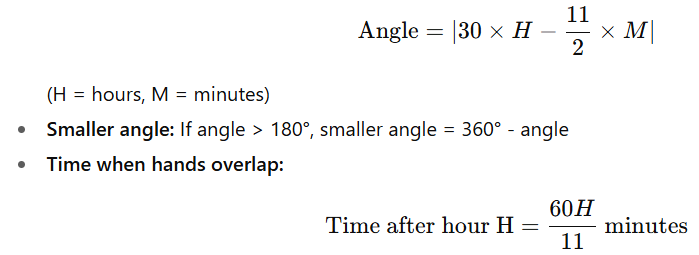
| Angle Formula | Angle = |
| Hands Overlap Times | Occurs every 65 5/11 minutes |
| Hands Opposite Time | Occurs every 32 8/11 minutes |
| Clock Angle Calculation | Smaller angle between hour and minute hands |
What are the types of Clock Reasoning Questions in Reasoning?
Clock Reasoning questions in exams generally come in these types:
- Direct: Find the angle between hands at a given time
- Puzzle-based: Multiple conditions involving clock times and hands’ positions
- Coded (symbol-based): Using symbols to represent hours and minutes
- Mixed-concept reasoning: Combining clock logic with other reasoning areas like direction or sequence
Clock Reasoning Formulas for Reasoning
Essential formulas to speed up the clock reasoning questions are as follows:
- Minute hand speed: 6° per minute
- Hour hand speed: 0.5° per minute
- Angle between hands:
Clock Reasoning Tricks for SSC CGL and Other Exams
Some quick tricks to solve Clock Reasoning questions are as follows:
- Always find the smaller angle between hands, not the larger.
- Use the formula for angle between hands instead of drawing clocks.
- When asked for time between overlaps or opposites, remember hands overlap every ~65 5/11 minutes.
- Visualize clockwise and anticlockwise directions carefully.
- For ‘how many times hands overlap in a day’ type, remember it’s 22 times.
- Start calculations from given time rather than from 12:00 to avoid confusion.
Common Mistakes to avoid while Solving Clock Reasoning
While practicing Clock Reasoning, watch out for these mistakes:
- Confusing larger and smaller angles always confirm smaller angle unless asked otherwise.
- Ignoring minute hand speed when calculating hour hand position.
- Forgetting to subtract angle from 360° if initial angle > 180°.
- Misreading the problem as 12-hour clock when it could be 24-hour format.
- Not visualizing clockwise vs anticlockwise directions properly, causing errors in angle calculations.
FAQs
Use angle formulas directly and memorize key times for overlaps and opposites to avoid lengthy calculations.
Yes, typically 1–2 questions appear, often moderate in difficulty.
It’s better not to skip as these are usually easy and scoring questions.
Questions where time or angles are represented with symbols or codes instead of numbers
Hi, I’m Aditi. I work as a Content Writer at Oliveboard, where I have been simplifying exam-related content for the past 4 years. I create clear and easy-to-understand guides for JAIIB, CAIIB, and UGC exams. My work includes breaking down notifications, admit cards, and exam updates, as well as preparing study plans and subject-wise strategies.
My goal is to support working professionals in managing their exam preparation alongside a full-time job and to help them achieve career growth.
