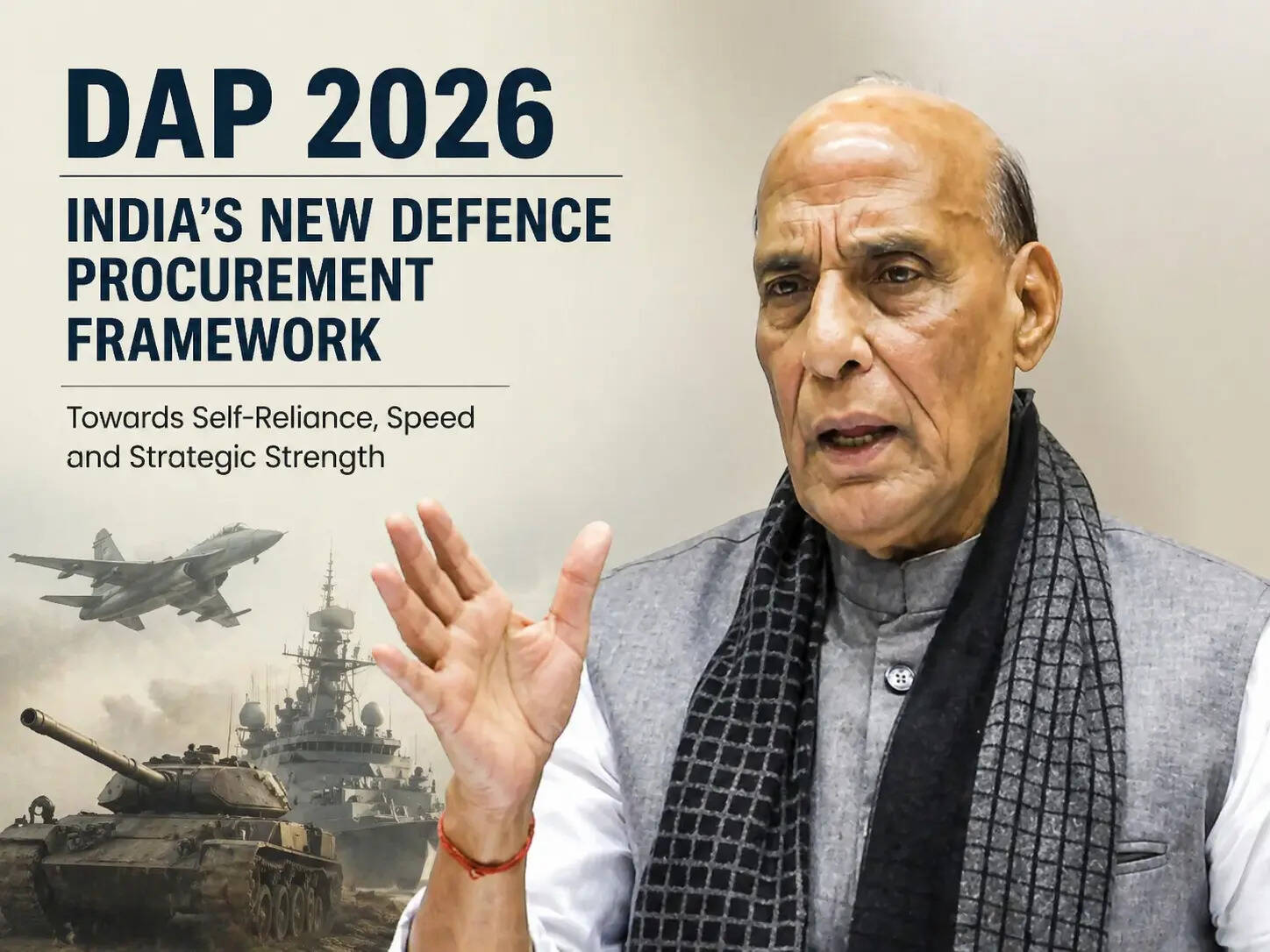
India’s draft Defence Acquisition Procedure (DAP) 2026 marks one of the most significant overhauls of the country’s military procurement architecture in recent years.
Released by the Ministry of Defence for public consultation, the proposed framework is set to replace DAP 2020 and arrives at a moment when India faces an increasingly volatile security environment and accelerating technological disruption in warfare.
The timing of the reform is particularly significant. India continues to confront an assertive China along the Line of Actual Control, persistent instability with Pakistan, growing Chinese maritime activity in the Indian Ocean Region, and an increasingly fragmented global geopolitical order shaped by the wars in Ukraine and West Asia.
These conflicts have demonstrated that nations dependent on foreign military supply chains can face serious operational vulnerabilities during prolonged crises. They have also highlighted how rapidly evolving technologies such as artificial intelligence, autonomous drones, cyber tools, space systems and electronic warfare capabilities are reshaping battlefields.
Against this backdrop, DAP 2026 seeks to fundamentally redefine how India acquires military capability. Rather than treating defence procurement as a routine administrative process, the new framework positions acquisition policy as a strategic instrument for strengthening military preparedness, building industrial capacity and reducing dependence on foreign suppliers.
Moving Beyond Licensed Manufacturing
One of the most striking elements of DAP 2026 is its explicit acknowledgement that India’s earlier model of defence indigenisation often produced limited strategic gains. For years, much of India’s domestic defence manufacturing revolved around assembling foreign systems under licensed production arrangements or relying heavily on transfer-of-technology agreements that offered only partial technological control.
The draft document signals a clear departure from that model. It states that the next phase of India’s defence industrial journey will be judged not merely by whether systems are manufactured in India, but whether they are genuinely owned by India in terms of intellectual property and technological control.
This shift has major implications. Future procurement decisions are expected to increasingly prioritise ownership of source codes, control over critical design architecture, access to technical documentation and independent upgrade capability. In modern warfare, where software upgrades can often determine operational superiority, such control has become essential. India’s past experiences with foreign platforms—from delays in spare supplies to restrictions on upgrades—have reinforced the need for greater technological sovereignty.
Creating a Long-Term Procurement Pipeline
A recurring criticism of India’s defence acquisition ecosystem has been the absence of long-term planning visibility for both the armed forces and domestic industry. Procurement decisions have often been fragmented, delayed and unpredictable.
DAP 2026 attempts to address this through a more structured planning framework. It mandates the preparation of a ten-year Integrated Capability Development Plan by Headquarters Integrated Defence Staff, alongside a Technology Perspective Capability Roadmap that could be made public to help industry align investments with future military requirements.
In addition, each service will prepare a two-year Annual Acquisition Plan before the beginning of every financial year. This reform could provide greater predictability for private industry, which has often hesitated to make large investments in defence production due to uncertain demand visibility.
Strengthening Domestic Industry
The new framework reinforces the government’s larger Atmanirbhar Bharat agenda by sharply prioritising indigenous procurement categories. DAP 2026 creates a clear hierarchy that places Buy (Indian-IDDM) at the top, followed by Buy (Indian) and Manufacture in India, Buy (Global) and Manufacture in India, and finally Buy (Global).
Foreign procurement is effectively positioned as the last resort.
The framework also introduces stricter indigenous content requirements. Buy (Indian-IDDM) projects will require at least 30 percent indigenous content during the trial phase and 60 percent by final contract execution. Buy (Indian) and Manufacture in India and Buy (Global) and Manufacture in India categories also mandate 60 percent indigenous content. Even global procurement categories may involve domestic content obligations.
These measures are designed to ensure that defence spending generates domestic industrial growth rather than perpetuating external dependence.
Bringing Startups into Mainstream Defence Procurement
Another important feature of DAP 2026 is the elevated role assigned to startups and smaller innovators. For several years, initiatives such as Innovations for Defence Excellence (iDEX) have helped startups enter the defence sector, but these programmes were often viewed as peripheral experiments rather than central procurement channels.
DAP 2026 changes that perception by formally integrating iDEX into mainstream acquisition pathways.
This is particularly important in sectors such as drone warfare, artificial intelligence, cybersecurity, robotics and space technologies, where startups can often innovate faster than traditional defence manufacturers. The war in Ukraine has demonstrated how relatively low-cost drone technologies can alter battlefield dynamics, underscoring the relevance of agile innovation ecosystems.
Faster Procurement in an Era of Technological Obsolescence
One of the most candid acknowledgements in DAP 2026 is that the biggest challenge in modern defence procurement may no longer be funding constraints, but technological obsolescence. Traditional procurement timelines often stretch over several years, while technologies in areas such as artificial intelligence, quantum systems and autonomous warfare platforms evolve at a far faster pace.
DAP 2026 attempts to solve this problem through specialised procurement pathways for fast-changing technologies. It expands Fast Track Procedures and introduces Low-Cost Capital Acquisition mechanisms to enable quicker purchases of operationally relevant systems. This flexibility could help India avoid acquiring outdated systems by the time procurement processes conclude.
Expanding Leasing and Strategic Partnerships
The draft framework also gives greater importance to leasing as a procurement tool. This allows the armed forces to access high-value assets without large upfront capital expenditure. Leasing may prove particularly useful for surveillance platforms, transport assets and specialised operational systems where ownership may not always be necessary.
At the same time, DAP 2026 retains space for foreign partnerships through government-to-government deals, strategic partnerships and joint ventures. This reflects strategic realism. While India seeks self-reliance, it continues to depend on foreign technologies in areas such as jet engines, advanced sensors, semiconductor systems and specialised propulsion technologies.
The Economic Dimension of Defence Procurement
The significance of DAP 2026 extends beyond national security. India’s defence spending has the potential to become a major driver of manufacturing growth, technological innovation and employment generation. A stronger domestic defence ecosystem could stimulate sectors such as advanced electronics, metallurgy, semiconductors, precision engineering and aerospace manufacturing.
The government has repeatedly articulated ambitious defence export goals, and DAP 2026 directly aligns procurement policy with those export ambitions. If implemented effectively, India could emerge not only as a major defence market but also as an increasingly competitive defence exporter.
The Real Test Lies in Execution
Despite its ambitious vision, DAP 2026 will ultimately be judged by implementation. India’s procurement ecosystem has historically struggled with bureaucratic delays, shifting operational requirements, prolonged trial cycles and contract disputes.
If these structural bottlenecks remain unresolved, even the most well-designed procurement reforms may fail to deliver meaningful change. The armed forces also face a delicate balancing act. While promoting domestic manufacturing remains important, operational readiness cannot be compromised by excessive delays in indigenous development.
A Strategic Turning Point
DAP 2026 signals that India is beginning to view defence procurement through a far wider strategic lens. It is no longer simply about purchasing military equipment. It is increasingly about building technological sovereignty, strengthening domestic industry, improving military preparedness and enhancing geopolitical autonomy.
If implemented with discipline and speed, DAP 2026 could mark the beginning of India’s transition from one of the world’s largest arms importers to a serious defence manufacturing power. That transformation would have consequences far beyond India’s defence sector—it would reshape the country’s broader strategic and economic trajectory.