

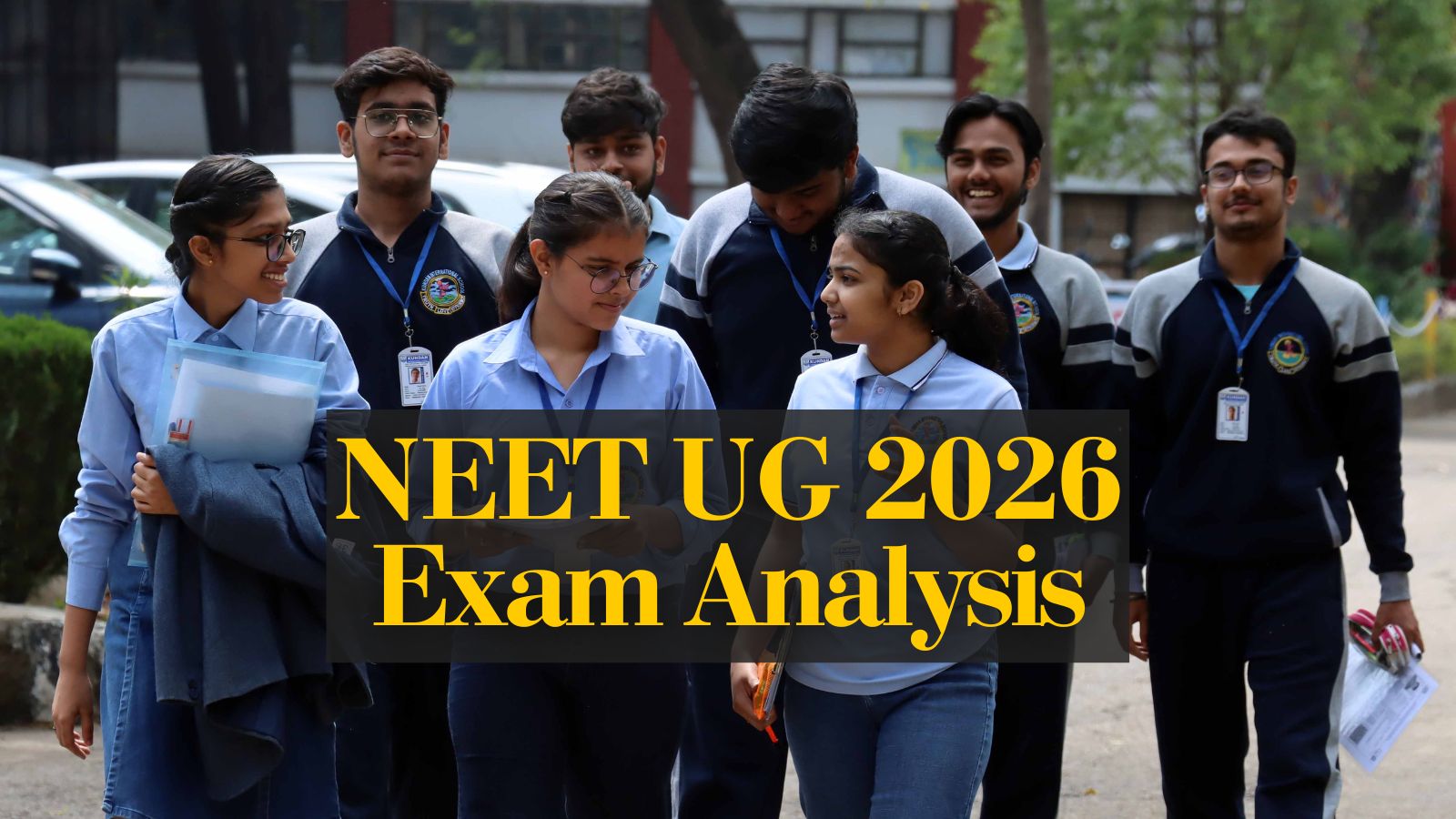
NEET Exam Analysis 2026: The National Testing Agency (NTA) concluded the NEET UG 2026 examination on May 3, with an estimated 23 lakh medical aspirants appearing for the pen-and-paper test across centres nationwide. Based on initial reactions and expert reviews, this year’s paper has been described as balanced, moderately difficult, and more reliant on consistency and time management than sheer problem-solving complexity.
According to early analysis, NEET 2026 was a well-balanced paper that leaned slightly easier than last year. However, it was not a paper that could be taken lightly. Instead of testing extreme difficulty, the exam focused on discipline, conceptual clarity, and the ability to manage time effectively across sections, NEET educators noted.
“NEET 2026 was a well-balanced paper that leaned slightly easier than last year, but importantly, it tested discipline over difficulty. Physics and Chemistry required conceptual clarity and precision, while Biology remained largely accessible—with Botany introducing a time challenge due to its length,” said Ujjwal Singh, Founding CEO, Infinity Learn by Sri Chaitanya.
“What stands out is that success this year is not about tackling a tough paper, but about managing time, staying consistent, and having strong fundamentals. Students who built their preparation steadily and stayed close to NCERT concepts would have found themselves at a clear advantage,” he added.
The overall difficulty level of the NEET UG 2026 question paper has been rated as moderate. Physics and Chemistry sections demanded conceptual understanding along with calculation accuracy, while Biology maintained a relatively easier tone. However, the length of certain sections made time management a critical factor.
Adding to this, expert faculties and educators across domains in Physics Wallah noted that Physics was moderate to tough and largely calculation-oriented, though not as intensive as last year, while Chemistry ranged from easy to moderate and remained largely NCERT-based and familiar to students. Biology, on the other hand, was described as easy in terms of concepts but moderate to tough overall due to its length and time-consuming nature, reinforcing the need for speed and accuracy.
Story continues below this ad
A key takeaway from this year’s paper is that it rewarded students who had maintained consistent preparation over time. Those with a strong command of NCERT textbooks and regular practice were better positioned to attempt the paper efficiently.
This assessment is further supported by Harpreet Singh, Director, Visionary Masterz, Delhi, who noted that while the paper was well-balanced, it was also time-consuming, with Physics emerging as the most challenging section due to its conceptual and calculation-heavy nature across topics like Current Electricity, Mechanics, and Electrostatics. Chemistry remained easy to moderate with largely NCERT-based questions, although Organic Chemistry included some tricky portions, while Biology stood out as the most scoring section with direct yet concept-driven questions.
NEET UG 2026: Section-wise analysis
As per initial analysis from NEET educators, here’s a subject wise breakdown of how the paper was this year:
Physics: The section was moderate in difficulty, focusing on conceptual clarity and numerical accuracy. Students needed to apply formulas carefully, with little room for guesswork.
Story continues below this ad
Here too, inputs from Physics Wallah educators indicate that while the section was balanced and evenly distributed across the syllabus, several questions required deeper thinking and multi-step solving, making it more calculation-intensive and slightly tricky for some students.
Chemistry: Similar to Physics, Chemistry required precision and a clear understanding of core concepts. Questions were largely balanced across topics.
Experts further highlighted that Inorganic Chemistry was particularly straightforward with direct NCERT-based questions, while Organic Chemistry leaned towards moderate to high difficulty due to a focus on reaction mechanisms. Overall, the section followed patterns similar to previous years, with a few time-consuming numerical problems.
Biology: Biology remained the most scoring section overall, but with internal variations. Zoology was straightforward and student-friendly, while Botany, despite being easy in terms of concepts, was lengthy and time-consuming.
Story continues below this ad
Educators at Physics Wallah also observed that Botany included very direct NCERT-based questions without complex numericals, while Zoology, although easy, featured statement-based and match-the-following questions that made it time-consuming. The Biology section overall was heavily NCERT-driven, with many questions solvable through elimination techniques and strong conceptual clarity.
Surbhi Mishra, faculty of Zoology, previously with Aakash Institute, and Unacademy, noted that the Zoology section closely followed NCERT patterns.
“I observed that most of the questions in the Zoology section were directly or indirectly based on NCERT. There was a noticeable change in trend this year, as no assertion reason questions were asked. The paper was easy to moderate in terms of difficulty, but it was time consuming due to lengthy statements and matching type questions. I also noticed that some questions were similar to or repeated from previous year papers. Overall, the Zoology section favourable for students,” she said.
One of the most notable shifts in NEET 2026 was the emphasis on time management rather than difficulty spikes. The absence of assertion-reason questions in Zoology and the presence of lengthy, statement-based and match-the-following questions suggest a move towards testing comprehension and patience.
Story continues below this ad
Overall, expert faculties and educators across domains in Physics Wallah noted that the paper remained aligned with previous year trends, balancing straightforward NCERT-based questions with a few sections that required deeper conceptual application. They emphasised that students who had prepared consistently over the past two years and maintained clarity of fundamentals would have found the paper manageable and fair.
