


AI will allow developers and teams that can crystallize requirements, architecture, and design to rapidly apply and evaluate different languages and data models to their project. AI will make iterative life cycles like spiral and evolutionary prototyping even more effective by allowing parallel development paths during each iteration. The key to success is leveraging AI in a way that allows you to focus on higher-level design issues while not losing control over code complexity. If you don’t learn these higher-level skills, developers and teams that do will be far more productive than you are.
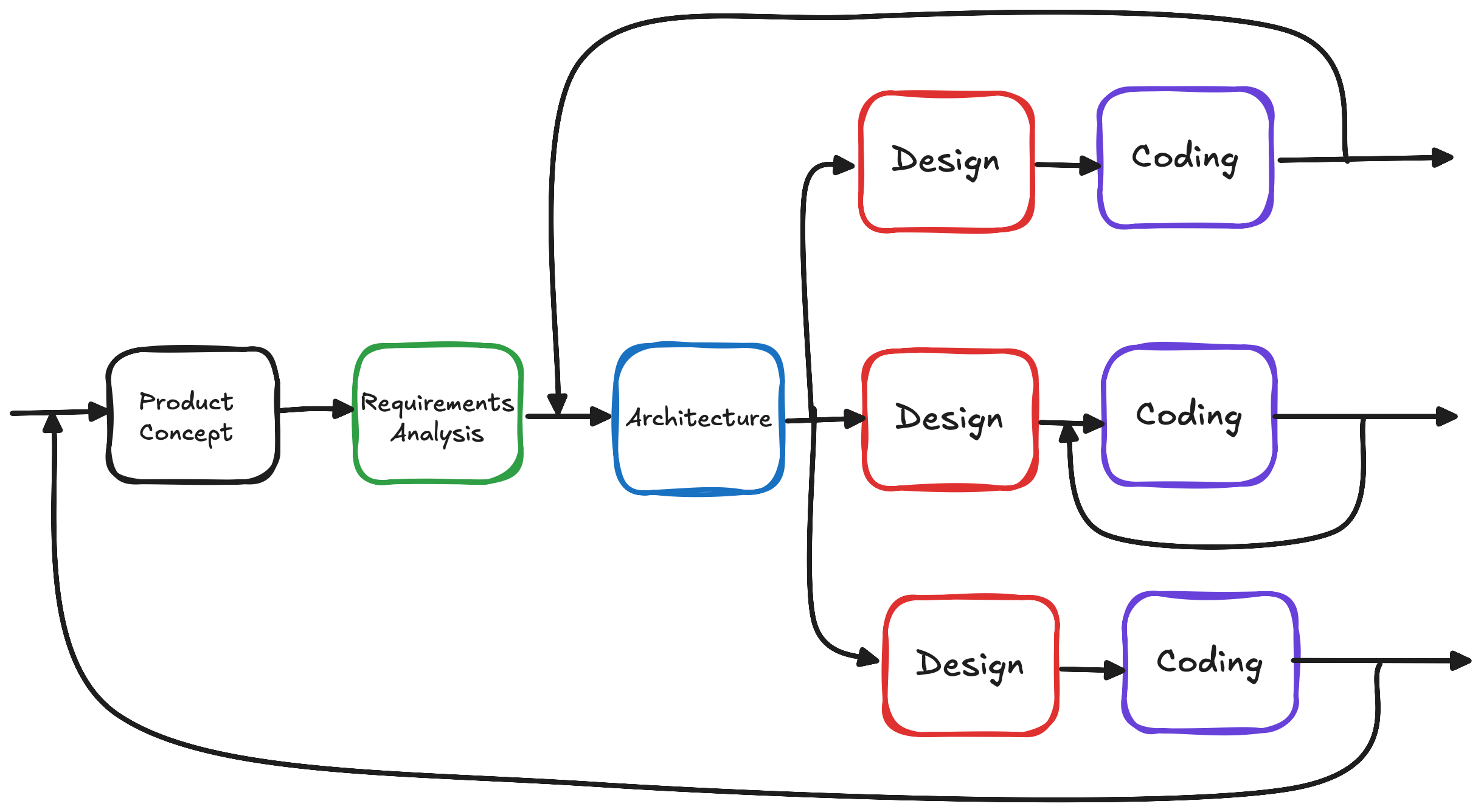
Iterative life cycle with parallel paths and feedback loops.
Confluent
Accidental vs. essential complexity – why AI cannot be a silver bullet
Some have argued that AI will significantly improve software productivity. They envision a future in which software developers need only write a few prompts and an LLM will produce software that can replace existing SaaS products. But as Fred Brooks argued in a famous 1986 paper, “No Silver Bullet,” this is still impossible because of the two types of complexity that remain—accidental complexity and essential complexity.
Accidental complexity (or ‘accidents’)
Accidents are not inherent to the problem itself, but to the production process including the tools, languages, hardware limits, and implementation details we use to build the software. Historically, most productivity gains come from reducing accidental complexity. AI productivity can reduce accidental complexity, but developers must deal with its own challenges including hallucinations and poor-quality generated code that must be detected.
