


Economic Planning is a significant topic in the JAIIB IE & IFS paper. Understanding it helps banking professionals grasp government initiatives, resource allocation, development strategies, and policy impacts on banking operations. In this blog we have provided economic planning in India JAIIB Ie and IFS key concepts, calculation methods, preparation strategies, and solved examples to help you revise efficiently for the exam.
What is Economic Planning in India?
Economic Planning refers to the government’s systematic effort to allocate resources efficiently, achieve balanced growth, and ensure socio-economic development in India. It covers planning approaches, five-year plans, objectives, and evaluation of plan outcomes.
- Relevance for Banking Professionals:
- Helps in understanding government priorities and credit flow in different sectors.
- Assists in analyzing policy impacts on lending, investment, and financial inclusion.
- Provides insight into sectors receiving priority funding under national plans.
- Skills Required:
- Knowledge of India’s planning history and key objectives
- Understanding of plan strategies and outcomes
- Ability to connect planning policies with banking and finance
Download Practice Quiz on Economic Planning in India
Strengthen your preparation for the JAIIB IE & IFS Economic Planning in India section with well-structured practice quizzes designed to cover all important concepts. These quizzes focus on key areas such as Five-Year Plans, planning objectives, NITI Aayog reforms, sectoral allocation, and policy-driven economic development.
Download PDF
Attempt Quiz on JAIIB IE & IFS Economic Planning in India
Boost your exam preparation by attempting targeted quizzes based on the JAIIB IE & IFS Economic Planning in India syllabus. These quizzes include concept-based, analytical, and application-level questions to test your understanding of planning models, government strategies, development indicators, and the role of NITI Aayog in modern economic planning.
1. Who set up the National Planning Committee in 1938 and under whose leadership did it function?
2. Who is credited with being the first person to advocate economic planning for India, through his 1934 publication?
3. The Bombay Plan of 1944 was drafted by which group?
4. What was the estimated total cost of the Bombay Plan, and over how many years was it to be implemented?
5. Which alternative plan to the Bombay Plan was drafted by M. N. Roy in 1944 on behalf of the Indian Federation of Labour?
6. The People’s Plan, costing about Rs. 15,000 crores, primarily emphasised development through which means?
7. The Gandhian Plan of 1944 was authored by whom?
8. What was the central feature of the Gandhian Plan?
9. The Colombo Plan for India (1951–1956) was primarily aimed at improving living standards in which region through development spending?
10. According to German economist Hermann Levy, economic planning is best described as a means to:
11. Which type of economic planning is most prevalent in India, given its system of government?
12. ‘Planning by inducement’ primarily relies on which tool to influence private investment decisions?
13. The Planning Commission of India was established in which year, and under whose chairmanship?
14. What was the constitutional/legal status of the Planning Commission?
15. The Planning Commission functioned under the guidance of which apex policy-making body?
16. In which month and year was the draft outline of India’s First Five Year Plan presented?
17. On which economic model was the First Five Year Plan primarily based?
18. What was the targeted versus actual growth rate achieved during the First Five Year Plan (1951–1956)?
19. The First Five Year Plan laid primary emphasis on which sector?
20. The Second Five Year Plan is also popularly known by which name, after its principal architect?
Quiz Summary
Final Score: 0.0

Sign Up

Login
Forgot Password
Please enter the Email ID we will send you a Email with the link to reset the password.

What topics are covered under Economic Planning in India for JAIIB IE & IFS paper?
The Economic Planning section in JAIIB IE & IFS paper focuses on government strategies for resource allocation, development planning, and policy interventions.
- Introduction to Economic Planning
- Objectives of Economic Planning in India
- Five-Year Plans (historical and current)
- NITI Aayog and planning reforms
- Planning strategies: centralized, indicative, and decentralized
- Evaluation of plan performance and key indicators
- Role of Planning in banking and financial sector development
Why is economic planning in India important in the JAIIB IE & IFS paper?
Understanding Economic Planning is crucial for banking professionals as it helps analyze how government policies affect credit priorities, investment flows, and economic development initiatives.
- 2–3 questions appear on average from this topic in IE & IFS paper.
- Questions can be conceptual, scenario-based, or calculation-oriented.
- Knowledge of planning helps understand priority sectors, development programs, and fund allocation.
Also: Check out the detailed JAIIB IE and IFS Syllabus
What are the key concepts in Economic Planning in India for IE & IFS paper?
Key concepts include economic planning, objectives like growth, equity, and stability, and different types of planning. It also covers Five-Year Plans and their role in shaping India’s economy.
| Concept | Explanation | Example |
| Economic Planning | Systematic government strategy for resource allocation and growth | Five-Year Plans |
| Objectives of Planning | Growth, equity, stability, employment generation | Balanced regional development |
| Types of Planning | Centralized, indicative, decentralized | NITI Aayog’s approach vs. Five-Year Plans |
| Five-Year Plans | Historical planning mechanism in India | 12th Plan (2012–17) objectives |
| NITI Aayog | Policy think-tank replacing Planning Commission | Sustainable development programs |
| Priority Sector | Sectors receiving special funding under plans | Agriculture, MSMEs, renewable energy |
Check out the detailed JAIIB Notification 2026
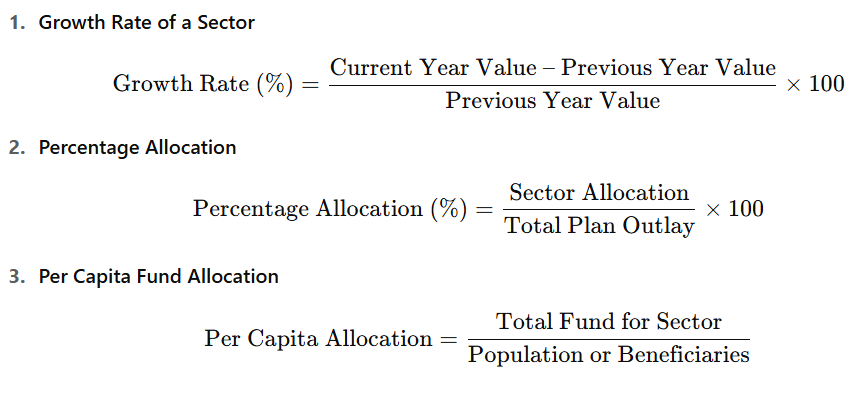
What calculations and formulas are important in Economic Planning in India?
In economic planning, basic calculations are related to growth rates, fund allocation, and sector-wise distribution. These help in analyzing how government budgets are divided among different sectors.
What types of questions are asked from Economic Planning in India in JAIIB IE & IFS Paper?
Questions are usually asked in the form of definitions, comparisons, and policy-based concepts. For example, differences between centralized and decentralized planning are common. Questions may also focus on Five-Year Plans and the role of NITI Aayog. Some questions are scenario-based and linked to banking and economic policies. Evaluation and objectives of planning are also frequently tested.
- Key Areas:
- Planning History: Questions on Five-Year Plans, Planning Commission, and NITI Aayog
- Objectives & Strategies: Growth, equity, employment, and sectoral priorities
- Policy Impact on Banking: How plans influence credit flow, subsidies, and priority sector lending
- Evaluation: Success and failures of plans, indicators, and GDP contribution of sectors
- Question Formats:
- Definitions & Explanations: e.g., “Define economic planning”
- Comparisons: e.g., “Difference between centralized and indicative planning”
- Policy & Current Affairs: e.g., “Role of NITI Aayog in post-2015 planning”
What are the best preparation strategies for economic planning in India?
Preparation Strategy for Economic Planning in IE & IFS Paper are as follows:
- Prepare structured notes for each Five-Year Plan and objectives.
- Focus on planning reforms, NITI Aayog, and sectoral allocations.
- Solve scenario-based questions to apply planning concepts in banking.
- Keep track of recent government schemes and budget allocations.
- Revise key terms, ministries, and policy changes before the exam.
Supercharge Your JAIIB IE & IFS Prep, Get the Complete Strategy Today!
What are the common mistakes to avoid in Economic Planning in India?
Many candidates confuse the objectives of different Five-Year Plans. Some also ignore recent changes like the role of NITI Aayog. Relying only on memorization instead of understanding is another common mistake. Misreading data related to sectoral allocation can also lead to errors. It is important to focus on concepts and current developments for better accuracy.
- Ignoring post-2015 planning reforms and NITI Aayog updates.
- Confusing objectives of different Five-Year Plans.
- Misinterpreting allocation percentages or sectoral priorities.
- Relying solely on memorization instead of understanding objectives.
FAQs
Revise structured notes, practice scenario-based questions, and stay updated with reforms.
Use timelines, mnemonics, and connect plans with sectoral banking impacts.
Yes, schemes like PM-Kisan, PMMY, and Atmanirbhar Bharat may appear.
Only basic calculation formulas; understanding planning objectives and impact is more important.

Hi, I’m Aditi. I work as a Content Writer at Oliveboard, where I have been simplifying exam-related content for the past 4 years. I create clear and easy-to-understand guides for JAIIB, CAIIB, and UGC exams. My work includes breaking down notifications, admit cards, and exam updates, as well as preparing study plans and subject-wise strategies.
My goal is to support working professionals in managing their exam preparation alongside a full-time job and to help them achieve career growth.
