Effective border security and management around the world today is a complex and multi-dimensional challenge that requires carefully balancing national security against the need for facilitating legitimate trade and travel.
Global trends show a shift from purely physical barriers to “smart borders”, integrating advanced technology to counter sophisticated threats, including illegal infiltration, smuggling and terrorism.
India’s land borders, at over 15,000 kms, are amongst the longest in the world. While the Indo-Pak and Indo-Bangladesh borders are physically fenced, other borders are unfenced and remain more vulnerable to illegal infiltration, smuggling, etc. India faces multifarious challenges in border security and management, which include cross-border terrorism, illegal infiltration, drugs and arms smuggling, undemarcated borders, and territorial disputes with some of its neighbours.
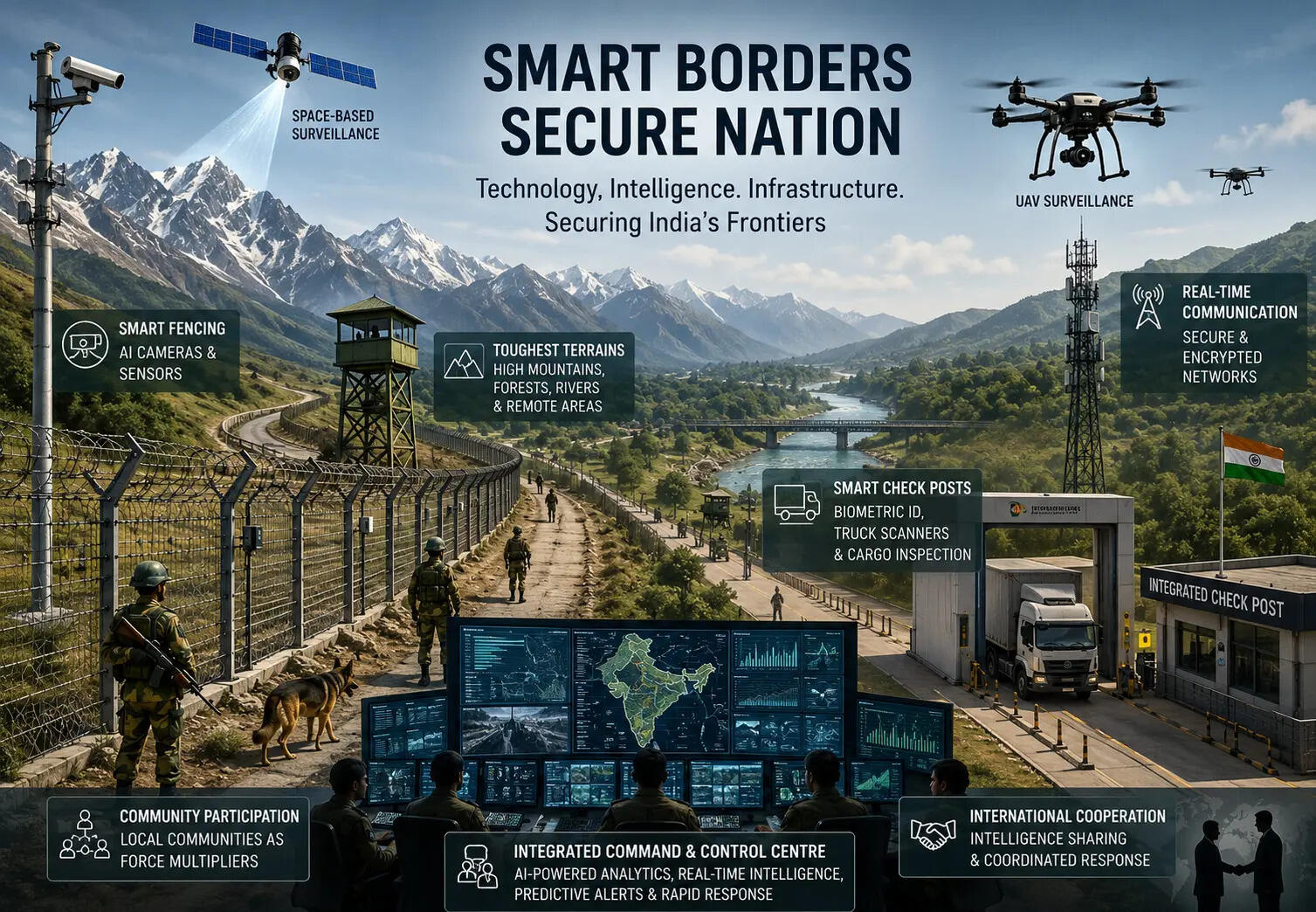
First, porous borders and difficult terrain, including dense forests along the Myanmar border, high mountains on the China and Pakistan borders and riverine areas along the Bangladesh border, make 24×7 surveillance difficult and challenging.
Secondly, our western border with Pakistan faces constant attempts at infiltration and cross-border terrorism. Illegal infiltration and cattle smuggling are major challenges along the Indo-Bangladesh border.
Thirdly, drug smuggling through the porous borders remains a major challenge. Smuggling of drugs through drones flying from across the borders have also been reported in recent times.
Fourthly, unresolved border disputes with China have resulted in frequent military standoffs. Infrastructural deficiencies along the border, such as incomplete fencing, lack of all-weather roads and outdated surveillance tools may also hinder quick response times.
To address the challenges noted above, the best practices worldwide are evolving towards a “whole-of-government” and technology-based solutions to create “smart borders”. Border management today needs to go beyond physical infrastructure to integrate terrain, technology, and intelligence.
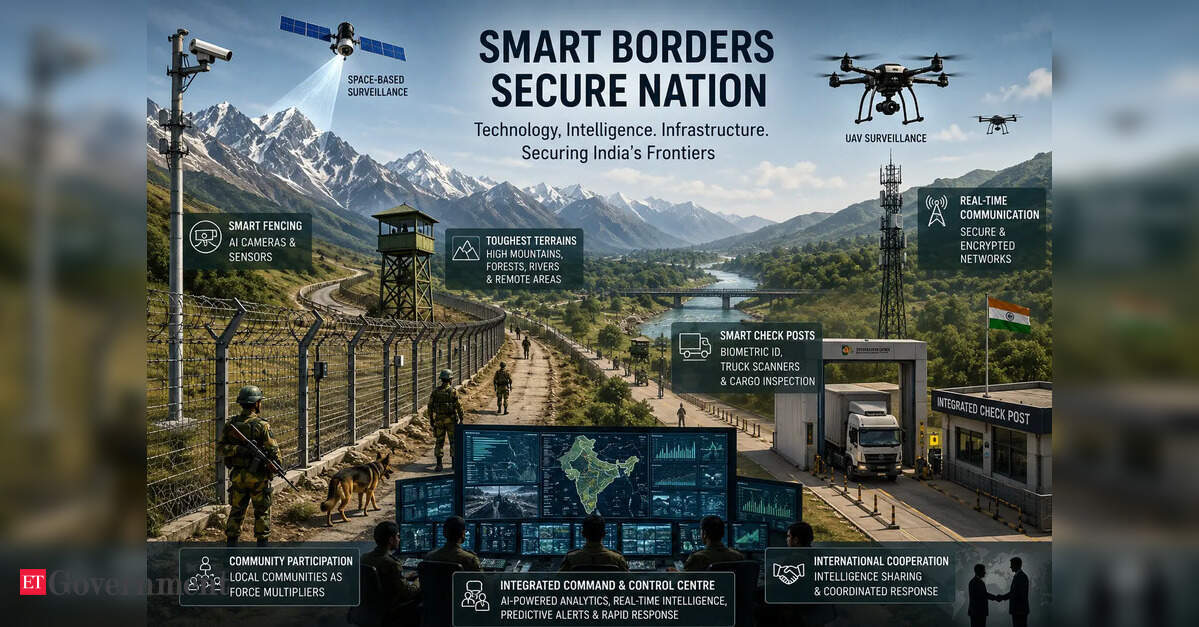
On our borders, physical assets need to be combined with AI-enabled digital surveillance, data analytics, space-based assets, and real-time intelligence fusion to create integrated security systems. Intelligence, Surveillance and Reconnaissance (ISR) capabilities need to be strengthened through AI cameras, smart fencing sensors, Unmanned Aerial Vehicle (UAV) imageries, predictive analytics on legacy data, and GIS/ERP integration, enabling continuous detection, analysis, and response.
Integrated Command and Control Centres with unified intelligent dashboards can enable this ecosystem to operate effectively. These systems would require very robust cybersecurity protocols to be put in place to protect the digital assets.
At the integrated check posts and authorised border crossing points, biometric identification can be implemented to prevent fraud. For cargo, full body truck scanners can be installed to detect any hidden contraband, arms, etc.
Secondly, institutional and strategic approaches are also important for ensuring integrated border management. These would involve focusing on interdepartmental cooperation and coordination amongst customs, immigration, border guarding forces and state government agencies to break functional silos and ensure real-time sharing of information and coordinated responses.
International cooperation with the neighbouring countries for sharing intelligence and coordinating responses to any activities on the ground would also be helpful. However, this may not always be feasible with hostile neighbours. Involving the local border communities for creating a human intelligence network can also prove very useful in sourcing intelligence.
Thirdly, creating modern border infrastructure is extremely important for securing our borders. Both lateral and axial roads in the border areas, especially along the Indo-China border, need to be developed at a rapid pace to allow for easier movement and quick response by our border guarding forces.
Recently approved schemes for building lateral and axial roads along the border in Punjab and Rajasthan and along the Indo-China border aim at addressing this infrastructure deficit along our borders.
Last, but not the least, developing the border villages is critical for border security. The Vibrant Villages Programme, now operational in all the bordering states and UTs, aims at improving village level infrastructure, connectivity and enhancing economic opportunities to reduce local susceptibility to criminal influence. It has already made an impact in the remote villages along the Indo-China border by reversing outmigration of the local population.
In future, border management needs to shift from reactive border control to proactive and dynamic situational awareness, aligned with evolving threats and broader national security and resilience objectives.
The greatest impact is expected from AI-enabled predictive and prescriptive threat assessment, integrated surveillance across land, sea, air, space, and cyber domains, AI-assisted logistics and personnel deployment, and the use of AI-enabled robotics. We need to take advantage of this rapidly evolving technological landscape to secure our borders.
(The author is Secretary, Department of Border Management, Ministry of Home Affairs in Government of India. Views expressed are personal.)