

Canadian High Commissioner to India Chris Cooter has recently said this is “probably the best time ever” for Indian students to apply to Canada, saying the country has not even reached its international student cap. His remarks come at a time when official data from Immigration, Refugees and Citizenship Canada (IRCC) shows a sharp decline in new international student arrivals and reduced immigration targets.
According to the latest IRCC figures, Canada welcomed 7,040 new international students in January 2026. That is about 37 per cent lower than the number recorded in January of the preceding year. Overall temporary resident arrivals also fell by nearly 28 per cent year-on-year, while temporary worker arrivals declined by around 20 per cent.

Cooter said there is a “misperception” in India that Canada has shut its doors to international students in an interview with news agency ANI. “We haven’t even reached those caps. So actually, this is probably the best time ever to apply as an Indian student, because we want you there and there’s space in these caps,” he said. The envoy also said the cap introduced a few years ago was aimed at addressing housing shortages and removing low-quality institutions from the system.
Why did Canada cap international student intake?
Canada first introduced limits on international student intake after concerns over housing shortages, pressure on public services and the rapid growth of private colleges.
Cooter said the cap was imposed because there “simply wasn’t enough housing” and authorities also wanted to deal with “fly-by-night colleges”. He said those issues have since been addressed.
The cap, however, remains in place in 2026.
IRCC has said it expects to issue up to 408,000 study permits this year, including permit extensions. From January 2026, master’s and doctoral students at public institutions will be exempt from Provincial and Territorial Attestation Letter (PAL/TAL) requirements, although the overall cap continues.
What do the latest IRCC numbers show?
The decline in new student arrivals has continued into 2026. According to IRCC data, Canada received 7,040 new international students in January 2026, compared with the corresponding month last year. Temporary worker arrivals stood at 11,850.
Story continues below this ad
The slowdown has also been visible during peak admission periods. August, traditionally Canada’s busiest intake season, saw international student arrivals fall from nearly 79,725 in 2024 to about 45,010 in the previous year.
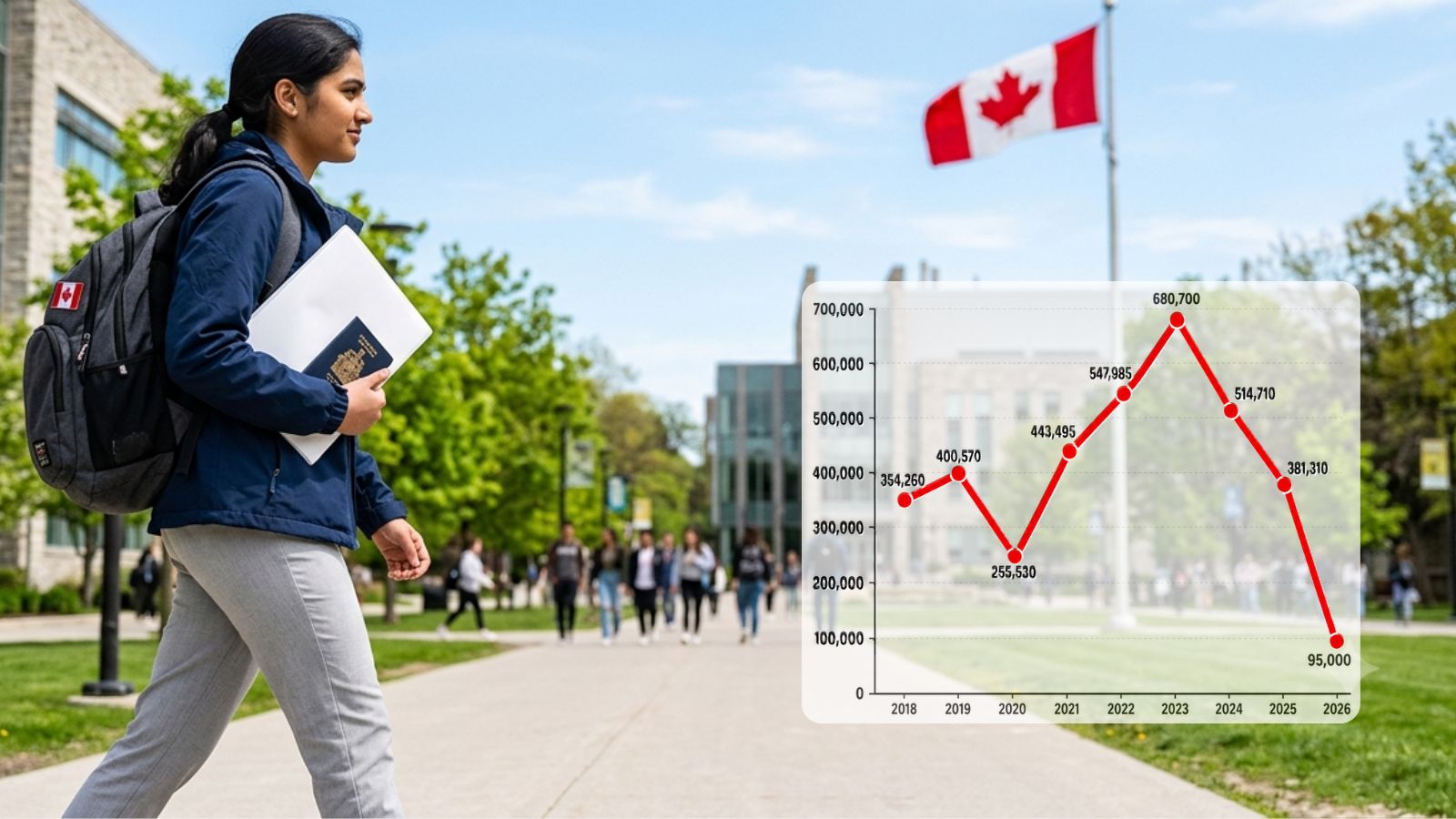
Official IRCC data also shows that the number of people whose study permits became effective in Canada rose steadily before and after the pandemic, peaking in 2023 before declining over the past two years.
Canada study permit holders by year in which permits became effective (Total unique persons)
| Year | Total unique persons | Year-wise change |
| 2018 | 354,260 | — |
| 2019 | 400,570 | +13.1% |
| 2020 | 255,530 | −36.2% |
| 2021 | 443,495 | +73.6% |
| 2022 | 547,985 | +23.6% |
| 2023 | 680,700 | +24.2% |
| 2024 | 514,710 | −24.4% |
| 2025 | 381,310 | −25.9% |
| 2026 | 95,000 | −75.1% |
Note: The 2026 data is year-to-date (January–April) and is not directly comparable with the full-year totals for 2018–2025.
Despite the fall in new arrivals, Canada continues to host a large Indian student population. As of early 2026, more than 4.27 lakh Indian students were studying in the country. Reports have linked the decline in fresh admissions to stricter visa rules, higher refusal rates and policy changes introduced over the past two years.
Story continues below this ad
What has Canada planned for immigration till 2028?
The latest figures are part of a broader shift in Canada’s immigration policy.
Under the 2026-2028 Immigration Levels Plan, the government has reduced targets for temporary residents while stabilising permanent immigration levels.
The plan sets a target of 155,000 new international student arrivals in 2026. That is 49 per cent lower than the previous year’s target. The target for new temporary workers has been fixed at 230,000, down 37 per cent from the earlier target.
Canada has also set a target of admitting 3.80 lakh new permanent residents in 2026, around four per cent lower than the previous year’s target.
Story continues below this ad
The government has said these measures are intended to reduce pressure on housing, infrastructure and public services. It has also set a goal of bringing the temporary resident population to below five per cent of Canada’s total population.
What has Canada said about future student intake?
While reducing overall numbers, the Canadian government has said it will continue to prioritise sectors facing labour shortages.
According to the Immigration Levels Plan, future immigration will focus on highly skilled workers in areas such as healthcare, skilled trades, and emerging technologies.
The plan also promises faster processing, streamlined applications and clearer pathways to permanent residence for skilled temporary workers and graduates.
Story continues below this ad
Cooter also said Canada is working to improve visa processing after receiving feedback from students and businesses. Referring to Canadian Prime Minister Mark Carney’s visit to India earlier this year, he said efforts are underway to make the visa process faster and more consistent for applicants.
