

Preparing for the IBPS PO exam while keeping backup career options open is never easy. Yet, Pitambar Gupta proved that a focused strategy can outweigh months of scattered preparation. An Electronics and Communication Engineering graduate, Pitambar cleared IBPS PO in his very first attempt, relying on his strengths, smart question selection, and consistent mock test practice rather than attempting every topic under the sun.
His journey is a reminder that success in banking exams is not about studying everything. It is about studying the right things, trusting your preparation, and executing your strategy on exam day.
From Engineering to Banking: A Practical Career Decision
Pitambar completed his engineering in 2025 and was initially preparing for CAT, where he secured an impressive 97.32 percentile. However, after discussing career options with his family, he decided to explore banking exams as well since the syllabus had considerable overlap with his CAT preparation.
He began preparing for banking exams around March-April. Although he could not clear SBI PO Prelims, he treated it as a learning experience. He refined his approach and successfully cracked IBPS PO in his very first attempt, proving how quickly the right strategy can make a difference.
Accuracy Over Attempts: His Biggest Prelims Strategy
Unlike many aspirants who chase higher attempts, Pitambar focused on maintaining accuracy. He attempted around 62 questions in Prelims and scored nearly 55–56 marks, comfortably clearing the cutoff.
According to him, mock tests completely changed the way he approached the exam. Instead of solving questions sequentially, he learned to identify easy and scoring questions within seconds.
His approach was simple:
- Scan the paper before attempting questions.
- Solve easy and calculation-based questions first.
- Skip lengthy questions instead of wasting time.
- Take calculated risks based on mock test analysis.
This strategy helped him maximize marks without unnecessary negative marking.
Mock Tests Helped Him Master Question Selection
One lesson Pitambar repeatedly emphasized was that mock tests are not just for practice—they teach strategy.
After taking several Oliveboard mock tests, he understood which questions deserved his time and which ones should be skipped immediately. That decision-making ability made a significant difference in the actual examination.
Speaking about his experience, he shared that Oliveboard’s mock tests closely matched the exam level and helped him prepare for real exam pressure.
For any IBPS PO aspirant, consistent mock analysis is as important as syllabus completion.
Practice with IBPS PO Mock Tests and Sectional Tests to improve speed, accuracy, and question selection.
Playing to His Strengths in IBPS PO Mains
For Mains, Pitambar knew that trying to excel in every section equally would not be the smartest strategy. Since Quantitative Aptitude, Reasoning, and English were already his strongest areas because of his engineering background, he decided to maximize his score there instead of spending excessive time chasing General Awareness.
For General Awareness, he focused only on the last two to three months of current affairs, following Oliveboard’s YouTube guidance. Instead of overloading himself with months of content, he studied only what he could confidently remember.
Another smart decision was prioritizing 2-mark questions whenever possible.
His reasoning was straightforward: spending an extra minute to earn two marks was often a better investment than solving multiple one-mark questions under pressure.
This practical approach helped him score well in Mains while maintaining high accuracy.
Strengthen your preparation with Previous Year Papers, current affairs resources, and regular sectional practice to improve your Mains performance.
Interview Preparation: Keep It Simple
Pitambar admitted that he initially had very little knowledge of banking operations before the interview.
Instead of referring to multiple resources, he trusted Oliveboard’s interview guidance and focused on day-to-day banking topics such as NPAs, negotiable instruments, payment systems, and banking operations.
Interestingly, several interview questions came directly from the concepts he had revised through the interview preparation sessions.
The experience reinforced one important lesson: structured preparation often works better than trying to study everything available online.
His Advice for Every IBPS PO Aspirant
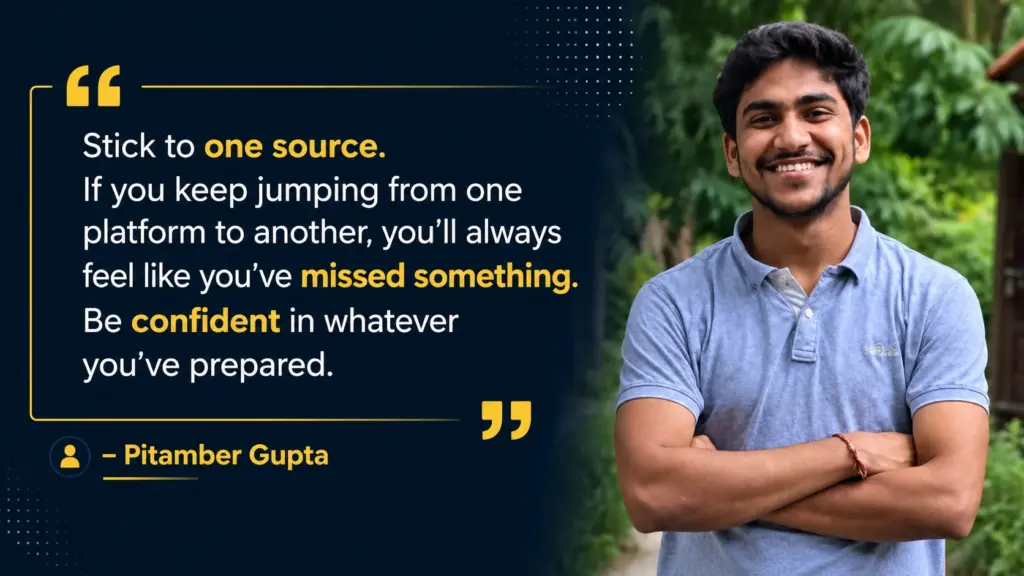
Pitambar believes many aspirants lose valuable time by constantly changing study sources. Rather than worrying about what they haven’t studied, candidates should focus on executing what they already know with confidence.
His advice is simple:
- Build your strongest subjects first.
- Prepare weak areas gradually without overloading yourself.
- Take plenty of mock tests before the exam.
- Stay consistent with one trusted source instead of constantly switching.
Confidence, according to him, comes from preparation, not from collecting more study material.
Final Thoughts
Pitambar Gupta’s first-attempt success wasn’t driven by extraordinary study hours. It came from clarity, consistency, and smart execution. By focusing on accuracy, analyzing mock tests, trusting one preparation source, and capitalizing on his strengths, he converted a backup plan into a successful banking career.
If you’re preparing for IBPS PO 2026, remember that the right strategy often matters more than studying everything. Build your preparation with quality mock tests, structured courses, previous year papers, and regular practice.

I started my journey with storytelling and journalism, and somewhere along the way, I discovered how much I truly love writing. Words have always been my way of connecting with people.
With 4+ years of experience in content creation, social media, and video storytelling, I focus on building meaningful conversations, not just posts. I enjoy understanding audiences, planning engaging content, and turning followers into active, connected communities.
At Oliveboard, I work on creating value-driven content that informs, engages, and brings people together.
