A rocket reaches orbit only after overcoming gravity. A commercial launch company must overcome an equally formidable combination of engineering risk, capital intensity, regulatory complexity and global competition. With Vikram-1 successfully completing its maiden orbital flight, Skyroot Aerospace has cleared the first—and most visible—of those barriers.
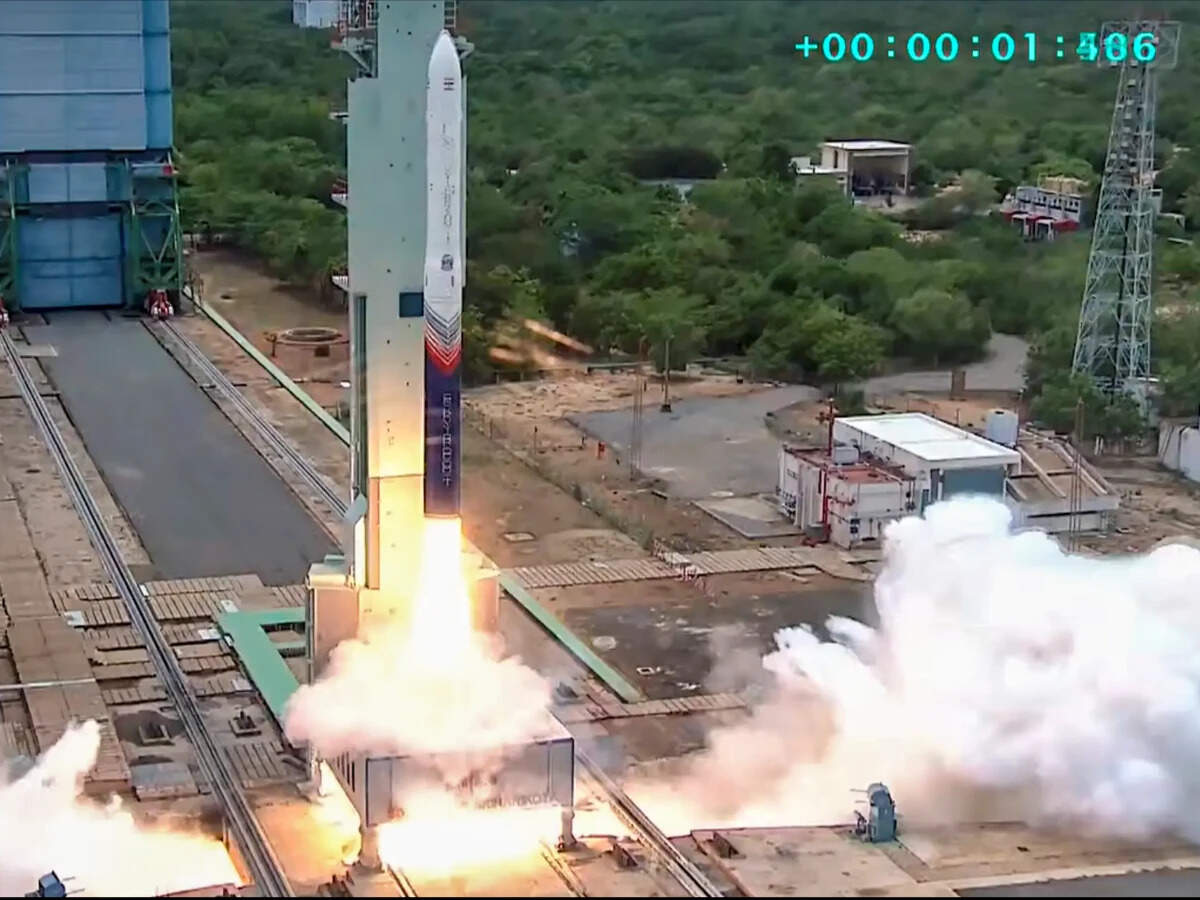
The Hyderabad-based space technology company on Saturday became the first Indian private enterprise to design, build and successfully fly an orbital-class rocket. Mission Aagaman lifted off from the First Launch Pad at the Satish Dhawan Space Centre in Sriharikota and placed its payloads into a low-Earth orbit of approximately 450 km at an inclination of 60 degrees.
The flight successfully deployed Skyroot’s SCOPE satellite and Grahaa Space’s Solaras satellite, while carrying other in-orbit experiments and technology-demonstration payloads. ISRO confirmed that Vikram-1 lifted off at 12:05:30 pm and described the mission as the first orbital launch undertaken by an Indian private company from Indian soil. The agency said the two satellites were injected into low-Earth orbit, while the remaining payloads would conduct experiments from the rocket’s upper stage.
The achievement is important not merely because Vikram-1 reached space, but because it reached orbit on its first attempt. Orbital launches require precise coordination across propulsion, stage separation, avionics, telemetry, guidance and navigation. Even established space programmes have experienced failures during the first flights of new launch vehicles.
Prime Minister Narendra Modi described the mission ahead of the launch as “a historic new frontier for India’s space journey”.
“This four-stage rocket is designed to provide rapid and on-demand launch services. This mission highlights the talent, determination and entrepreneurial spirit of our youth. It also shows how our space-sector reforms are unlocking new opportunities for innovation and enterprise,” the Prime Minister said in his message.
He added: “May Vikram-1 soar high, create history and inspire a generation of innovators.” A handwritten postcard from the Prime Minister bearing the words “Vande Mataram” was carried aboard the rocket. Following the successful flight, Modi spoke to the Skyroot team and congratulated its members.
The symbolism of the Prime Minister’s message was matched by the larger policy significance of the launch. Vikram-1 is the most concrete demonstration yet that the opening of India’s space sector to private participation is beginning to produce independent technological capabilities rather than merely a growing number of startups and investment announcements.
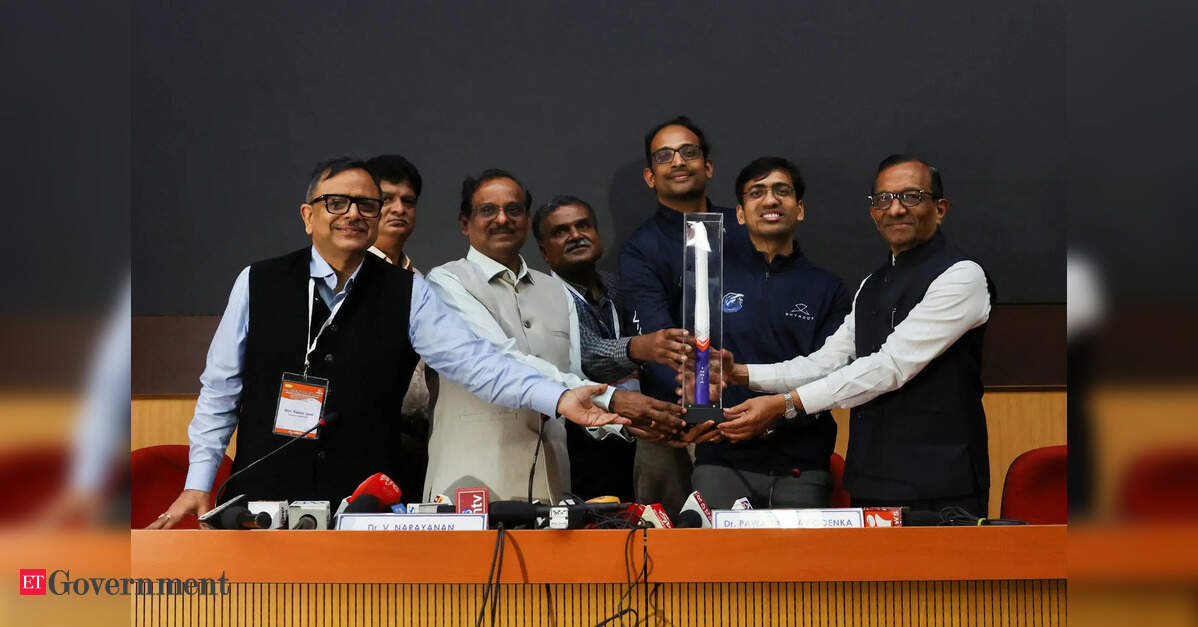
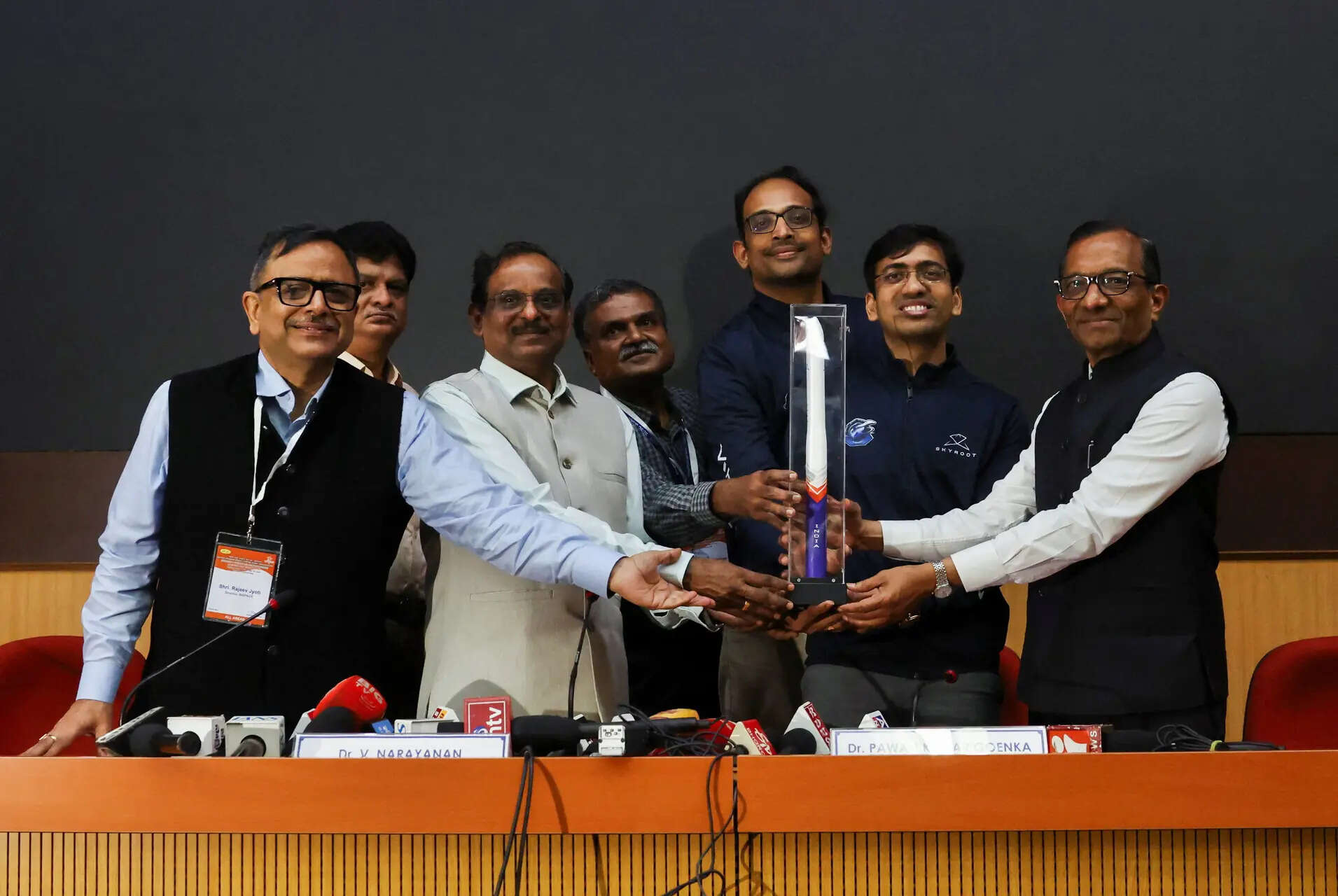
Dr V. Narayanan, Chairman of the Indian Space Research Organisation, said the achievement reflected the growing maturity of India’s private space sector.
“This achievement is the outcome of years of innovation, perseverance and engineering excellence, and reflects the growing maturity of India’s private space sector,” Narayanan said. “It is encouraging to see Indian industry translating technological capability into launch capability, complementing our national space programme.”
The word “complementing” is central to understanding the emerging structure of India’s space economy. Vikram-1 is a privately developed launch vehicle, but its successful flight was supported by the institutional infrastructure and accumulated expertise of the national space programme.
ISRO provided Skyroot with access to its solid-motor casting and static-test facilities at Sriharikota. Vikram-1’s first-stage motor was cast and tested there, while the second-stage motor was validated at ISRO facilities. The Raman-1 liquid engine used in the upper stage was tested at the Liquid Propulsion Systems Centre. ISRO also supported trajectory analysis, vehicle integration, stage preparation, material handling and launch-site safety.
IN-SPACe, the regulatory and promotional agency created after the 2020 reforms, facilitated Skyroot’s access to these facilities and provided technical consultations, mission-readiness reviews and launch clearances. The mission, therefore, illustrates an evolving public-private model in which government infrastructure and regulatory support enable private companies to build commercially oriented launch systems.
Dr Pawan Goenka, Chairman of IN-SPACe, called it a national achievement supported by a much broader industrial network.
“Only a handful of nations can reach space on their own, and today a private Indian company joined that exclusive club,” Goenka said. “What lifted off today is the culmination of years of work, a team of over a thousand people, and efforts of close to four hundred suppliers with it. Congratulations to Team Skyroot. You have given us an India moment.”
The participation of nearly 400 suppliers is particularly significant. The economic impact of a launch programme is not confined to the company assembling the rocket. It creates demand for advanced materials, precision manufacturing, electronics, propulsion components, sensors, software, testing equipment and specialised engineering services. If Skyroot and other Indian launch companies can build a steady order book, the result could be the emergence of a deeper domestic space manufacturing ecosystem.
Vikram-1 is approximately 22 metres tall and employs an all-carbon-composite structure to reduce weight. Its four-stage configuration comprises three solid-fuel stages and a liquid-fuel orbital adjustment stage. The vehicle incorporates high-thrust solid motors, a 3D-printed liquid engine and low-shock separation systems designed to protect sensitive satellite payloads. It can carry payloads of up to 350 kg to low-Earth orbit and up to 260 kg to a sun-synchronous orbit.
During Mission Aagaman, the rocket completed its principal flight milestones and validated its propulsion, avionics, telemetry, guidance, navigation and control systems under operational conditions. In addition to the SCOPE and Solaras satellites, the mission carried technology payloads from Cosmoserve and Germany-based DCubed, along with symbolic artistic payloads.
“We are immensely proud to stand here today. Vikram-1 reached its designated orbit and deployed our own SCOPE satellite, Grahaa Space’s Solaras satellite, and other in-orbit experiments, making Skyroot the first private company to take an Indian rocket to orbit on its very first flight,” said Pawan Kumar Chandana, Co-founder and CEO of Skyroot Aerospace.
Chandana said the mission demonstrated that India possesses the technological and industrial capacity to build launch vehicles conforming to global standards. “Our mission has always been to open space for all. Today we opened that door a little wider. This is not the destination. It is the beginning. From here, we leap,” he said.
That distinction between a beginning and a destination is important. A successful development flight validates a design, but a commercial launch company is ultimately judged by reliability, launch frequency, turnaround time, pricing and the ability to deliver satellites to their required orbits on schedule.
Skyroot has described Mission Aagaman as a test flight and indicated that further developmental missions will be undertaken before routine commercial operations begin. The company will now have to examine the large volume of flight data generated by Vikram-1, refine its systems and demonstrate that the performance can be repeated consistently.
“Every milestone today reflects the dedication of hundreds of engineers, technicians and mission specialists who believed in pushing the boundaries of what was possible,” said Naga Bharath Daka, Co-founder and COO of Skyroot Aerospace.
“Even as we celebrate, we are already applying today’s learnings to the next chapter of the Vikram series and to building a world-class launch capability from India, for the world,” he added.
Skyroot enters a global market with expanding demand but intense competition. The proliferation of small satellites for Earth observation, communications, navigation, climate monitoring, scientific research and defence has created demand for more frequent launches. Dedicated small-launch vehicles offer customers greater control over launch dates, orbital inclination and destination than conventional rideshare missions.
However, the dedicated-launch model faces formidable price pressure from larger reusable rockets carrying multiple satellites in rideshare configurations. SpaceX has changed global launch economics, while Rocket Lab’s Electron has built a substantial flight record in the dedicated small-satellite segment. European, Chinese, Japanese and South Korean companies are also developing or operating new launch vehicles.
Vikram-1’s opportunity, therefore, does not lie solely in offering the lowest price per kilogram. It can compete through responsive launch schedules, customised orbital deployment, shorter integration timelines and dedicated missions for commercial or strategic customers. For satellite operators that require a specific orbit or cannot wait for a suitable rideshare opportunity, flexibility and schedule certainty can be as important as headline launch cost.
The mission also has implications for India’s strategic autonomy. Commercial launch capacity can support civilian applications, but responsive access to orbit is increasingly relevant to national security. Smaller satellites can be deployed or replenished for communications, surveillance, maritime-domain awareness and disaster management.
A diversified launch ecosystem, incorporating both ISRO vehicles and privately operated rockets, can improve national resilience while freeing ISRO to concentrate more resources on complex scientific, human-spaceflight and exploration missions.
India opened the space sector to greater private participation in 2020, followed by the Indian Space Policy 2023, which clarified the respective roles of ISRO, IN-SPACe, NewSpace India Limited and non-governmental entities. The government has set the target of expanding India’s space economy from around $8 billion to $44 billion by 2033. That ambition will require Indian companies to capture international business across launch services, satellite manufacturing, applications, data analytics and ground infrastructure—not simply serve domestic demand.
Skyroot, founded in 2018 by former ISRO scientists Pawan Kumar Chandana and Naga Bharath Daka, took an initial step in November 2022 when Vikram-S became the first privately developed Indian rocket to reach space on a suborbital flight. Vikram-1 represents a much larger technological leap because reaching orbit requires achieving and sustaining the velocity necessary to place a payload around the Earth.
The company’s roadmap now includes Vikram-2, designed to carry payloads of up to 1,000 kg to low-Earth orbit, with its maiden flight targeted for 2027. It also plans a fully reusable vehicle in which both the booster and upper stage would be recovered. These are ambitious objectives, and their commercial viability will depend on development schedules, capital availability, customer commitments and flight reliability.
Skyroot was valued at more than $1.1 billion following investment from institutions including GIC, Temasek, Sherpalo Ventures and funds managed by BlackRock. The successful flight should strengthen investor and customer confidence, but launch-vehicle development remains capital-intensive, with long testing cycles and limited tolerance for failure.
Mission Aagaman has nevertheless altered the starting point of India’s private space debate. The question is no longer whether an Indian startup can develop an orbital rocket. Skyroot has shown that it can. The questions now are how frequently it can fly, how reliably it can serve customers and whether India can convert this engineering breakthrough into a commercially sustainable launch industry.
Vikram-1’s maiden success has opened that possibility. The difficult work of turning one historic flight into a dependable route to orbit begins now.