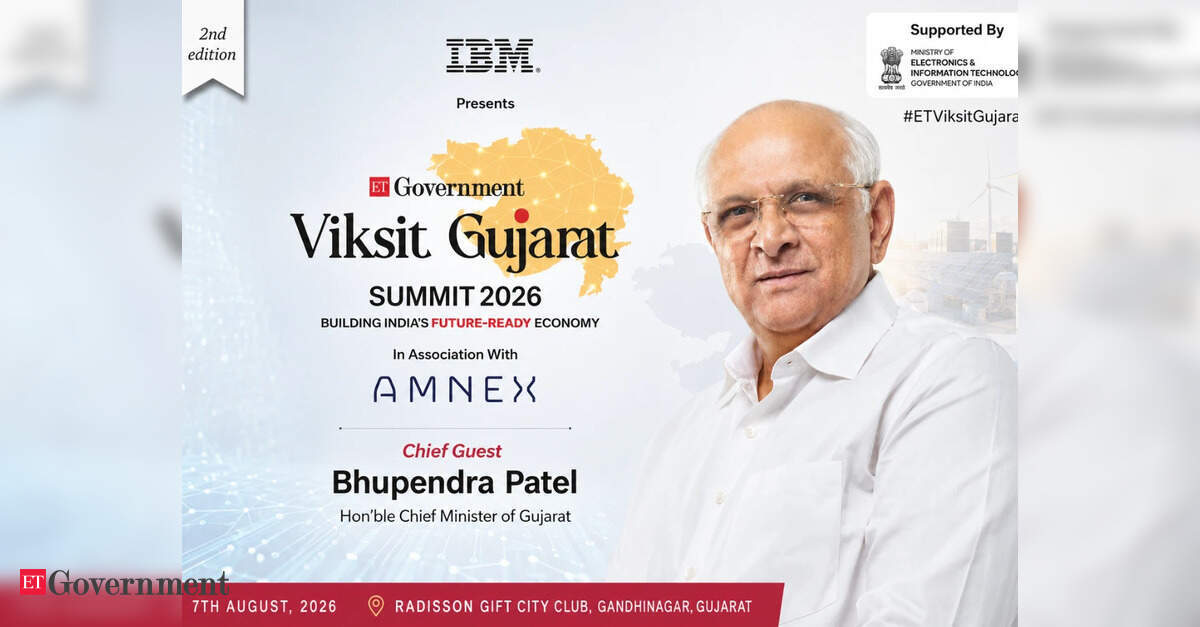
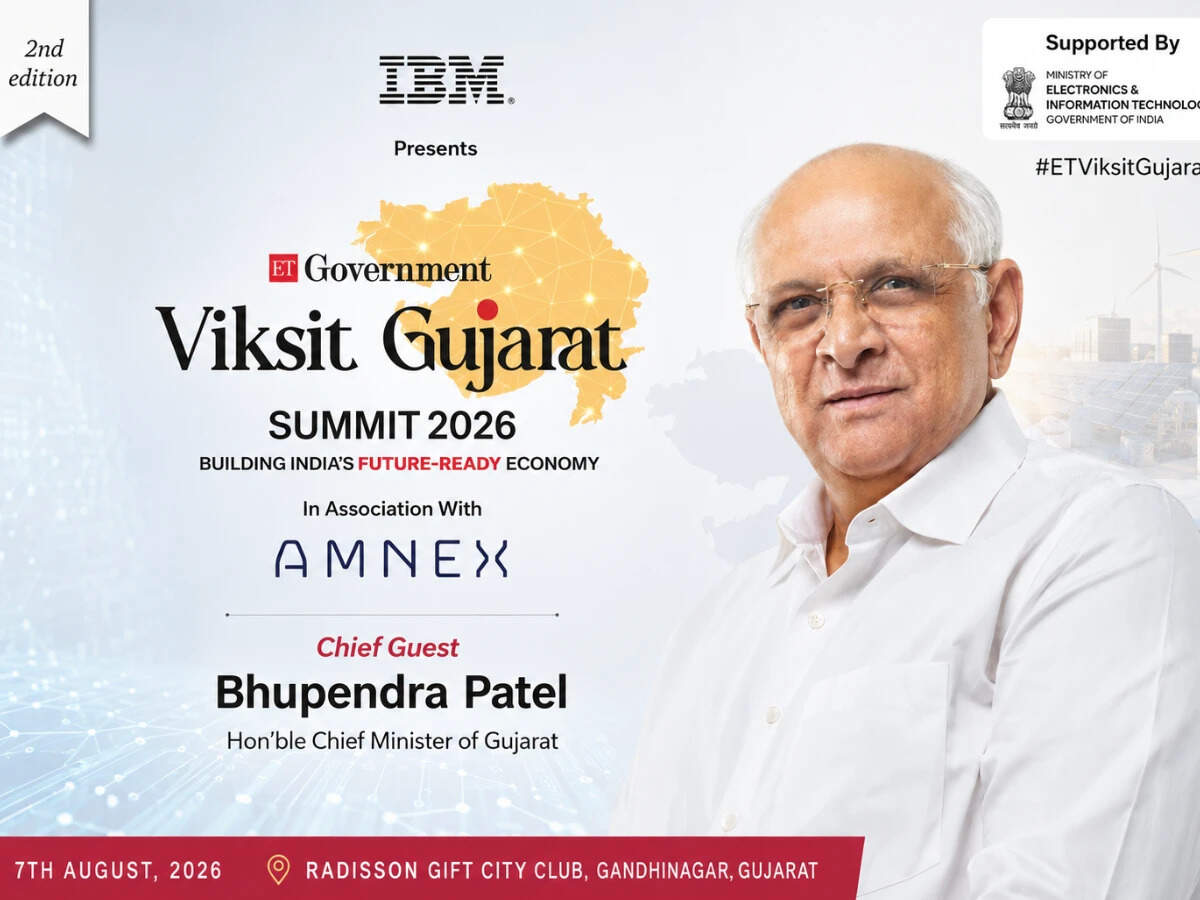
Gandhinagar, August 7: At a time when states are emerging as the principal engines of India’s economic transformation, Gujarat will today host a significant policy dialogue on governance, technology and industrial growth.
The Viksit Gujarat Summit 2026, organised by ETGovernment – The Economic Times, will bring together senior policymakers, ministers, bureaucrats, industry leaders, technology innovators, diplomats and academia to deliberate on the state’s roadmap towards becoming a globally competitive, innovation-driven economy by 2047.
The summit, to be held at the Radisson GIFT City Club in Gandhinagar, is expected to provide a comprehensive platform for discussions on the next generation of economic reforms and technological transformation that will shape Gujarat’s growth over the coming decades.
With the national vision of Viksit Bharat 2047 gathering momentum, Gujarat is widely regarded as one of the country’s foremost laboratories for policy innovation, industrial development and digital governance. The deliberations at today’s summit are therefore expected to have relevance not only for Gujarat but also for policymakers across India.
The event will be inaugurated by Gujarat Chief Minister Bhupendra Patel, who will deliver the Chief Guest address during the inaugural session. The opening session will also feature addresses by Deputy Chief Minister Harsh Sanghavi, Energy and Petrochemicals Minister Rushikesh Patel, Forests, Environment, Climate Change, Science and Technology Minister Arjunbhai Modhwadia, and Chief Secretary Manoj Kumar Das.
The presence of the state’s political and administrative leadership underscores the importance being attached to the summit as Gujarat accelerates its efforts to position itself at the forefront of India’s economic transformation. Representatives from the diplomatic community, including the Ambassador of Denmark to India, will also participate in the inaugural session, reflecting Gujarat’s growing engagement with international partners in areas such as sustainability, clean energy and advanced technologies.
The theme of the inaugural session—”Architecting India’s Tomorrow: Gujarat’s Blueprint for 2047″—captures the central objective of the summit: examining how the state can leverage technology, infrastructure, manufacturing excellence and governance reforms to sustain high economic growth while creating opportunities for innovation, entrepreneurship and employment.
Over the course of the day, policymakers and experts will deliberate on a wide spectrum of issues that are expected to define the next phase of Gujarat’s development. Discussions will examine the state’s ambitions in semiconductor manufacturing and advanced industries, the deployment of artificial intelligence across government departments, cybersecurity in an increasingly digital economy, digital twins for infrastructure planning, smart governance, logistics, mobility, clean energy, urban transformation and industrial competitiveness.
One of the major themes likely to dominate the conversations is the growing role of artificial intelligence in governance. Governments across India are increasingly moving beyond pilot projects towards large-scale deployment of AI for citizen services, decision support and public administration.
The summit will explore how Gujarat can leverage AI not merely as a technological tool but as a governance enabler capable of improving efficiency, transparency and service delivery. Discussions are also expected to focus on the digital infrastructure required to support AI adoption, including data platforms, cybersecurity frameworks and skilled human resources.
Another major focus area will be Gujarat’s aspiration to become a leading destination for semiconductor manufacturing and other advanced technology industries. With India investing heavily in developing a domestic semiconductor ecosystem, Gujarat has emerged as one of the preferred destinations for large-scale investments because of its industrial ecosystem, infrastructure and policy support.
The summit will assess how the state can build on this momentum to strengthen its position in electronics manufacturing, precision engineering and high-value industrial production.
The discussions will also examine the evolution of Gujarat’s industrial economy beyond conventional manufacturing. Experts will explore how emerging technologies—including AI, automation, digital twins and Industry 4.0 solutions—are redefining manufacturing competitiveness and enabling industries to improve productivity while reducing operational costs. These conversations are expected to resonate strongly with both policymakers and industry leaders as India seeks to strengthen its position in global supply chains.
Cybersecurity will constitute another critical pillar of the summit. As governments digitise public services and industries become increasingly interconnected, protecting digital infrastructure has become a strategic necessity. Senior technology experts from government and industry will discuss the challenges associated with securing digital ecosystems while maintaining the pace of innovation and digital transformation.
The summit will also devote considerable attention to infrastructure development and urbanisation. Sessions on smart cities, sustainable urban planning, transportation networks and logistics are expected to examine how digital technologies can improve urban governance while supporting economic growth. Experts will discuss how integrated infrastructure planning can make cities more efficient, resilient and environmentally sustainable as Gujarat continues to urbanise rapidly.
Energy security and green industrial growth will form another important pillar of the day’s deliberations. As India pursues ambitious renewable energy targets while expanding manufacturing capacity, Gujarat is expected to play a pivotal role owing to its strong presence in renewable energy, petrochemicals and industrial infrastructure. The summit will explore strategies for balancing industrial expansion with sustainability objectives and energy resilience.
Several senior officers from the Government of Gujarat, the Government of India, public sector organisations, regulatory bodies, international institutions and leading technology companies will participate in the discussions. Their participation is expected to enrich the dialogue by bringing together diverse perspectives from policy, administration, industry and academia on the opportunities and challenges associated with building a future-ready economy.
The summit comes at an important moment for Gujarat. The state continues to attract major investments across manufacturing, electronics, renewable energy, digital infrastructure and emerging technologies while strengthening its reputation as one of India’s most business-friendly destinations. With flagship initiatives such as GIFT City, semiconductor investments, digital governance reforms and smart infrastructure projects gathering momentum, Gujarat is seeking to consolidate its position as a global investment and innovation hub.
Beyond individual policy announcements, the Viksit Gujarat Summit seeks to encourage dialogue between government, industry and technology leaders on the structural changes required to achieve the vision of Viksit Bharat 2047. As India’s economy becomes increasingly technology-driven and globally integrated, the conversations taking place in Gandhinagar today are expected to offer valuable insights into how one of the country’s most economically dynamic states intends to navigate the next two decades of growth.
For policymakers, investors, entrepreneurs and technology leaders, the summit represents more than a conference. It offers an opportunity to understand the evolving priorities of one of India’s leading economic powerhouses and to explore partnerships that can contribute to the state’s long-term development agenda. As the deliberations begin this morning, Gujarat will once again seek to demonstrate how policy innovation, technological adoption and collaborative governance can together shape the blueprint for India’s future-ready economy.