

Cube and Dice Reasoning is an important topic in the Reasoning Ability section of various competitive exams. Questions based on cubes and dice test a candidate’s spatial understanding, observation skills, and ability to identify the position of faces, opposite sides, and different cube formations. In this blog, we have covered important Cube and Dice Tricks and Questions, basic concepts, common question types, shortcuts, and useful solving methods for SSC, Railways, Banking, and other competitive exams.
Download Cube and Dice Tricks and Questions PDF
Cube and Dice Questions are commonly asked in the Reasoning Ability section of competitive exams such as SSC, Railways, Banking, and other government examinations. These questions may involve identifying opposite or adjacent faces of a dice, counting cubes, analysing painted cubes, or determining the position of different faces after rotation. Practising such questions regularly can help candidates develop better visualization skills, understand cube and dice patterns quickly, and improve both speed and accuracy in the exam. Candidates can practise the Cube and Dice questions given below and download the PDF for offline preparation.
Practice Cube and Dice Questions Live
Cube and Dice Reasoning questions generally assess how well a candidate can visualise three-dimensional objects and understand the relationship between their different faces. Questions may be based on standard dice, open and folded dice, opposite faces, adjacent faces, cube nets, painted cubes, or counting smaller cubes formed after cutting a larger cube. Below are some Cube and Dice Questions for live practice.
1. Find the missing number. The same rule is followed in each row.
14 12 38
2 7 16
2 12 ?
2. Find the missing number. The same rule is followed in each row.
2 10 22
4 10 24
5 13 ?
3. Find the missing number. The same rule is followed in each row.
4 12 28
12 13 38
4 4 ?
4. Find the missing number. The same rule is followed in each row.
4 10 24
11 9 29
9 3 ?
5. Find the missing number. The same rule is followed in each row.
12 6 30
14 9 37
9 3 ?
6. Find the missing number. The same rule is followed in each row.
3 11 17
6 3 15
2 5 ?
7. Find the missing number. The same rule is followed in each row.
13 3 29
3 3 9
10 13 ?
8. Find the missing number. The same rule is followed in each row.
3 6 12
4 3 11
2 11 ?
9. Find the missing number. The same rule is followed in each row.
4 3 12
2 10 20
10 8 ?
10. Find the missing number. The same rule is followed in each row.
11 5 55
9 8 72
5 7 ?
11. Find the missing number. The same rule is followed in each row.
9 6 54
10 4 40
4 9 ?
12. Find the missing number. The same rule is followed in each row.
7 7 49
8 4 32
4 12 ?
13. Find the missing number. The same rule is followed in each row.
10 10 101
7 9 64
11 6 ?
14. Find the missing number. The same rule is followed in each row.
2 4 9
9 8 73
8 7 ?
15. Find the missing number. The same rule is followed in each row.
11 2 23
10 5 51
10 8 ?
Quiz Summary
Final Score: 0.0

Sign Up

Login
Forgot Password
Please enter the Email ID we will send you a Email with the link to reset the password.

Dice – Basic Concepts
Die is a small, throwable object with marked sides that can rest in multiple positions. Dice is a cube. It has a different number placed on each side.
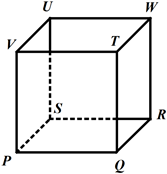
1. Basic properties
- There are six faces, eight vertices, and twelve edges in a cube.
- Four faces are adjacent to one face.
- There are three pairs of opposite faces.
- Only three sides of a cube are visible at a time and these sides can never be on the opposite sides of each other.
2. Open Dice
The following diagram is of an open dice when it is flattened out.
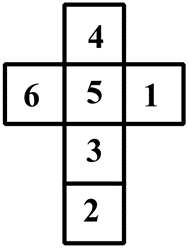
- 2 is the top face of the cube.
- 5 is the bottom face of the cube.
- 4, 6, 1, and 3 are the side faces of the cube.
- Faces 6 and 1 are always opposite to each other.
- Faces 4 and 2; 5 and 2 do not have a common side since these faces are opposite to each other.
3 Observation of an Open Dice
Variations of an open die are as follows :
A)
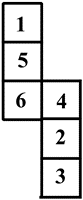
Faces 1 and 6, faces 4 and 3, faces 5 and 2 are opposite to each other.
B)
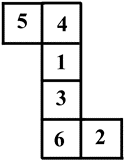
Faces 1 and 6, faces 4 and 3, faces 5 and 2 are opposite to each other.
C)
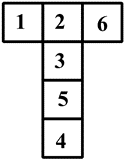
Faces 1 and 6, faces 4 and 3, faces 5 and 2 are opposite to each other.
Cube and Dice Tricks
To master various Cube and Dice Tricks, one should learn the two basic rules of cubes and dice. Most of the questions asked can be addressed by using these rules.
1. Rule 1
If two dice are given in different orientations but one face is common. Then the remaining surfaces are opposite to each other.
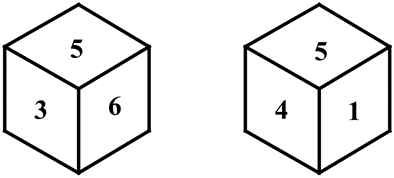
- Here, face 5 is the common face.
- Faces 3, 6, 4, and 1 are adjacent to the face 2. Hence, face 2 is opposite to face 5 here.
- Faces 3 and 4 and faces 6 and 1 are opposite to each other.
2. Rule 2
If two dice are given in different orientations but two faces are common. If out of those two common faces one face is in the same position, then the faces which are not common are opposite to each other.
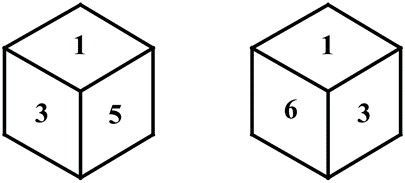
- Here, faces 1 and 3 are common faces.
- Face 1 is at the same position.
- Face 5 and 6 are not common.
- Hence, faces 5 and 6 are opposite to each other.

Hello, I’m Aditi, the creative mind behind the words at Oliveboard. As a content writer specializing in state-level exams, my mission is to unravel the complexities of exam information, ensuring aspiring candidates find clarity and confidence. Having walked the path of an aspirant myself, I bring a unique perspective to my work, crafting accessible content on Exam Notifications, Admit Cards, and Results.
At Oliveboard, I play a crucial role in empowering candidates throughout their exam journey. My dedication lies in making the seemingly daunting process not only understandable but also rewarding. Join me as I break down barriers in exam preparation, providing timely insights and valuable resources. Let’s navigate the path to success together, one well-informed step at a time.
