India and Armenia are moving towards a substantially deeper defence relationship, with discussions expanding from the supply of artillery, rocket systems, radars and air-defence weapons to possible joint development, industrial collaboration and new-generation missile systems.
Defence Secretary Rajesh Kumar Singh’s two-day visit to Armenia, beginning August 16, is the latest indication that what started as a relatively modest arms relationship is evolving into a structured strategic and military partnership.
Singh’s visit comes at a particularly important stage. Armenia has emerged as one of the largest overseas customers for Indian-made weapon systems, while New Delhi is seeking to transform itself from a major arms importer into an increasingly consequential exporter of complete defence platforms.
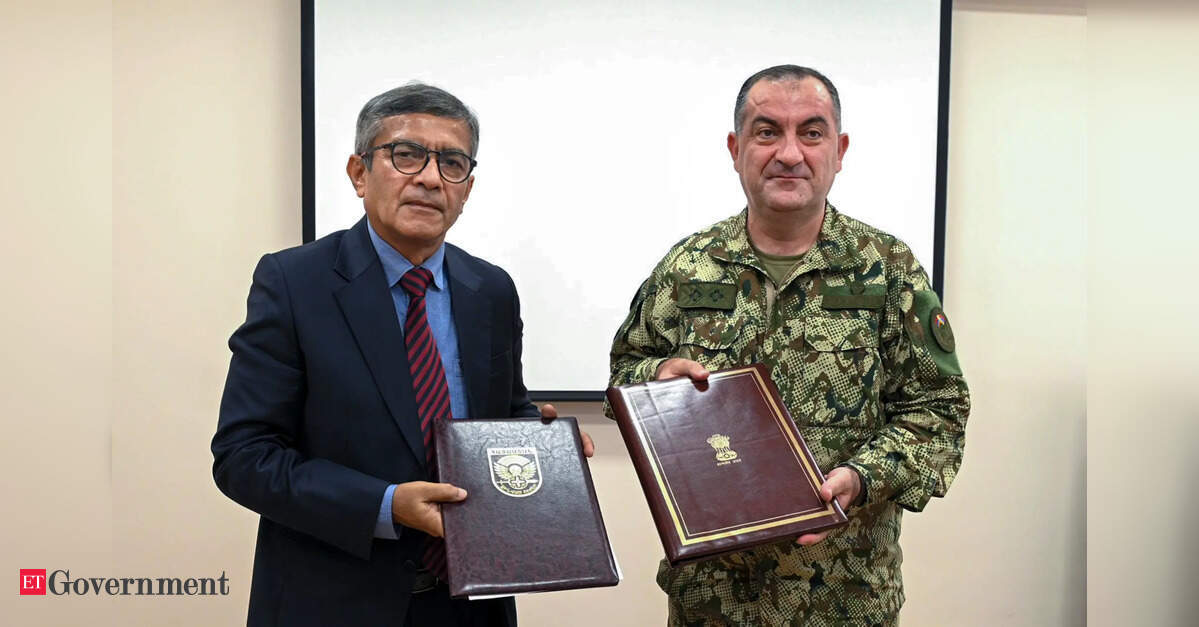
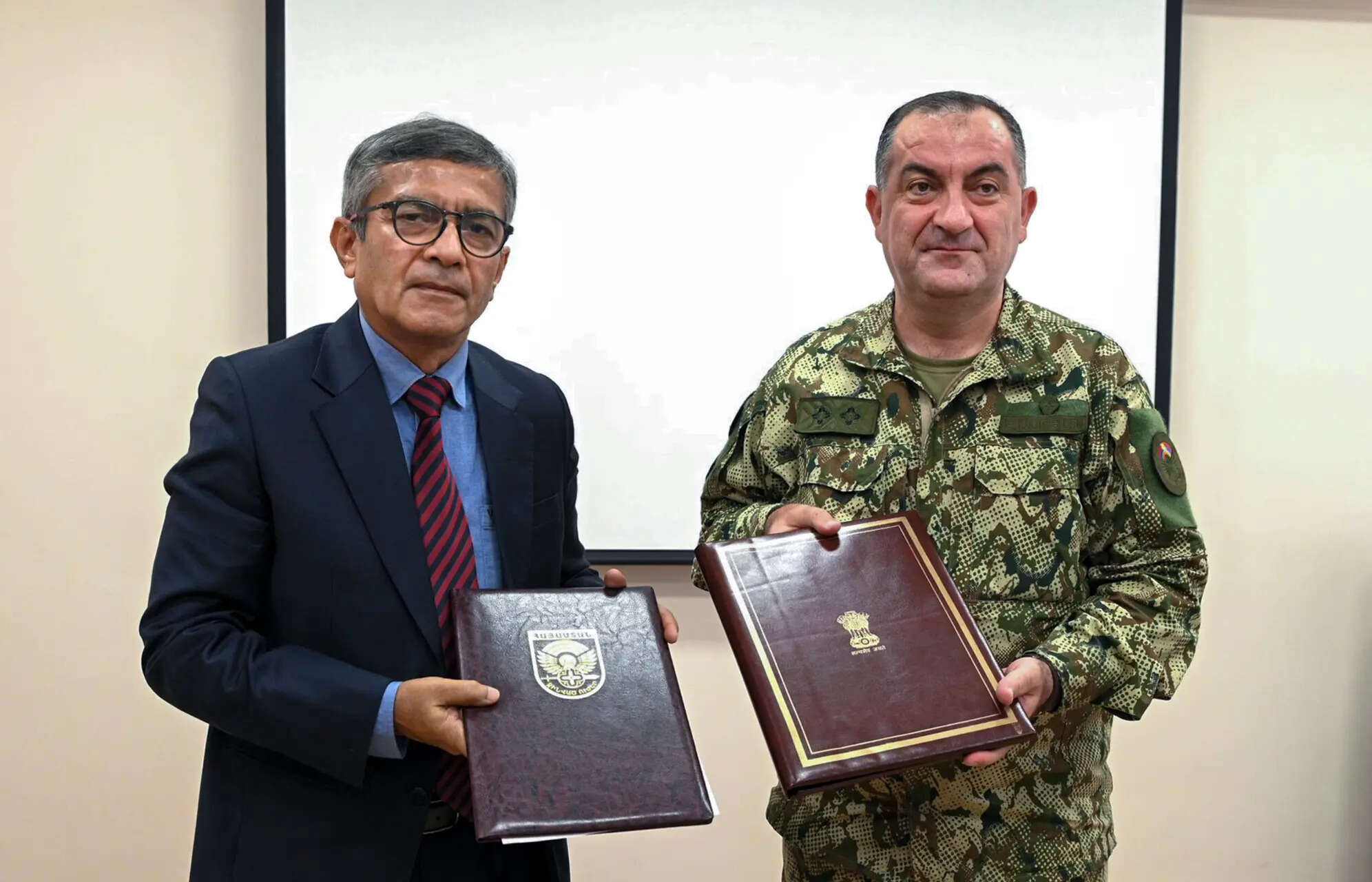
During the visit, Singh met Armenian Defence Minister Suren Papikyan, with discussions covering bilateral defence cooperation and, significantly, military-technical cooperation. Armenian official reporting on the meeting confirmed that these areas figured prominently in the talks.
The discussions are also expected to examine new areas of cooperation and follow up on conversations held during the visit of Armenia’s First Deputy Defence Minister and Chief of the General Staff, Lieutenant General Edvard Asryan, to India in April. During that visit, Asryan met Singh, Chief of Defence Staff General Anil Chauhan and Air Chief Marshal A.P. Singh.
The Armenian Ministry of Defence said the two countries reviewed implementation of their bilateral cooperation plan and reached agreements on deepening cooperation in several professional areas.
The more consequential dimension is the possibility of taking the relationship beyond conventional procurement. During Asryan’s April visit, the two sides explored avenues for joint ventures in the development of military hardware. Reports at the time also indicated that Armenia was considering local production or integration of selected Indian-origin systems.
Advanced cost negotiations were reportedly under way for the possible acquisition of India’s Pralay tactical surface-to-surface missile, while Armenia was also understood to be examining the Astra Mk-1 beyond-visual-range air-to-air missile and possible upgrades associated with its Su-30SM fighter fleet. No final agreement on these systems has been officially announced, and the negotiations should therefore be viewed as prospective rather than concluded deals.
A Pralay agreement, if eventually concluded, would be particularly significant. It would take India-Armenia defence commerce beyond artillery, battlefield surveillance and air defence into the domain of precision tactical strike weapons.
Such an export would necessarily have to comply with India’s export-control regime and its international commitments, including those associated with the Missile Technology Control Regime. It would nevertheless represent an important technological and commercial milestone for India’s defence industry.
The foundation for the present relationship was laid well before the latest round of high-level engagement. One of the earliest major breakthroughs came with Armenia’s approximately $40 million purchase of four Indian Swathi weapon-locating radars. Developed by DRDO and manufactured by Bharat Electronics Limited, the system is designed to detect hostile artillery, mortar and rocket fire and determine their launch positions. The acquisition demonstrated that an Indian-developed battlefield system could compete successfully in a foreign market.
The relationship accelerated sharply after 2022. Armenia subsequently contracted for a much broader portfolio of Indian systems, including Pinaka multi-barrel rocket launchers, anti-tank weapons, ammunition and artillery. MP-IDSA notes that contracts since 2022 have covered systems including the 214-mm Pinaka, Konkurs anti-tank missiles, mortars, ammunition, artillery systems, anti-drone equipment and Akash air-defence systems.
Artillery has become another important pillar. Armenia received the first six Advanced Towed Artillery Gun Systems supplied by Bharat Forge in 2023. The ATAGS is a 155mm/52-calibre system developed through collaboration between DRDO and Indian industry.
Its export is significant not merely because of the contract value but because artillery is one of the sectors in which India has spent decades attempting to develop a strong indigenous technological and manufacturing base. Armenia’s willingness to deploy Indian-origin artillery therefore provides both an export reference and operational credibility for India’s defence industry.
Air defence represents an even more strategically important dimension. Armenia became the first overseas customer for the Akash family of surface-to-air missile systems. It is estimated that that Armenian contracts for Indian defence equipment between 2020 and 2024 reached approximately $2 billion and notes that Armenia placed an order for 15 Akash systems valued at about $720 million. Deliveries subsequently began, strengthening Armenia’s ability to counter aircraft, missiles and unmanned aerial threats.
The defence relationship is increasingly being institutionalised rather than remaining dependent on individual arms contracts. The first formal defence consultations between the two ministries were held in Yerevan in May 2024. They covered military-technical cooperation, military education, personnel training and exchange of experience. The consultations produced a cooperation plan for 2024-25 and established a joint working group on bilateral defence cooperation.
That mechanism has since expanded. Defence consultations held in Hyderabad in October 2025 reviewed implementation of the annual programme and produced a 2026 Cooperation Programme covering high-level and expert visits, military education, military-technical cooperation, combat training, exercises and exchanges of experience. The diplomatic-military infrastructure has also strengthened: Armenia appointed a defence attaché in New Delhi in 2023, while India decided in 2024 to appoint its first military attaché to Armenia.
At the political level, Defence Minister Rajnath Singh and Armenian Defence Minister Suren Papikyan met during Aero India in February 2025. The Ministry of Defence said the two ministers acknowledged the growing importance of bilateral defence ties and discussed greater training cooperation as well as possible joint ventures between defence industries. Armenia’s participation as an observer in the Joint India-Central Asia Army exercise was also agreed upon as part of efforts to improve interoperability.
The strategic logic behind Yerevan’s turn towards New Delhi is equally important. Armenia has traditionally relied heavily on Russian military equipment, but the changing security environment in the South Caucasus and Moscow’s preoccupation with the Ukraine conflict encouraged Yerevan to diversify its sources of weapons.
Indian systems offered an important advantage: much of India’s defence architecture itself evolved around Soviet and Russian-origin platforms, making several Indian systems comparatively easier to integrate into an Armenian military that has historically operated Russian equipment. This compatibility is one of the factors facilitating the rapidly expanding partnership.
For India, Armenia offers something equally valuable: a demanding overseas customer willing to procure complete Indian combat systems rather than merely components and subassemblies. This distinction matters for New Delhi’s ambition to establish India as a significant global defence manufacturing and exporting power. Successful overseas deployment of Pinaka, Akash, ATAGS, Swathi and other systems provides Indian manufacturers with reference customers that can strengthen their position when competing for contracts elsewhere.
Rajesh Kumar Singh’s Yerevan visit therefore represents more than another round of defence diplomacy. The relationship has already travelled from radar exports to artillery, rocket systems, air defence and anti-drone capabilities; the next phase could involve precision missiles, joint ventures, local integration, training and co-development.
The April 2026 discussions on military hardware development and the continuing negotiations over additional systems suggest that both sides are considering a transition from a buyer-seller relationship towards a longer-term defence-industrial partnership.
For Armenia, India provides an additional source of modern weapons at a time when diversification has become central to its military modernisation. For India, Armenia has become a strategically important proving ground for its emergence as an exporter of sophisticated indigenous defence platforms.
If the negotiations now under way translate into new contracts and industrial partnerships, the India-Armenia defence relationship could become one of the clearest demonstrations of how India’s expanding indigenous defence capabilities are beginning to acquire both commercial and geopolitical significance beyond South Asia.