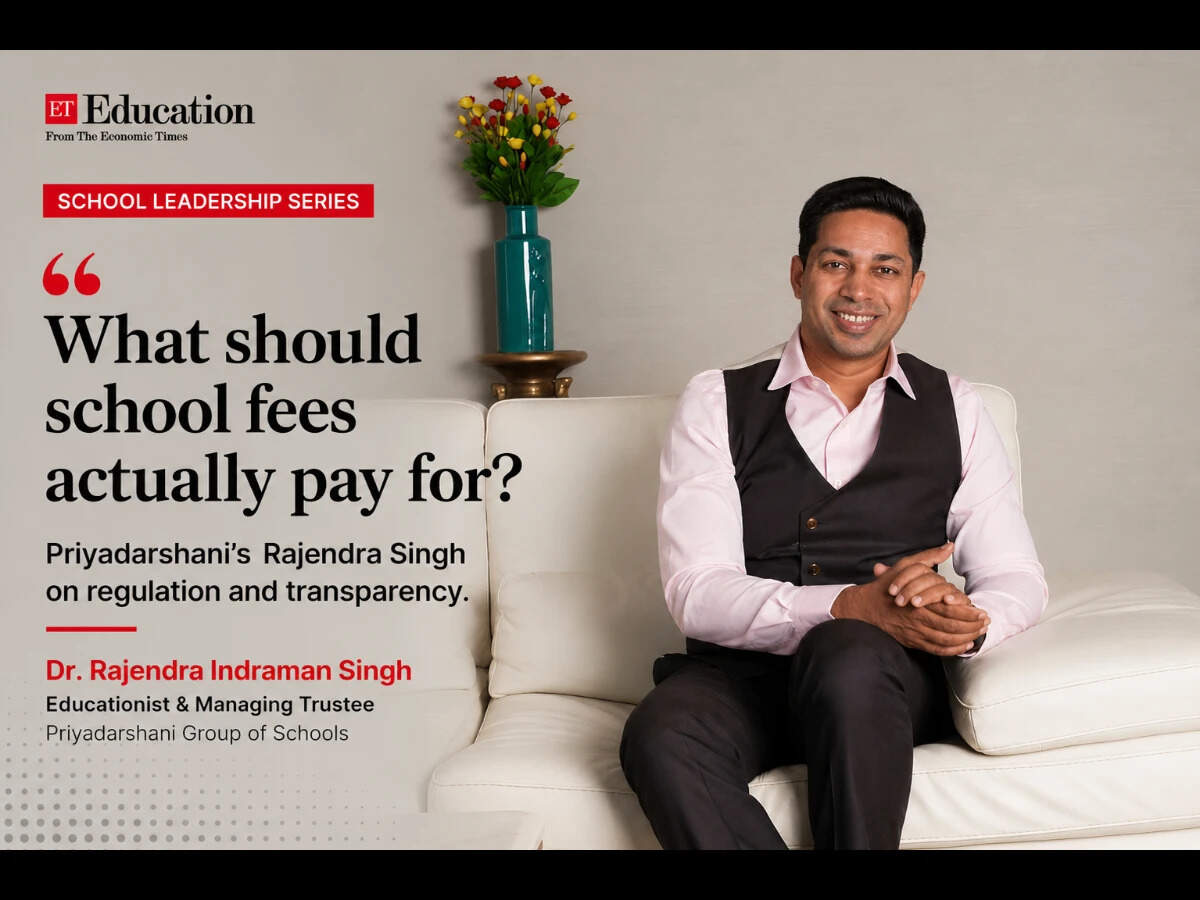
The debate over school fees is often reduced to one question: how much should a school be allowed to charge? But Dr Rajendra Singh believes the issue is more complex. For him, fee regulation also needs to examine what schools provide for the fees they charge, how parents can assess that value, who is entering school education and whether new schools are being established where they are actually needed.
Singh, Managing Trustee of Priyadarshani Group of Schools, has spent decades in school education and currently leads a school group with more than 17,000 students. He argues that parents have a choice when selecting a school and that different school ecosystems will naturally come at different costs. At the same time, schools need to be able to justify their fees and parents should ask what they are getting in return.
The discussion becomes more pointed when Singh addresses the commercialisation of schooling. He argues that there should be greater scrutiny of those entering the school sector, while governments should use population density and existing school capacity to determine where new schools are needed.
In a wide-ranging conversation with ETEducation, Singh also discusses changing parenting patterns, the loss of childhood, artificial intelligence and the need to strengthen what he calls “human intelligence”, the fundamentals of reading, writing and mathematics, the changing role of teachers, curriculum overload and why students need greater ownership of their learning.
Q: You have worked closely with independent and budget schools. How difficult is it today to balance affordable fees with rising costs of teachers, technology, infrastructure and compliance? What does the current fee-regulation debate get wrong?
Dr Rajendra Singh: Fees are always an equivalent component of what is the expense of a budget school or any other school. Fees have two aspects to look at. I will quickly mention one aspect. Fee finally has to define what kind of ecosystem a school is made of.
Like you go into a three-star hotel, you know what you want to pay. You go into a five-star hotel, you know what you want to pay. What kind of ecosystem you want is a parent’s choice.
It is absolutely a parent’s choice. I can choose a Marathi school, a ZP school, a budget school or a school charging Rs 1 lakh. It is the parent’s choice.
But when it comes to the argument around fees, I think there has to be a limit. There has to be a line drawn at an ethical level by both schools and parents about how much schools can charge and whether they can justify that charge.
Q: So, when you say parents should verify whether the fee is justified, how can they actually do that? Should they look at the school’s website or other sources?
Dr Rajendra Singh: According to the fee regulation act in Maharashtra, and other such states also have their fee regulation acts, the information is readily available. You can Google it and read it.
Parents can ask the school: How much is the percentage of increase? Is it every alternate year? What is the basis for this percentage? All these basic questions have to be asked. They should ask how much the fee will be raised.
Secondly, if the fee, for example, is Rs 1 lakh, what are you providing in that Rs 1 lakh?
The first thing is the student ratio, the fundamental facilities, and then add-on facilities like sports and laboratories. Parents should get a generic idea of what the school is providing. Today, parents visit four or five schools before they finalise one. That comparison needs to be there.
Q: In some cases, schools may keep the fee structure unchanged but add other costs. How do you view this, and do current fee regulations address such charges?
Dr Rajendra Singh: Yes. Let’s address the elephant in the room.
Some schools are moving towards profit-making. Let’s address it directly instead of turning away from it. As school leaders, particularly those who have seen four decades of education, we have seen that there is some profit-making in the school sector.
I think the government and people should move together. If you want to start a hospital or you want to become a doctor, there is a basic test. You have to go through basic formalities to become a doctor.
But when you want to start a school, which is a fundamental constitutional right of the people of India, there is no such kind of screening. So people who have a vested interest might get into this sector from the point of view of business. That is point number one.
Q: So what kind of screening or regulation do you think is needed?
Dr Rajendra Singh: There has to be screening. Number two, if the government knows the population density of an area and the number of schools there, then if somebody wants to start a school, the government should be able to define where schools are required.
If an area has a certain population and a certain number of schools, and somebody wants to start another school, the government should say: this is where a school is required. If you want to start a school and work for the people, this is the area we will offer you.
If you see Delhi NCR, schools are coming up in populated areas where there are already more schools. So why are schools coming into those areas? What is the intention behind them?
There has to be responsibility on the government.
One is screening who is starting the school and understanding their background in education. Second, new schools should be allocated on the basis of population density and where they are actually required. There should also be a budget cap.
I know Noida will have a different budget cap and Gurgaon will have a different budget cap. According to that, schools should be allocated and placed where they are required.
Then this problem can be controlled.
Q: In some parts of NCR, there are already 10 schools within two kilometres, making admissions increasingly difficult. Do we need better regulation on where new schools can open?
Dr Rajendra Singh: If there are 10 schools, that means 10 schools are there. The population of schools will increase because the interest and intention must be business rather than education. Otherwise, you will open a school where schools are needed.
If you think of the country first, if you think of society first, and take responsibility as a school leader and as an educationist, you will go where you are needed.
Who will do admissions? The government does, right? And the government already has the data.
So that can be a rectified problem. Then only people who are really willing to build society, develop the country and have the intention of education and integrity in education will come forward.
Q: You started with just five students and now lead a group serving more than 17,000 students. Over these decades, what has changed most in the expectations of parents and students?
Dr Rajendra Singh: I think primarily competition has changed. There is much larger competition in schooling and in school education, and then there is competition all over for getting into college. In parenting, I feel parenting has become more predictive. I am not using the word aware parenting. Aware parenting is also there, but it has also become very protective.
I believe the success model of every person comes from the struggle they have in their own life. I am sure you must also have struggled in your life. That struggle is what makes you what you are and defines you as a person.
But in today’s era, parents try to avoid giving that struggle to students. When something actually comes up, students may or may not be able to handle it. There is very protective and caring parenting, with too much awareness and more focus on what the child will do and how it will end.
Somewhere, I feel childhood is getting lost.
Q: What does that mean for parents and schools?
Dr Rajendra Singh: Parenting needs a major change. Earlier, we used to go out and play, and when we came back, the body, mind and emotions were all fatigued and functional. That is not happening now.
The parenting role has to change. Parents need to see that the child goes out and plays. It could be a protected play area, or sometimes a semi-protected environment which is a little more challenging.
Earlier, we had natural ways of challenging ourselves. Even something as simple as going to school was a bit of a challenge. To achieve goals in life, you need consistency of action. So having a routine is absolutely fine. You need consistency of action whether you are exercising, preparing yourself or studying.
But apart from that, the routine should have something else. There is something I don’t remember right now, but there is a saying that a life without play makes a person very serious in life.
In today’s era, of course, the gadgets we have are unavoidable and they have taken a toll on students’ lives. They have given them exposure, and because of that we have to accept the fact that going out and everything has changed.
Q: AI is now becoming unavoidable in education. How should schools approach it?
Dr Rajendra Singh: The use of artificial intelligence is an unavoidable phenomenon. You can’t stop it. So we can’t fight against it.
Rather, what we should do is focus on how we increase HI, human intelligence. If human intelligence is higher and more responsible, human intelligence will always be at the top. But if human intelligence is not developed at the childhood level, at the school level, then we may have difficulty in the future.
Q: AI is changing classrooms and the future of work. What should schools teach children about AI beyond simply using AI tools? And what aspect of education should remain distinctly human?
Dr Rajendra Singh: As a school, and having been a teacher for a long time, I will go back to the fundamental background. When you type anything or when you write something, where does your brain work faster?
Writing. There is no computer. A lot of people use faster devices for writing. If their brain is working faster, maybe it is a pencil or something else. The brain is connected to your hands.
If you see all around us, writing skills are going down. So we cannot forget the fundamentals of reading, writing and mathematics. That is the foundation of the Indian education system and it has to be focused on. In the era of AI, you can’t just pass on information. The teacher’s job earlier was to pass on information. Now information is free and you have better information, and you can see it multiple times.
So what the teacher has to do is create life-value lessons connected to life-value skills and work at an emotional and mental level to make a stronger, independent and curious human being. The teacher’s job in the AI era has upgraded, not downgraded.
Q: You have emphasised financial literacy, problem-solving, communication and life skills alongside academics. Which skills do you believe Indian schools are still failing to develop adequately?
Dr Rajendra Singh: I think Indian schools are failing to transfer the ownership of learning to the student. Our schools are built around instruction models, not all of them, but most of them. I tell you, you listen and you follow. Our generation has become a following generation. We follow. We do not ask the right questions.
Schooling earlier was simplified into this: Class 10 was to go to Class 11. Class 11 was to get a good college. College was to get a better job. The job was to get a better house and so on and so forth. Education was not made for survival. Education was not made to be curious, to ask the right questions, to be a problem-solver or to have a critical-thinking mind.
It was made to achieve the next class. That is the change we need to bring today in the schooling education pattern. We need to transfer ownership to the students so that they ask questions, come forward and become problem-solvers.
Q: You started your career as a teacher in the 1990s. How has the teaching profession changed or evolved, and what needs to be done to attract, retain and develop high-quality teachers?
Dr Rajendra Singh: I think the teaching profession is the most revolutionised and galvanised profession today. It has changed because teachers have to upgrade themselves to such a level to meet the standards of students right now, because students are brilliant. They are amazing. They are brilliant. They know what they want.
They know how to speak. They know how to ask questions. So the teaching profession has evolved from being more theatrical to becoming more individualistic.
Earlier, teachers were theatrical. They were instructing 40, 50 or however many students together. There was a theatrical appearance to teaching. Now it is becoming individualised and personalised. That is a major shift in teaching.
Q: There is also increasing discussion around open schooling, which has existed in the US and other Western countries for some time. Do you think homeschooling or open schooling will become more significant in India in this decade?
Dr Rajendra Singh: Somehow, as a school, with homeschooling or open schooling, there is an important reason behind my disagreement. A school gives you an ecosystem where education is not only happening in the classroom. It is happening with your peers, with obstacles and with socialising skills.
There is a whole ecosystem your child is part of from the point of leaving home and coming back home.
Whereas when it comes to homeschooling, it is more materialistic in terms of the subjects being taught or the value being provided. The exposure in a school is much grander and wider than in homeschooling and open schooling.
Q: Schools are adding STEM, robotics, coding, AI, sports and life skills, while parents continue to expect strong academic results. How can schools prepare children for the future without simply adding more to an already crowded curriculum?
Dr Rajendra Singh: At Priyadarshani, what we believe is less is more. A good teacher can take a purse from the ground and build a whole teaching experience around it, including the ecosystem and how the purse or the object came to be on the ground.
Always focus on good teaching and fundamental teaching lessons. Of course, some of the newest skills are needed in schooling education today.
But this whole gimmick of having so many labs raises one question: are schools doing justice to students?
Why 20 minutes here, 30 minutes there and 50 minutes somewhere else? The child can become confused. While adding so many things, we should not forget the core philosophy of education, which is to create a responsible, curious and strong human being.
Sometimes, when so many things are added, we forget the core reason why education needs to be there.
Q: You have also been associated with ESA and NISA. What are the biggest policy challenges facing independent and budget private schools in Maharashtra right now, and what reforms would make the biggest difference?
Dr Rajendra Singh: NISA, the National Independent Schools Alliance, is trying to bridge the gap between the government and education. Forty-eight per cent, precisely, of schools in our country are private schools, out of which 78 per cent are budget schools. Less than 13 per cent are IB, IGCSE and all those kinds of schools.
The other 52 per cent are government schools, which are really not in shape. NISA is trying to bridge that gap by associating with the government and improving the overall education system in the country. Every school is a school. Every child has a right to education.
That is the gap we are trying to bridge. That is the main policy decision we want to get into.
Q: And how is NISA doing that? Are you working with the government?
Dr Rajendra Singh: If you go to the NISA website or the Centre for Civil Society, we have done a lot of research which is free and open. Through this research, we are showing the objectives of education and the end goals. We have done a systematic analysis of what government schools are doing, what they should be doing and how to bridge the gap to bring an equivalent educational level across the country.
Through this research, we recommend policies. We only recommend policies which can bring a better educational system into our country.
Q: Looking ahead to 2035-40, what will distinguish schools that remain relevant from those that struggle? And if you could change three things in Indian school education today, what would they be?
Dr Rajendra Singh: When it comes to schooling, I think schools in the future will be mainly student-governed. The student is the end point of the schooling system, where he will be at the top of the schooling system and schools will be mainly student-governed.
Students will participate not only in learning and ownership of learning, but also in how they can learn better. That is what I foresee because of this brilliant generation which is coming ahead. As for the second question, we don’t believe in asking what we would do. We are already doing it.
Our schools have started a student-governed system. We have four student bodies.
The events are now done by the students. For the last 18 years, the chief guest for our flag-hoisting on Republic Day and Independence Day has been selected from among the students. They have to put themselves forward and explain why they can be the chief guest and what their success story is.
We are already moving towards that. To find a leader, the responsibility of doing good things or being a leader is not someone else’s. It is yours.
Gradually, we are changing the ecosystem of schools where students are stakeholders and decision-makers. These are the small steps we are taking towards changing education in the future.