India and Japan are seeking to recast their economic partnership around a new set of strategic priorities—semiconductors, artificial intelligence, advanced manufacturing and long-term institutional capital—as the two countries look beyond their traditional infrastructure-led relationship towards deeper integration in technology and global value chains.
Commerce and Industry Minister Piyush Goyal’s engagements in Tokyo on August 25 indicate that New Delhi and Tokyo are increasingly viewing economic cooperation through the prism of economic security.
At an India-Japan industry roundtable on semiconductors and artificial intelligence, Goyal made a pitch for combining Japanese technology, engineering and manufacturing capabilities with India’s expanding market, engineering talent and policy-backed push to develop domestic technology ecosystems.
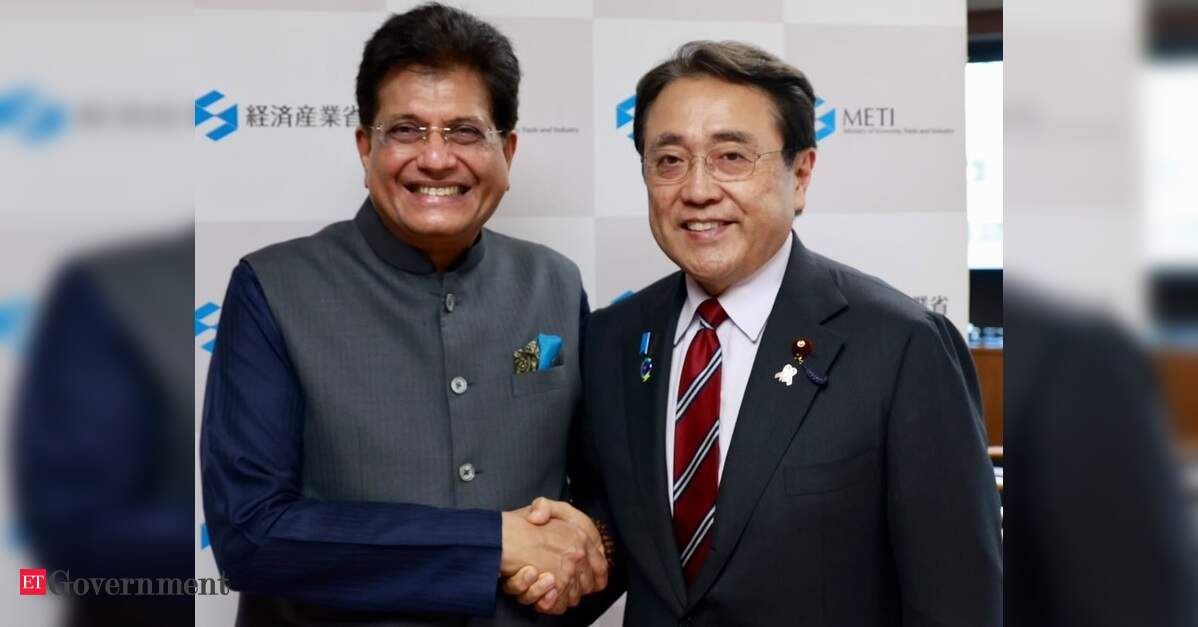
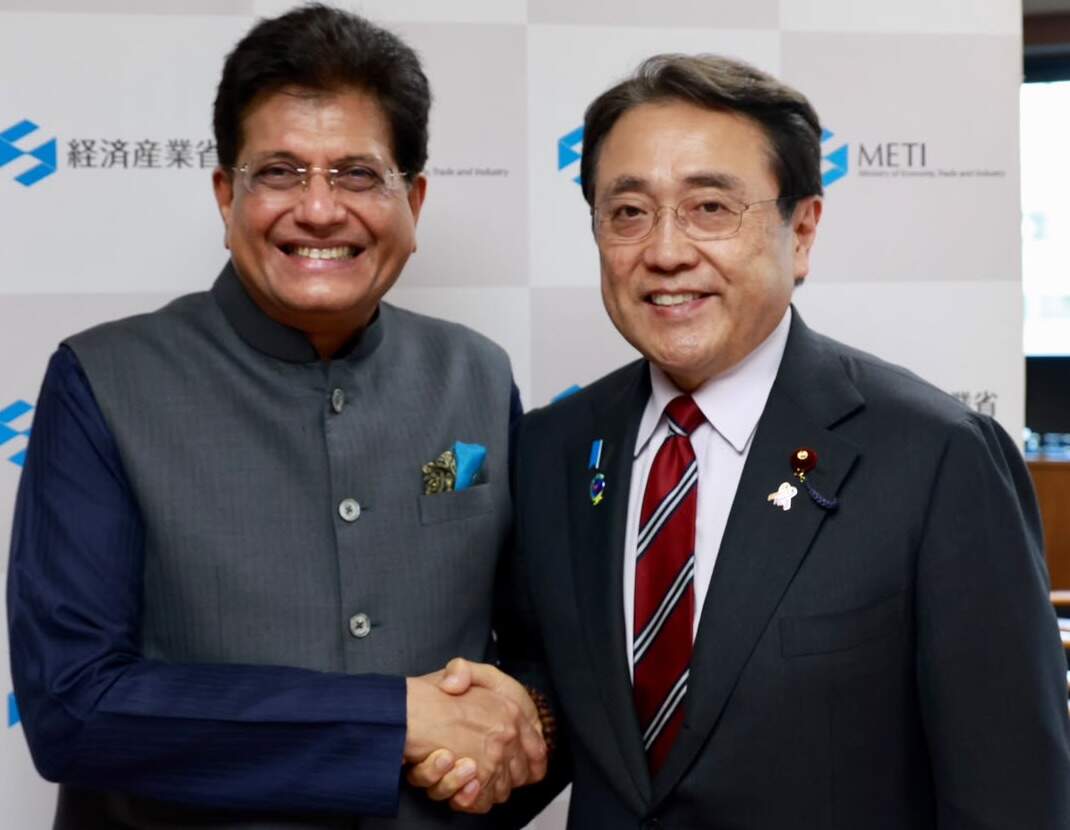
In a separate interaction with major Japanese financial and investment institutions, the minister sought greater flows of long-term Japanese capital into India. He also held bilateral talks with Japan’s Minister of Economy, Trade and Industry, Akazawa Ryosei, during which the two sides agreed on the need to accelerate the review of the India-Japan Comprehensive Economic Partnership Agreement (CEPA).
Taken together, the meetings point towards an effort to build a more integrated India-Japan economic architecture in which trade, investment, manufacturing, technology and financial flows reinforce one another.
Semiconductors emerge as a strategic pillar
The semiconductor roundtable was particularly significant because the industry lies at the intersection of manufacturing, digitalisation and national economic security.
Goyal told Japanese industry representatives that India’s domestic semiconductor demand is projected to reach $150 billion by 2032. He highlighted the government’s strategy spanning chip design, semiconductor machinery and materials, fabrication, assembly, testing, marking and packaging (ATMP), outsourced semiconductor assembly and test (OSAT), research and development, and talent.
The government, according to the Commerce Ministry, has committed $10 billion under Semicon India 1.0 and another $15 billion under Semicon India 2.0.
The scale of these commitments illustrates an important evolution in India’s semiconductor policy. New Delhi is no longer looking merely at attracting a handful of fabrication plants. The objective is increasingly to develop a broader ecosystem extending from design and materials to equipment, fabrication, packaging, research and skills.
This is precisely where Japan assumes considerable importance.
While the global semiconductor debate tends to focus heavily on advanced chip fabrication, Japan retains formidable capabilities in semiconductor manufacturing equipment, specialty chemicals, materials, components and precision engineering. India, meanwhile, brings a large domestic market, engineering talent, a substantial chip-design base and increasingly aggressive policy incentives.
The complementarity is potentially powerful. But converting it into an industrial ecosystem will require much more than investment announcements. Semiconductor manufacturing depends on highly reliable power and water, sophisticated logistics, specialised suppliers, trained manpower and extraordinarily demanding quality standards.
Building these capabilities simultaneously will determine whether India develops a globally competitive semiconductor cluster or remains dependent on imported machinery, materials and components even as domestic fabrication capacity expands.
The presence of companies such as Tokyo Electron, Daifuku, Tanaka Precious Metals Technologies, Fujifilm Holdings, Toray Industries, Kyocera, Fuji Electric, TOK, ROHM, NEC and MinebeaMitsumi at the roundtable is therefore noteworthy. These companies represent capabilities extending well beyond chip fabrication itself and into the industrial ecosystem that supports electronics and semiconductor production.
Japanese participants, according to the government, expressed confidence in India’s semiconductor and AI opportunities and reiterated their commitment to “Make in India, Design in India and Develop in India.”
The challenge now is to translate that expression of intent into factories, R&D centres, supplier networks, technology partnerships and Indian participation in global semiconductor value chains.
AI adds another dimension to technology partnership
Artificial intelligence offers a somewhat different opportunity.
Unlike semiconductor fabrication, which is extraordinarily capital-intensive, AI provides greater scope for leveraging India’s strengths in software, engineering and digital infrastructure. Japan possesses significant industrial and robotics expertise, while India has scale in software services, digital platforms and technical manpower.
A deeper partnership could therefore extend beyond developing AI models to industrial AI applications in manufacturing, robotics, mobility, healthcare, logistics, financial services and smart infrastructure.
Such collaboration could also create a bridge between India’s digital capabilities and Japan’s manufacturing sophistication. For India, the larger opportunity is to ensure that AI becomes a driver of industrial productivity rather than remaining concentrated in software and consumer-facing applications.
This makes the semiconductor-AI linkage strategically important. Compute infrastructure ultimately depends upon chips, data centres, energy and communications networks. A country seeking significant capabilities in AI must consequently think simultaneously about semiconductors, computing infrastructure, energy security and talent.
Japanese capital for India’s next investment cycle
Goyal’s separate discussions with Japanese financial institutions represented the financial side of the same strategy. Senior representatives of MUFG, Development Bank of Japan, Mizuho, Morgan Stanley, Nomura and Nippon Life participated in discussions on long-term capital flows and investment opportunities.
Goyal highlighted opportunities in semiconductors, AI, data centres, renewable energy, green hydrogen, advanced manufacturing and digital infrastructure while making the case for greater Japanese institutional participation in India.
The Japanese capital has historically played an important role in India’s infrastructure and industrial development. The emerging proposition, however, is broader: India wants Japanese capital to move into technology-intensive industries, digital infrastructure, clean energy and sophisticated manufacturing.
Some Japanese financial institutions are already expanding significantly.
MUFG highlighted an investment of around $4 billion in Shriram Finance and its growing interest in renewable energy and hydrogen. The Development Bank of Japan outlined opportunities in property development and venture capital, while Mizuho pointed to the improving profitability of Japanese businesses in India and the expansion of its operations, including its Global Capability Centre in Pune.
Morgan Stanley said India had become one of its most important global locations, employing more than 19,000 people, while Nomura highlighted opportunities extending into AI and cybersecurity. Nippon Life emphasised the importance of long-term “patient capital” and the returns generated by its Indian operations.
These observations matter because Japanese institutional investment could provide precisely the kind of long-duration capital required for India’s infrastructure, manufacturing and technology expansion.
Investors also put regulatory concerns on the table
The Tokyo discussions were not simply a one-way investment pitch. Japanese institutions also raised issues that continue to influence investment decisions, including profit repatriation, access to Indian capital markets, regulatory predictability and currency movements.
These concerns highlight an important reality. India’s growth rate and market size can attract investor attention, but investment decisions—particularly those involving large amounts of patient institutional capital—are ultimately shaped by risk-adjusted returns.
Regulatory stability, taxation, capital mobility, dispute resolution and predictable rules can therefore be as important as headline economic growth. Goyal assured investors that the government would continue working towards improving the ease of doing business and creating a more seamless investment environment.
The success of India’s effort to mobilise substantially greater Japanese capital may consequently depend not only on creating investment opportunities but also on reducing the friction involved in entering, operating in and exiting those investments.
CEPA review could modernise the economic framework
The decision by Goyal and Akazawa to accelerate the review of the India-Japan CEPA provides another important piece of this emerging architecture.
The agreement came into force in 2011, when the structure of the global economy was significantly different. AI, semiconductor resilience, digital trade, clean-energy supply chains and economic security have since become major elements of international economic policy.
Making CEPA more forward-looking could therefore provide the institutional framework for a much wider economic partnership.
The bilateral talks covered trade, investment, next-generation industries, manufacturing, technology and innovation. Both sides also reviewed progress towards the target of mobilising JPY 10 trillion in Japanese private investment into India.
A modernised economic framework could help address market-access barriers while facilitating investment and supply-chain integration in sectors that barely featured in bilateral economic discussions when the original agreement was negotiated.
From infrastructure partnership to economic-security partnership
For decades, the economic dimension of India-Japan relations has been closely associated with Japanese development assistance, infrastructure financing and manufacturing investments, particularly in automobiles.
That foundation remains important, but the emerging relationship is potentially more strategic.
Semiconductors, AI, clean energy, digital infrastructure and advanced manufacturing are increasingly intertwined with national security and geopolitical competition. Supply-chain disruptions during the pandemic and subsequent geopolitical tensions have demonstrated the vulnerabilities created by excessive concentration of critical technologies and manufacturing capacity.
India and Japan therefore have reasons extending beyond commercial returns to deepen their industrial partnership.
India wants technology, investment, manufacturing capabilities and greater integration with global value chains. Japan is looking for large growth markets, diversified manufacturing locations and resilient supply chains. The strategic relationship between the two countries provides an additional layer of trust.
But complementarities alone do not guarantee outcomes.
India will have to demonstrate that it can provide the infrastructure, skills, regulatory predictability and industrial ecosystems required by Japanese companies. Japanese corporations, for their part, will have to move beyond incremental investment strategies if they intend to capture opportunities emerging from India’s expanding technology and manufacturing markets.
Goyal’s Tokyo engagements have placed semiconductors, AI and institutional capital prominently on the bilateral economic agenda. The next test will be implementation.
If the two countries can translate policy alignment into factories, technology partnerships, R&D, supplier ecosystems and sustained capital flows, India-Japan economic relations could evolve from a largely infrastructure-and-investment partnership into something considerably more consequential: a strategic technology and economic-security partnership capable of shaping supply chains across the Indo-Pacific.