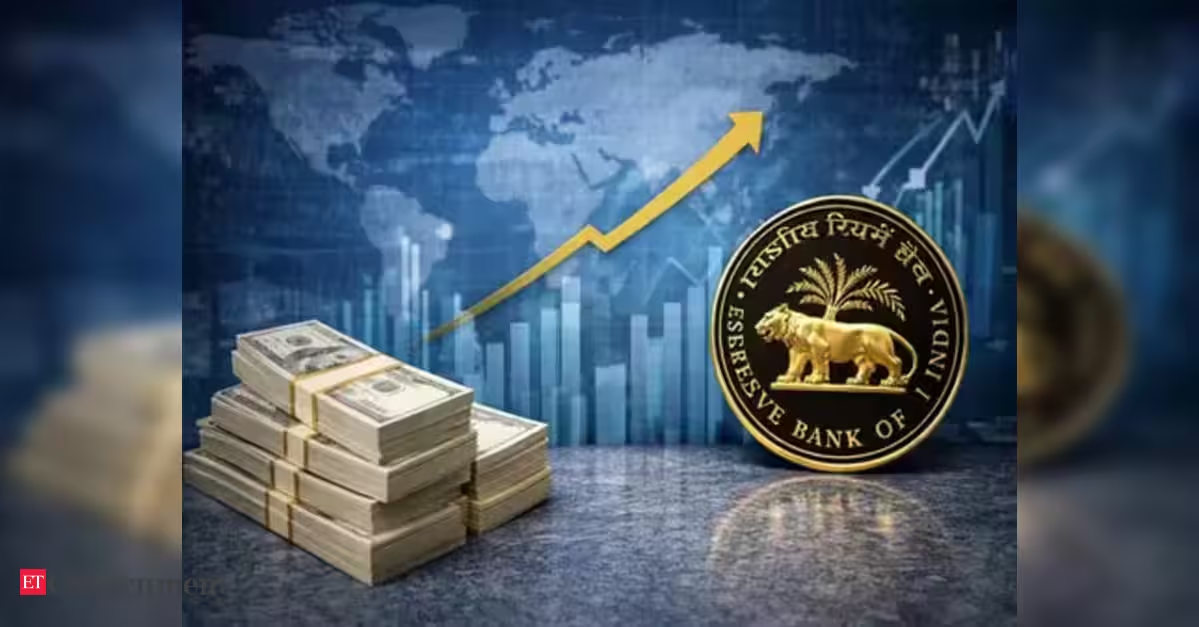
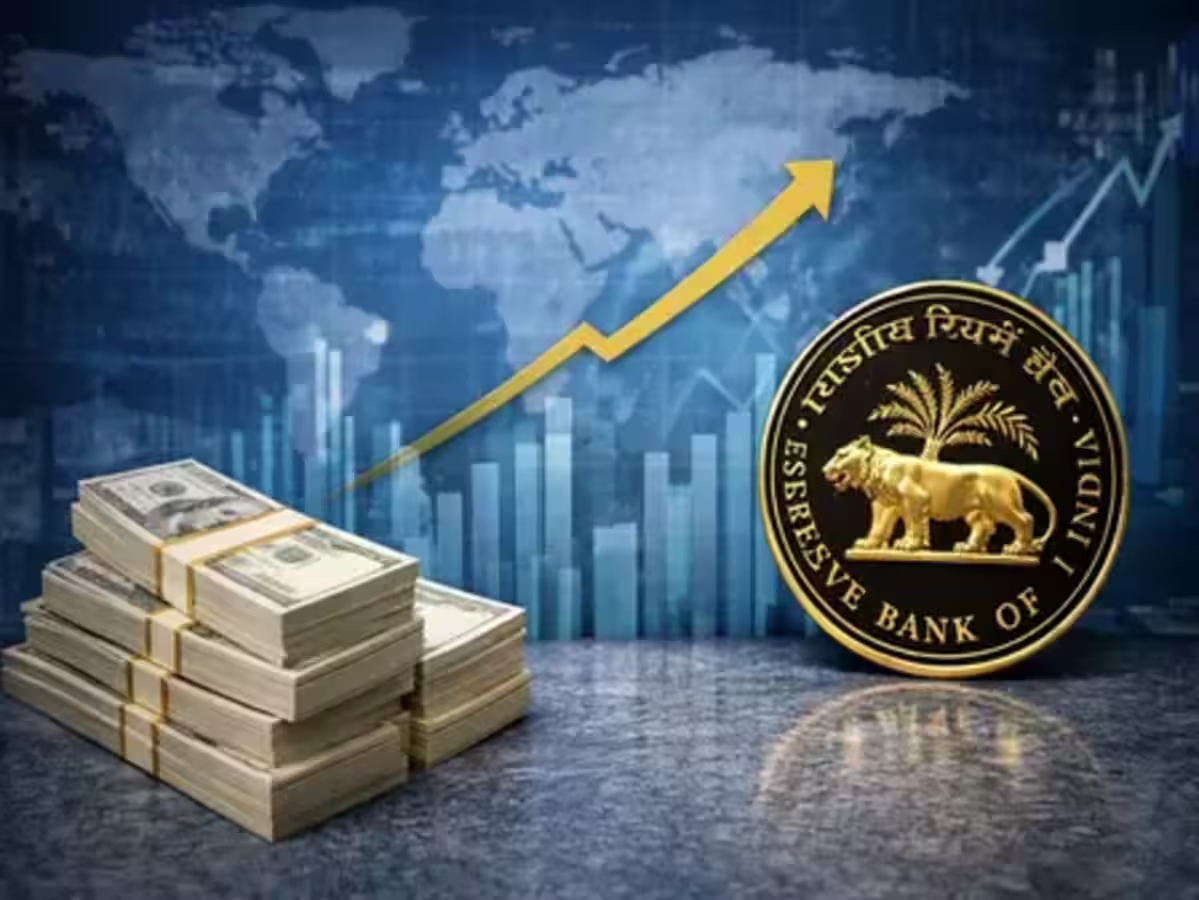
At a time when wars are making capital cautious, oil expensive and currencies vulnerable, India has quietly accumulated the largest foreign-exchange war chest in its history. The country’s reserves surged to $740.80 billion in the week ended August 28, 2026, giving the Reserve Bank of India unprecedented firepower to manage external shocks. Yet the headline number tells only half the story.
A substantial part of the recent accumulation has come not from a sudden boom in exports or foreign direct investment, but from an extraordinary mobilisation of foreign-currency deposits and borrowings facilitated by the RBI. India has strengthened its external shield—but in doing so it has created a second policy challenge: managing the rupee liquidity and future dollar obligations generated by that shield.
RBI data show that reserves jumped $11.475 billion in a single week, from $729.328 billion on August 21 to $740.803 billion on August 28. It was the ninth consecutive weekly increase, taking the cumulative rise over those nine weeks to nearly $75 billion. The previous record, before the recent run-up, was about $728.5 billion at the end of February.
The composition is equally significant. Foreign-currency assets, the largest component, rose by $9.337 billion during the latest week to $600.670 billion. Gold reserves increased by $2.191 billion to $116.409 billion. Special Drawing Rights with the International Monetary Fund stood at $18.810 billion, while India’s reserve-tranche position with the IMF was $4.914 billion.
For an economy heavily dependent on imported energy and integrated with global capital markets, such reserves are more than an accounting achievement. They constitute insurance against precisely the kind of geopolitical environment confronting India today.
Wars in West Asia and Eastern Europe have altered global energy, trade and investment calculations. India, which imports roughly 85 per cent of its crude-oil requirements, remains particularly exposed to prolonged increases in international energy prices. At the same time, geopolitical uncertainty, elevated interest rates and risk aversion constrain global investment flows. Capital that might otherwise move into emerging economies can retreat towards dollar assets during periods of stress.
India’s experience with FDI illustrates this more complex environment. Gross FDI remained reasonably strong: during April-December 2025, gross inflows rose to $73.3 billion from $63.1 billion a year earlier. But repatriation by foreign investors remained high at about $44.4 billion, while outward FDI by Indian companies increased to $24.9 billion from $18.5 billion. Consequently, net FDI was only $4 billion during the period, although that was an improvement from $0.6 billion a year earlier. The Ministry of Finance itself noted that gross inflows remained below their potential in an intensely competitive global investment environment.
That distinction between gross and net capital flows is important. India remains an attractive investment destination, but the global environment is hardly conducive to a straightforward FDI boom. The continuing Russia-Ukraine conflict, instability across West Asia and associated energy and shipping risks have made long-duration investment decisions more complicated. Against that backdrop, building a larger reserve cushion has considerable strategic value.
The remarkable feature of the latest reserve accumulation, however, is how the dollars arrived.
In June, the RBI introduced special USD-INR swap arrangements offering favourable hedging facilities for Foreign Currency Non-Resident (Bank), or FCNR(B), deposits and overseas borrowings. The response dramatically exceeded expectations. Between June 5 and August 31, more than $136 billion was mobilised through the special facilities, of which roughly $127 billion came from non-resident deposits.
In effect, India used the depth of its banking system and the financial capacity of its overseas population to reinforce its external balance sheet at a moment of geopolitical stress. The strategy has parallels with the special FCNR(B) window deployed during the 2013 taper tantrum, although the present mobilisation is vastly larger.
There is, however, an important qualification. These dollars are not the same as reserves accumulated through persistent current-account surpluses or permanent equity capital. FCNR deposits and overseas borrowings ultimately represent liabilities. The RBI’s swap arrangements transfer or absorb substantial currency risk, creating future dollar commitments on its balance sheet. The headline reserves are therefore exceptionally strong, but part of the increase comes with an associated future obligation.
The immediate consequence is already visible in India’s money markets. The foreign-currency mobilisation has generated an enormous quantity of rupee liquidity. Banking-system surplus liquidity reached around ₹9.7 lakh crore in early September. The RBI has consequently been forced to absorb liquidity through Variable Rate Reverse Repo operations and may have to use longer-duration VRRRs, bond sales, dollar-rupee swaps, the Market Stabilisation Scheme or changes in reserve requirements if the surplus persists.
On September 4 alone, the RBI absorbed more than ₹6 lakh crore through two VRRR auctions. That illustrates the paradox created by the successful forex mobilisation: the central bank wanted dollars to strengthen the external buffer, but acquiring those dollars injects rupees into the domestic banking system. Unless the excess liquidity is sterilised, overnight rates can fall below the desired monetary-policy corridor and potentially add to inflationary pressures. Sterilise too aggressively, however, and the RBI risks tightening financial conditions or pushing up government bond yields.
The RBI is therefore conducting two operations simultaneously—strengthening India’s external defences while preventing the resulting liquidity from weakening domestic monetary control.
What makes this exercise manageable is that the underlying economy remains in reasonably good shape despite the geopolitical turbulence.
India’s real GDP expanded 7.8 per cent year-on-year in April-June 2026, considerably above the RBI’s 7 per cent projection. Nominal GDP grew 10.3 per cent. Real GVA expanded 8.2 per cent. Manufacturing grew strongly, while investment and services provided substantial momentum. The official GDP release described the performance as sustained growth despite global headwinds.
Fiscal indicators have also remained relatively controlled. The Centre’s fiscal deficit during April-July stood at ₹4.55 lakh crore, or 26.8 per cent of the full-year target, compared with 29.9 per cent of the target in the corresponding period last year. Capital expenditure simultaneously increased to around ₹4.5 lakh crore, suggesting that fiscal consolidation has not yet required a retreat from infrastructure investment.
The $740.8-billion reserve figure should therefore be interpreted neither as proof that India is insulated from global turmoil nor merely as an artificially inflated headline. It represents a deliberate strengthening of the country’s financial defences at a particularly dangerous moment for the global economy.
The real test comes next. India ultimately needs reserves increasingly supported by durable sources—exports, services earnings, remittances and long-term FDI—rather than exceptional financial facilities. The RBI must also unwind or manage the liabilities created by its swaps while draining surplus rupee liquidity without destabilising interest rates.
But there is a larger message in the numbers. Two major theatres of war are disrupting energy markets, trade routes and global investment decisions, yet India is entering this uncertain period with record reserves, growth close to 8 per cent and a substantial domestic investment cycle. The external environment is deteriorating faster than India would like; the domestic economy, so far, is holding up better than might have been expected.
The $740.8-billion reserve stock is therefore best viewed as strategic insurance. It cannot prevent an oil shock, end geopolitical instability or manufacture FDI. What it can do is give policymakers time, credibility and financial firepower when those shocks arrive. In the present global environment, that margin of safety may prove considerably more valuable than the record itself.