

The most revealing outcome of the BRICS Summit in New Delhi may be what the grouping did not do. It did not announce a common currency. It did not declare war on the dollar. Nor did it transform itself into an explicitly anti-Western alliance. Instead, an enlarged grouping containing countries divided by wars, strategic rivalries and competing economic interests managed something less dramatic but arguably more useful: it negotiated a common position.
The unanimous adoption of the New Delhi Declaration on Saturday is therefore significant. With Iran and the United Arab Emirates sitting within the same grouping amid escalating tensions in West Asia, agreement was far from automatic. Yet BRICS leaders expressed “deep concern” over the escalation and called for “maximum restraint”, while urging countries to avoid actions that could aggravate the situation. The declaration reaffirmed dialogue, consultation and diplomacy as the preferred means of resolving international disputes.
That language is deliberately cautious. But diplomatic ambiguity was probably the price of unanimity.
The declaration also condemned deliberate attacks on civilian infrastructure and safeguarded peaceful nuclear facilities, and criticised unilateral sanctions imposed without authorisation from the UN Security Council. Crucially, it did not identify the countries responsible for the actions it criticised. That weakens attribution, but it also explains how countries with markedly different relationships with the United States, Israel and Iran could endorse the same document.
This is where India’s presidency appears to have made its mark. New Delhi has consistently resisted attempts to define BRICS simply through opposition to the West. Prime Minister Narendra Modi’s message at the summit was that “BRICS is not against anyone”; its purpose, in India’s formulation, is to widen participation in global governance rather than construct another rigid geopolitical bloc.
Modi’s more consequential formulation concerned the Global South. He argued that developing countries must move from being rule-takers to becoming “rule-shapers”, and called for the existing “pyramid of privilege” in global governance to be transformed into a “platform of partnership”. His argument links BRICS expansion to India’s longstanding demand for reform of institutions such as the UN Security Council and international financial institutions.
That distinction matters. There is a fundamental difference between demanding greater representation within the international system and attempting to overturn that system. India’s approach is closer to the former.
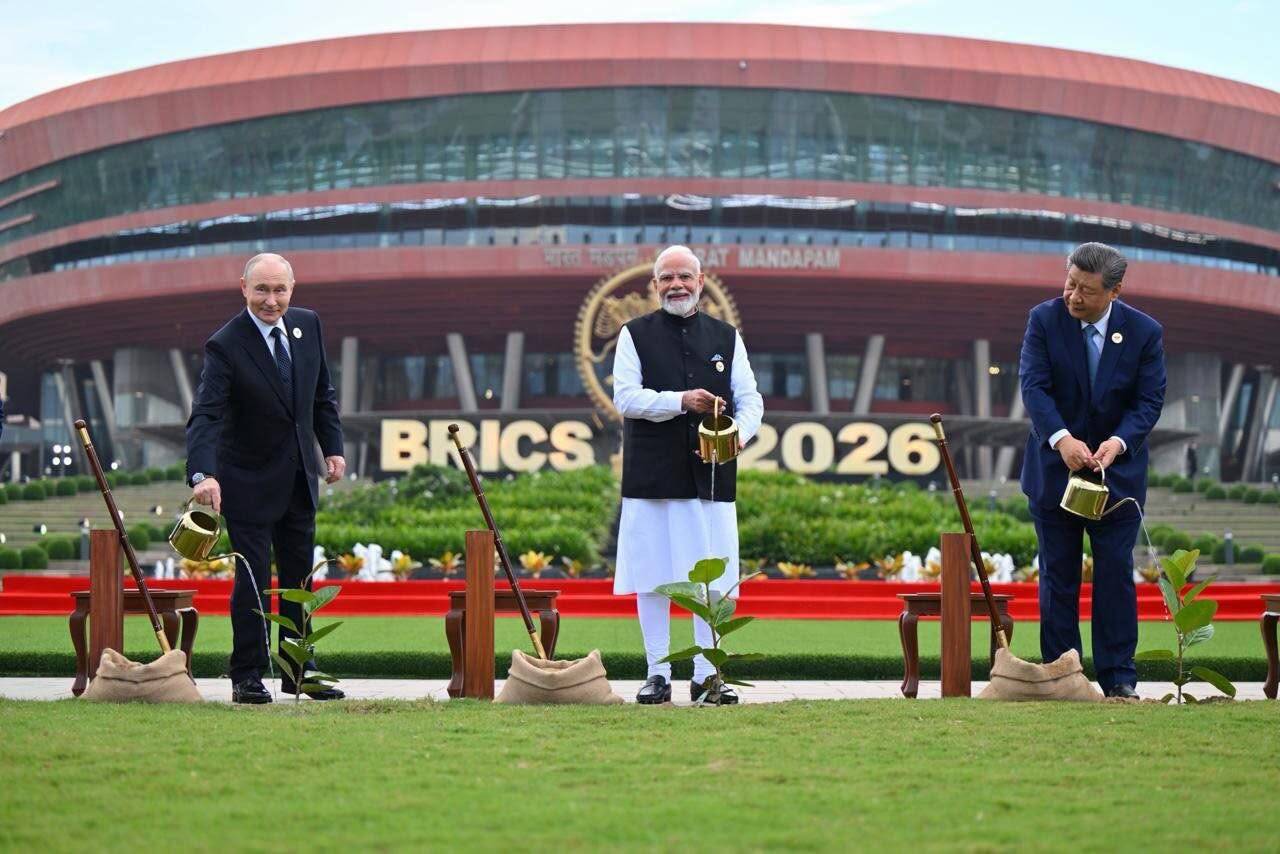
Russia’s rhetoric in New Delhi was, interestingly, also calibrated. President Vladimir Putin told the BRICS Business Forum: “We’re not against anyone.” He added that Russia was prepared to work with “all of our partners, old ones and new ones”. China, meanwhile, used the summit to call for a larger diplomatic role for BRICS. President Xi Jinping urged the grouping to contribute to peacemaking in West Asia and confirmed that China will assume the BRICS chairmanship and host the next summit in 2027.
The New Delhi consensus nevertheless should not be confused with strategic convergence. BRICS remains an extraordinarily heterogeneous grouping. India and China are strategic competitors despite their improving dialogue. Iran faces Western sanctions and is directly involved in the West Asian confrontation, while the UAE has very different security and commercial relationships. India maintains deep strategic partnerships with the United States and Europe even while sustaining its longstanding relationship with Russia.
The same contradictions become even clearer when economics enters the picture. For years, speculation about BRICS has focused disproportionately on de-dollarisation. Yet New Delhi demonstrates why replacing the dollar is far easier to discuss than accomplish. BRICS countries can increase bilateral settlement in national currencies, develop interoperable payment mechanisms and reduce transaction costs without creating a common currency or abandoning the dollar.
The structural problem is trade. India’s merchandise trade deficit with the other BRICS economies reached $226.1 billion in FY2026, according to a Global Trade Research Initiative analysis based on trade data. India’s exports to BRICS rose from $64.3 billion in FY2021 to $95.7 billion in FY2026, while imports surged from $138.8 billion to $321.8 billion. BRICS economies now account for 41.5 per cent of India’s merchandise imports.
These numbers expose the limits of monetary engineering. Local-currency settlement can alter the currency in which an invoice is denominated; it cannot eliminate the underlying imbalance between exports and imports. If one country persistently sells substantially more to another than it buys, somebody must ultimately hold the resulting currency, convert it into another asset or find additional goods and investments on which to spend it.
That is why the dollar retains its centrality. Its strength does not arise merely from political pressure by Washington. It rests on deep and liquid American capital markets, widespread international acceptance, the scale of dollar-denominated trade and finance, and the ability of governments, companies and investors to deploy dollar surpluses across a vast range of financial assets.
BRICS can gradually reduce dependence on the dollar at the margins. Replacing it at the centre of the global monetary system is another proposition altogether.
New Delhi has therefore been more persuasive when BRICS concentrates on practical cooperation. Modi’s proposal for a Seafarers’ Emergency Support Network is a good example. With conflict disrupting major shipping routes, the initiative seeks greater coordination to assist maritime workers in emergencies. Modi had already framed the economic logic succinctly: “Global trade progress is possible only when sea lanes are secure, supply routes remain open, and seafarers are safe.”
Such initiatives may sound less revolutionary than a BRICS currency, but they are more likely to produce tangible results.
That points to the larger lesson from New Delhi. BRICS does not need to become a military alliance, monetary union or anti-Western coalition to matter. Its potential lies precisely in its ability to bring together states that frequently disagree—and give them an institutional setting in which those disagreements do not automatically prevent cooperation.
The New Delhi Declaration embodies that approach. Its language on West Asia is cautious, sometimes deliberately ambiguous and devoid of explicit attribution. Yet securing unanimous language from governments occupying very different sides of today’s geopolitical divides is itself a diplomatic achievement.
BRICS may therefore be evolving into something more complicated than either its champions or critics sometimes suggest: not an alternative world order, but another influential centre within an increasingly multipolar one.
De-dollarisation remains largely an aspiration. The more immediate test of BRICS is whether it can turn political diversity into workable cooperation. In New Delhi, India has demonstrated that consensus itself can be a form of strategic power.

