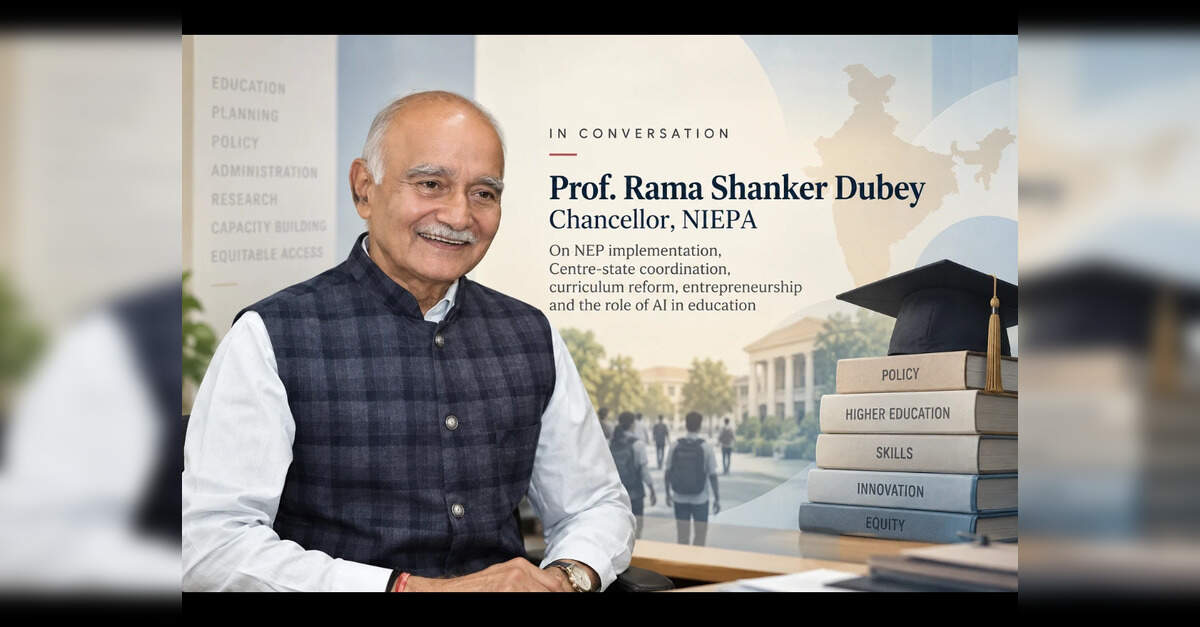
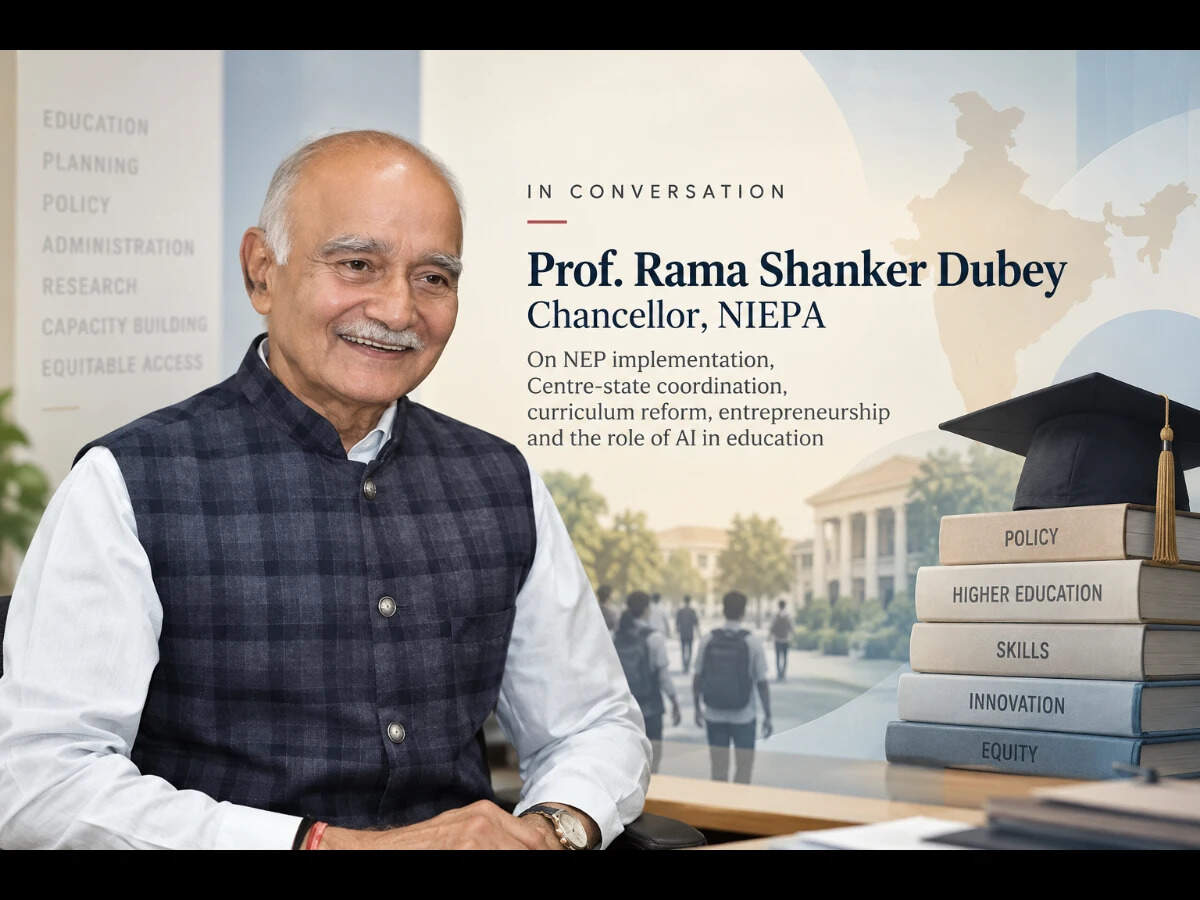
With India targeting a 50% gross enrolment ratio in higher education by 2035, the implementation of education policy across states remains a critical challenge. The National Institute of Educational Planning and Administration (NIEPA), a national institution under the Ministry of Education, works on education planning, administration, policy and capacity building.
Prof. Rama Shanker Dubey, Chancellor, NIEPA, brings experience of leading both central and state universities. He has served as Vice-Chancellor of Guru Ghasidas University, Bilaspur, Tilka Manjhi Bhagalpur University, Bihar, and Central University of Gujarat, where he served for six years until November 2025. He was also Professor of Biochemistry at Banaras Hindu University for more than two decades.
In this conversation with ETEducation, Prof. Dubey discusses NEP 2020 implementation, Centre-state coordination, strengthening state universities, curriculum reform, entrepreneurship and the role of artificial intelligence in teaching and learning.
Q. India has set an ambitious target of 50% gross enrolment ratio in higher education by 2035 under NEP 2020. What are the key challenges that could prevent India from achieving this target?
Prof. Rama Shanker Dubey: India is a diversified country, and education is in the Concurrent List. The central government has to play its role, but state governments also have to play a major role because almost all state universities are within the domain of state governments.
The vision document of NEP 2020 is historic. If it is implemented properly, we will get there. In central universities, it is almost implemented, and in many states also it has been implemented. But some states are not able to implement it. They are not taking any interest in it, or there may be other difficulties. If it is implemented properly, then definitely we will be able to meet the vision.
Q. Why does India often have strong education policies but face difficulties with implementation? What can be learnt from central universities?
Prof. Rama Shanker Dubey: You should take the example of the central universities. There is proper monitoring. There are 56 central universities right now, and I have been to Central University of Gujarat and seen it myself. All the components, such as integration of the Indian knowledge system, value-based education and skill-based education, including skilling, are being covered.
The curriculum is modified year after year to realise the vision of NEP 2020. That makes the process quicker. We need to develop those types of mechanisms with our state universities because the majority of students are studying in state universities. That is very important.
We also have to develop infrastructure in state universities and colleges. Especially in degree colleges, in many cases we have seen that the number of staff is less and the infrastructure is not adequate. With the participation of state governments, the public and the corporate sector, all should participate to strengthen the infrastructure.
Q. Funding and governance are often cited as constraints for state universities. What other changes are needed to strengthen their academic and research capacity?
Prof. Rama Shanker Dubey: Funding is there. One is government funding, but apart from that, universities can attract various types of projects from corporate bodies and organisations such as CSIR. There is a lot of extramural funding to support higher education. Many institutions are doing this. JNU, DU and BHU, for example, have centres of excellence for research.
In a university system, research should be taken up as a priority because research is the creation of knowledge. That is very important.
Another major thing that has been missing for many years is that our curriculum is not being revised in such a way as to meet the expectations of society and industry. That gap needs to be fulfilled. For this, our curriculum needs to be revised by inviting stakeholders from industry and other sectors so that the students who graduate are employable.
Q. NEP 2020 also puts considerable emphasis on entrepreneurship. How can universities move beyond entrepreneurship cells and create a stronger entrepreneurial culture?
Prof. Rama Shanker Dubey: Another very important aspect of NEP 2020 is developing entrepreneurial skills in students, and that starts from the schooling level itself. It begins with creative thinking, so that students can think about the problems of society, come up with ideas and incubate them. That leads to entrepreneurial development. They can come up with a process or a new product to solve the problems of society.
India is right now the third-largest entrepreneurship ecosystem in the world, with more than 2,50,000 registered startups, and that is growing. Many universities have developed research and development systems, entrepreneurial incubation cells and startup incubation cells, so awareness is coming up.
The only thing is that we have to speed up the process so that it reaches the ground level in all universities and colleges.
Q. You have worked in both central and state higher education settings. How can Centre-state coordination be improved to make education reforms more effective?
Prof. Rama Shanker Dubey: A mechanism should be developed. For example, central universities can serve as models for the implementation of NEP, entrepreneurship development and startup incubation cells. A central university can serve as a model for state universities. It can also hand-hold a state university nearby. That can be one mechanism.
Another mechanism is that there should be proper communication between the secretaries and ministers at the central and state levels. That can also help.
Q. Beyond coordination, what will be critical to achieving the 50% GER target by 2035?
Prof. Rama Shanker Dubey: By 2035, according to NEP 2020, we have committed that we will have a 50% gross enrolment ratio in higher education. For that purpose, the central and state governments are working together.
Many open universities are there, and it is their mandate to reach the remotest possible areas of the country. They are doing that through open learning and open distance learning. Digital universities are also coming up.
The aim is that education should reach everyone. But for that purpose, cohesive efforts from state governments, state universities and central universities are all needed so that we can achieve the target of 50% gross enrolment.
Q. AI is increasingly influencing teaching and learning. How do you see its role in education, and where should institutions draw the line?
Prof. Rama Shanker Dubey: AI is used in every sector, and education is one of them. In teaching and learning methods and in whatever we do, because most of the things we are doing now are on virtual platforms, AI has an important role to play.
But we have to see it with caution. AI should be an enabler. It should support us. It cannot be a substitute for the teacher. A PowerPoint presentation, for example, can be created through AI, but the role of the teacher cannot be replaced by AI.
A teacher is really a mentor for the student. When we talk about the purpose of education, which includes ethics and human values, and creating human values in the student to make them a good citizen of the country, that is something a teacher can mentor. It is important, and it cannot be replaced by AI.