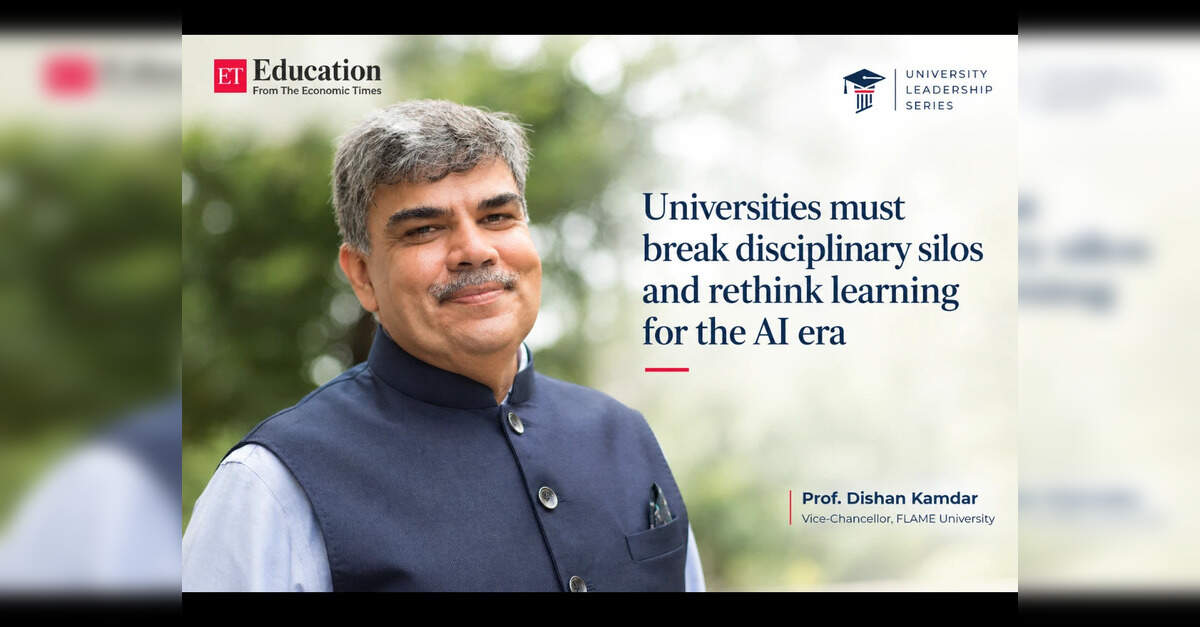
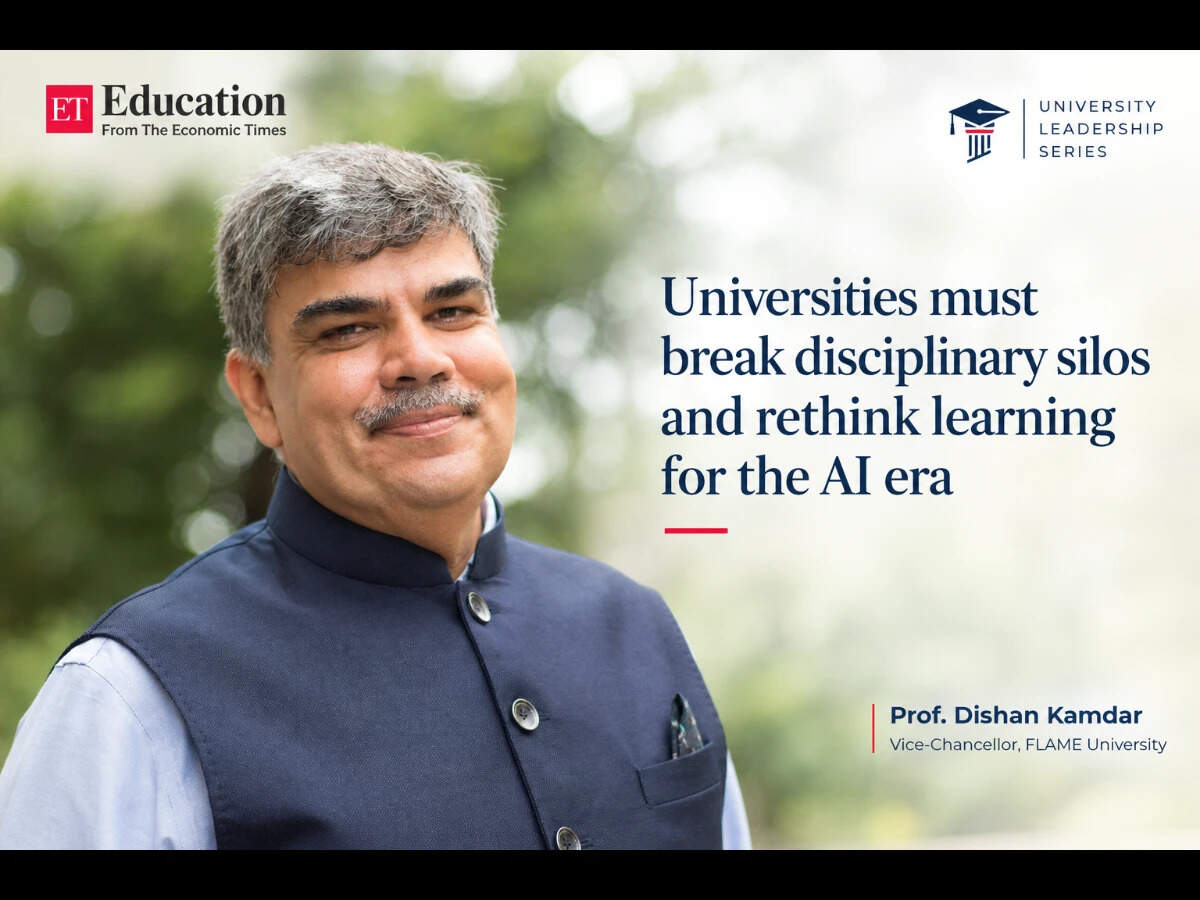
India’s higher education system is being pushed to rethink what universities should teach, how students should learn and what employability means in an AI-driven economy. In this conversation, Prof Dishan Kamdar, Vice-Chancellor, FLAME University, argues that liberal education must move beyond the first-job mindset, while universities need to break disciplinary silos, rethink pedagogy and build stronger connections with industry.
Q. Liberal education is still misunderstood in India, particularly around depth and career outcomes. What do you think are the biggest misconceptions about the model?
Prof Dishan Kamdar: There are two major misconceptions about liberal education. The first is that it is broad-based but lacks depth. That is not what liberal education is about. It exposes students to different disciplines while developing transferable capabilities such as judgement, curiosity, creativity and intellectual courage.
The second misconception is about its connection with careers. In medicine, you become a doctor; in law, you become a lawyer; in engineering, there is a relatively direct connection between the degree and a profession. With liberal education, that connection may appear less obvious.
But we need to ask a more fundamental question: are we preparing students only for their first job, or for the multiple careers they may have over their lifetime? The ability to learn, adapt and reinvent oneself becomes increasingly important.
That is where liberal education has a direct role. It is about holistic development and preparing individuals to navigate different situations and make informed decisions.
This interdisciplinary philosophy was also one of the reasons I was attracted to FLAME. The founders and investors had themselves followed an interdisciplinary approach, bringing together areas such as psychology, history and investment. That philosophy resonated strongly with my own belief in interdisciplinary education.
Q. Employers and students are increasingly focused on employability and return on investment. How should universities define ROI in liberal education?
Prof Dishan Kamdar: We need to redefine employability and ROI. Today’s generation will not switch five jobs. They will switch five careers in their lifetime.
So, the question is not simply whether a student gets a job after graduation. It is whether we are preparing that individual to remain employable and capable of reinventing themselves over the next 30 or 40 years.
Students need both holistic development and functional expertise. Employers increasingly look for people who can think creatively, critically evaluate situations, exercise ethical judgement under uncertainty, collaborate and remain curious.
At the same time, students need guidance. When I was at ISB, around 75-80% of our students at the time were career switchers. Many came from engineering, medicine or architecture and realised that the field they had initially chosen was not necessarily what they wanted to pursue.
Mentorship becomes important in such situations. A mentor can help a student understand their strengths and weaknesses, explore different industries and align career possibilities with their capabilities.
At FLAME, we have a strong emphasis on mentorship. We follow what I would describe as a guru-shishya-parampara, where faculty, peers and industry professionals play an important role in guiding students. Students also get the opportunity to explore different areas before choosing their major, and mentorship continues as they progress.
The curriculum also needs to remain connected to changing industry expectations. Employability is not about preparing someone for one job; it is about preparing them for multiple versions of themselves.
Q. With AI disrupting traditional ideas of learning and knowledge, what should remain at the core of a university education?
Prof Dishan Kamdar: The purpose of education is holistic development. Academic intelligence is only one form of intelligence. Emotional, cultural, social and aesthetic dimensions are equally important. There are seven or eight forms of intelligence that are vital to a student’s development.
AI is disrupting academic intelligence, but that is only one slice of the pizza. Other forms of intelligence develop through peer interaction, experiences and opportunities within the university.
At FLAME, for example, we are a residential university with more than 50 clubs, and sports is an important part of student life. These experiences teach students resilience, teamwork, ambition and grit. Those are capabilities that cannot simply be outsourced to a machine.
I also do not believe AI will replace teachers. AI can provide information and support learning, but it cannot empathise with a student, inspire them or help them understand whether a particular decision is ethical.
What will change is the role of the teacher. Faculty will increasingly move from being knowledge creators and disseminators to becoming architects of the student learning experience.
That requires significant investment in faculty capacity building. Students have changing learning preferences, and AI can support some of those preferences. But classrooms can no longer be designed primarily around the transmission of textbook knowledge. Pedagogy, learning experiences and evaluation will all have to evolve.
Q. AI is also challenging conventional assessment methods. How should universities assess students when generative AI can produce essays, reports and other take-home assignments?
Prof Dishan Kamdar: Traditional paper-and-pencil examinations were largely designed to test memory. Over time, universities moved towards take-home assignments, group projects and practical work because these were seen as better ways of testing understanding.
But AI can now do much of the work involved in a take-home assignment.
So we need a balance. Students must become proficient in using AI because they will encounter these tools in the workplace. At the same time, we cannot allow AI to replace first-principles thinking.
If a student submits a report generated with AI, we need to ask different questions. Did the student ask the right question? Do they understand the answer? Can they defend it? If we peel away the layers, does the student understand what is underneath?
That may require us to bring back some forms of paper-and-pencil assessment, viva examinations and debates. Open-book examinations can also test understanding, reasoning and the ability to ask the right questions rather than simply test memory.
There are therefore two objectives. One is to encourage AI proficiency. The other is to preserve first-principles thinking.
Assessment should increasingly look at the quality of the questions students ask, the decisions they make and the reasoning behind those decisions. If a student recommends a business strategy, for example, can they establish whether it is financially viable? If they recommend a policy, can they explain whether it is aligned with the larger policy environment? We are rethinking assessments at FLAME around these questions.
Q. Universities are constantly being asked to respond to emerging areas such as AI, cognitive psychology and new economic and technological trends. How do you decide what deserves a place in the curriculum?
Prof Dishan Kamdar: We should not chase everything that is new. There needs to be a clear set of criteria.
The first is long-term impact. Does the area have the potential to influence business, society, the economy or the knowledge base over the long term?
The second is whether it can be meaningfully assimilated with an existing discipline. The third is whether there is enough rigorous academic work and a sufficient body of knowledge to incorporate it into the curriculum.
Not every emerging trend needs to become a degree programme. Depending on its maturity and relevance, it could become a course, a workshop or a concentration.
AI is one example where the impact is already significant. Cognitive psychology, capital markets and applied econometrics are other areas where there is substantial academic work and clear relevance.
Universities need to distinguish between something that is merely fashionable and something that has the intellectual depth and long-term relevance to become part of an academic programme.
Q. Looking towards 2030, what are the three changes you believe Indian universities need to make in the way they teach and prepare students?
Prof Dishan Kamdar: The first is that we need to break disciplinary boundaries. We have traditionally organised universities around silos, but many of the problems students will encounter in the real world will not fit neatly into one discipline.
The National Education Policy is forward-looking in this regard. It talks about interdisciplinarity, creativity, innovation, entrepreneurial thinking, skilling and multiple entry and exit pathways. The challenge now is implementation.
The second change is that we need to rethink teaching and learning. AI is here to stay, and universities have to prepare faculty for that transition. At FLAME, we are investing substantially in faculty capacity building and working with technology providers, including Google and Gemini, to understand how AI can be integrated into teaching.
Faculty need to become architects of the student learning experience. A flipped classroom model, for instance, can allow students to come prepared and use classroom time for deeper discussion and application.
We also need to bring industry closer to the curriculum. A professor of practice should not merely come into a classroom and tell stories about their career. They should bring live projects and real problems. Recruiters increasingly want to see evidence of what students can actually do: portfolios, leadership experiences, projects and problem-solving capabilities.
The third change is agility. Faculty should be willing to drop a course that has become obsolete, learn something new and bring that knowledge into the classroom. AI will also need to be integrated differently across disciplines. The way AI is used in humanities will be different from how it is used in mathematics or psychology.
But while we embrace AI, we must preserve deep disciplinary knowledge and first-principles thinking. That also means rethinking examinations and assessment.
Ultimately, the way we teach, learn and assess has to change together.