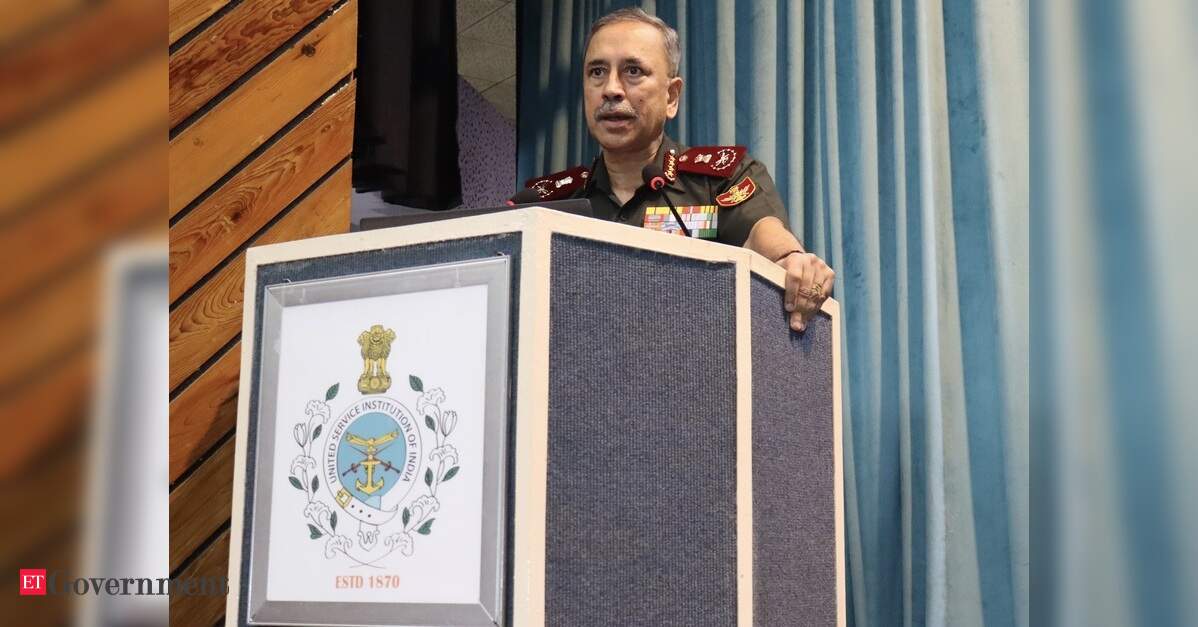
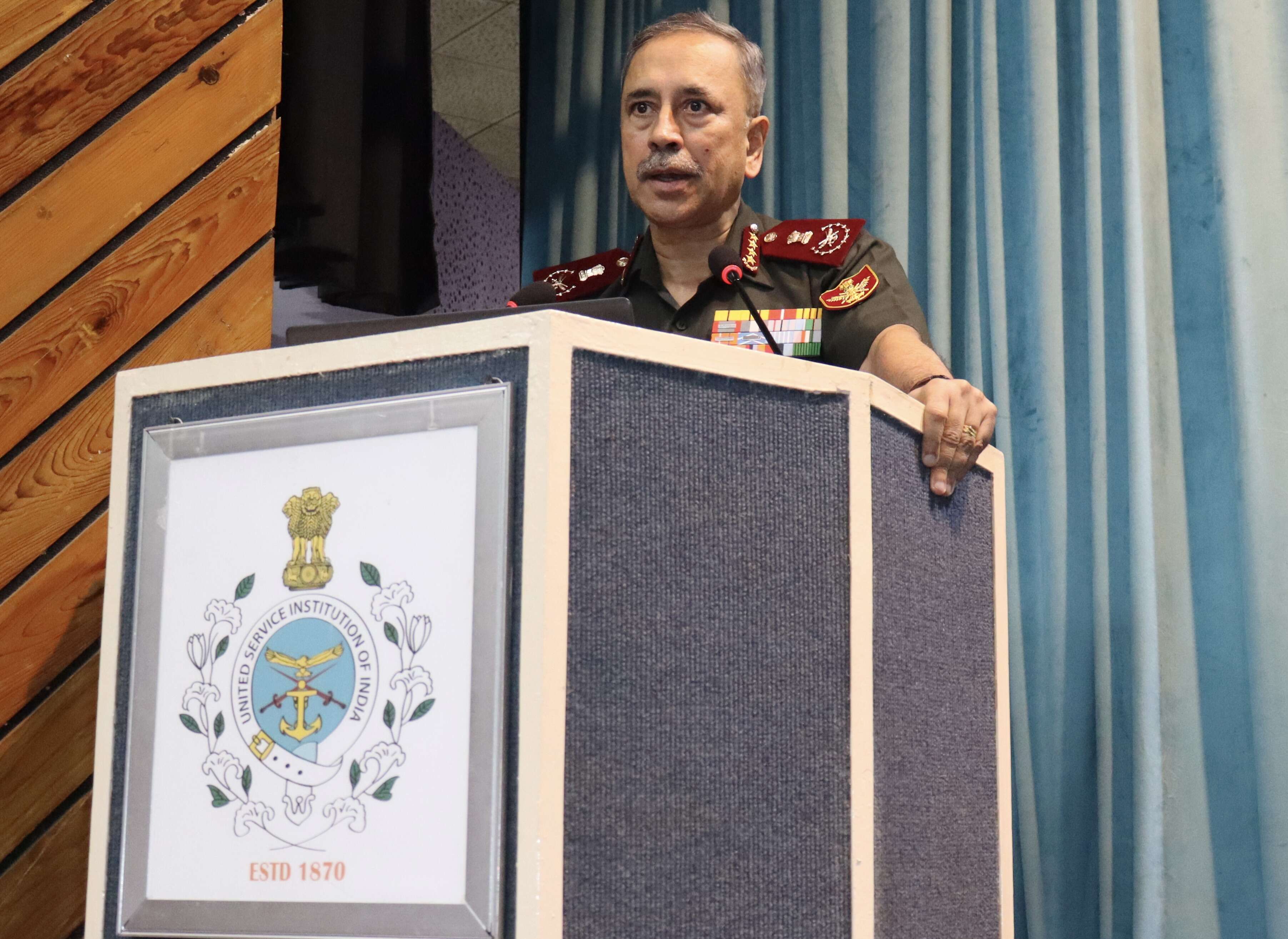
“Isolated platforms today are of no use.” With this stark assessment, Chief of Defence Staff General N. S. Raja Subramani laid out a vision of how India’s armed forces must prepare for an era in which military advantage will increasingly depend not on individual weapons or platforms, but on the speed at which sensors, networks, data, artificial intelligence and commanders can be connected to create battlefield effects.Delivering the keynote address on “Multi-Domain Operations and Related Technologies” at Defence Tech Day, General Subramani argued that the transformation of warfare requires a fundamental shift—from platforms to effects, from network-centric to data-centric operations, and from merely acquiring new technologies to reshaping doctrine, organisational structures and military thinking around them.
“Multi-domain operations are not about operating in different domains. It is about creating effects using various domains in a particular domain faster than the adversary can comprehend and respond to us,” the CDS said.
At the heart of his argument was what he described as a “system of systems” approach. A satellite may detect a target, another sensor may validate it, a network may transmit the information and an asset operating in the air, at sea, underwater or on land may ultimately create the required effect. The military advantage comes not from any one component but from their ability to communicate and act as an integrated whole.
This has major implications for how the armed forces conceptualise capability development. Instead of beginning with what the Army, Navy or Air Force separately needs, General Subramani said the starting point should be the operational effect that the military wants to create.
“It is not about what the Army needs, what the Navy needs, what the Air Force needs. It is about what are the effects that we need to create on the battlefield and, for those effects, what are the capabilities that we require,” he said.
That approach puts C4ISR—command, control, communications, computers, intelligence, surveillance and reconnaissance—at the centre of modern operations. Space-based surveillance and communications, aerial and naval assets, ground systems and electronic warfare capabilities must exchange information in near real time. The networks carrying this information must also remain functional in an electronically contested battlespace.
Redundancy, therefore, becomes as important as connectivity. The CDS pointed to space, optical fibre, radio, Wi-Fi and software-defined radio-based systems as possible elements of a resilient communications architecture. An adversary will attempt to jam, disrupt or degrade those networks; the architecture must consequently be designed to continue operating under attack.
But connectivity alone is not enough. General Subramani placed data at the centre of the next phase of military transformation.
The armed forces, he argued, must move beyond network-centric warfare towards genuinely data-centric operations. That requires common data standards and schemas across the services, digitisation of information currently held in other forms and, crucially, a change in institutional attitudes towards sharing.
“We have to get over our tendency to jealously guard our data and operate in silos,” he said. “Security can no longer be an excuse not to share data. Share data, and put the necessary security measures into place.”
The argument is significant because artificial intelligence is only as useful as the data on which it is trained. Military AI systems must work with clean, reliable and operationally relevant datasets and be trained by experts familiar with terrain, missions and decision-making conditions. The CDS also advocated development of sovereign language models, while suggesting that India need not treat indigenous development and open-source technologies as mutually exclusive choices.
Open-source models could be adapted, secured and trained on air-gapped networks for appropriate applications, while smaller, purpose-built sovereign models could be developed for sensitive military requirements.
On one of the most debated questions surrounding military AI—whether machines should eventually take operational decisions—General Subramani drew a clear line.
“No force can survive without utilising AI,” he said, but added that “the final decision is with the commander.”
AI, in this formulation, is a tool for accelerating analysis, generating courses of action and supporting commanders rather than displacing human command responsibility. The armed forces, he said, are already developing structured programmes for commanders, operational personnel and technical specialists so that AI can be employed appropriately at different levels.
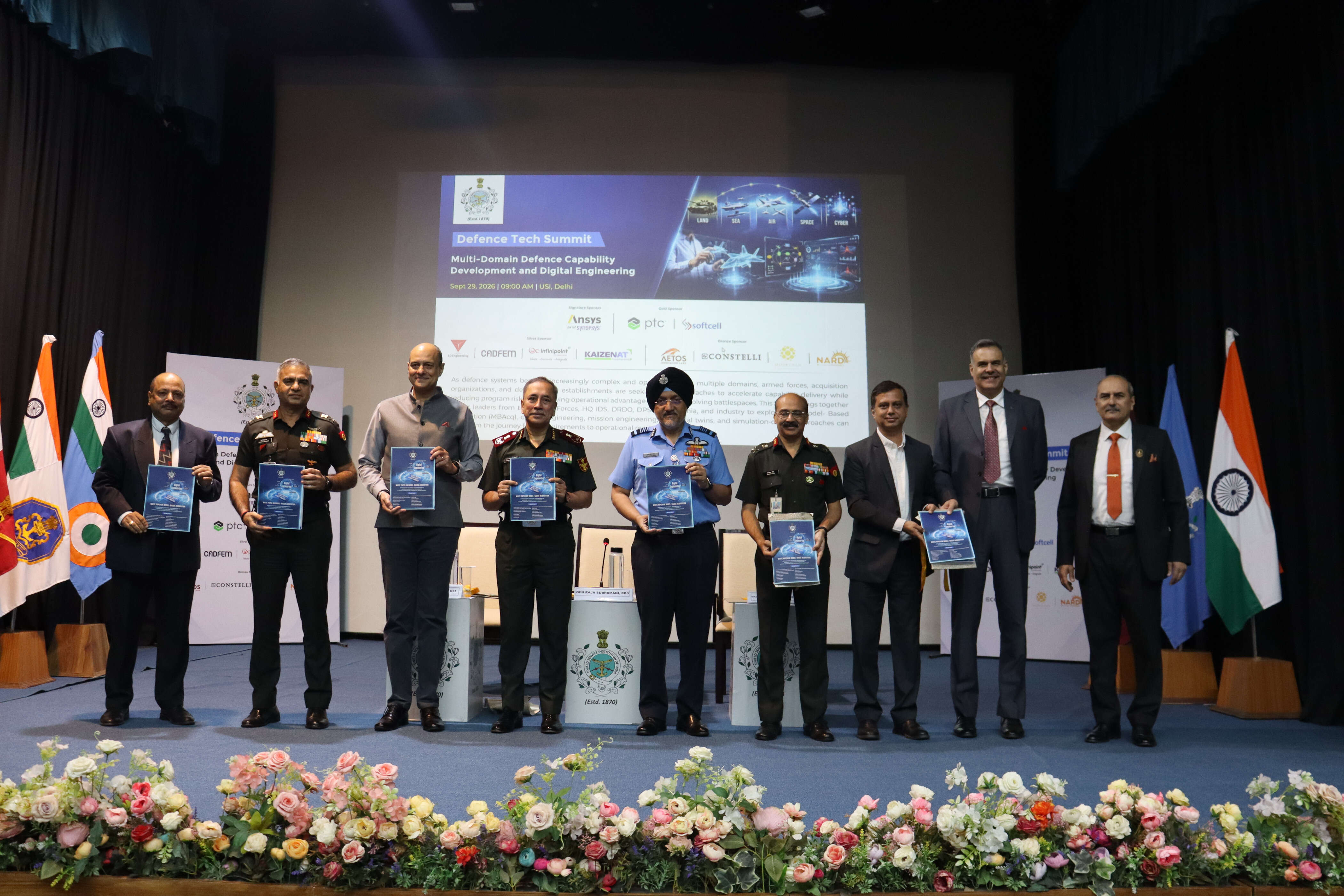
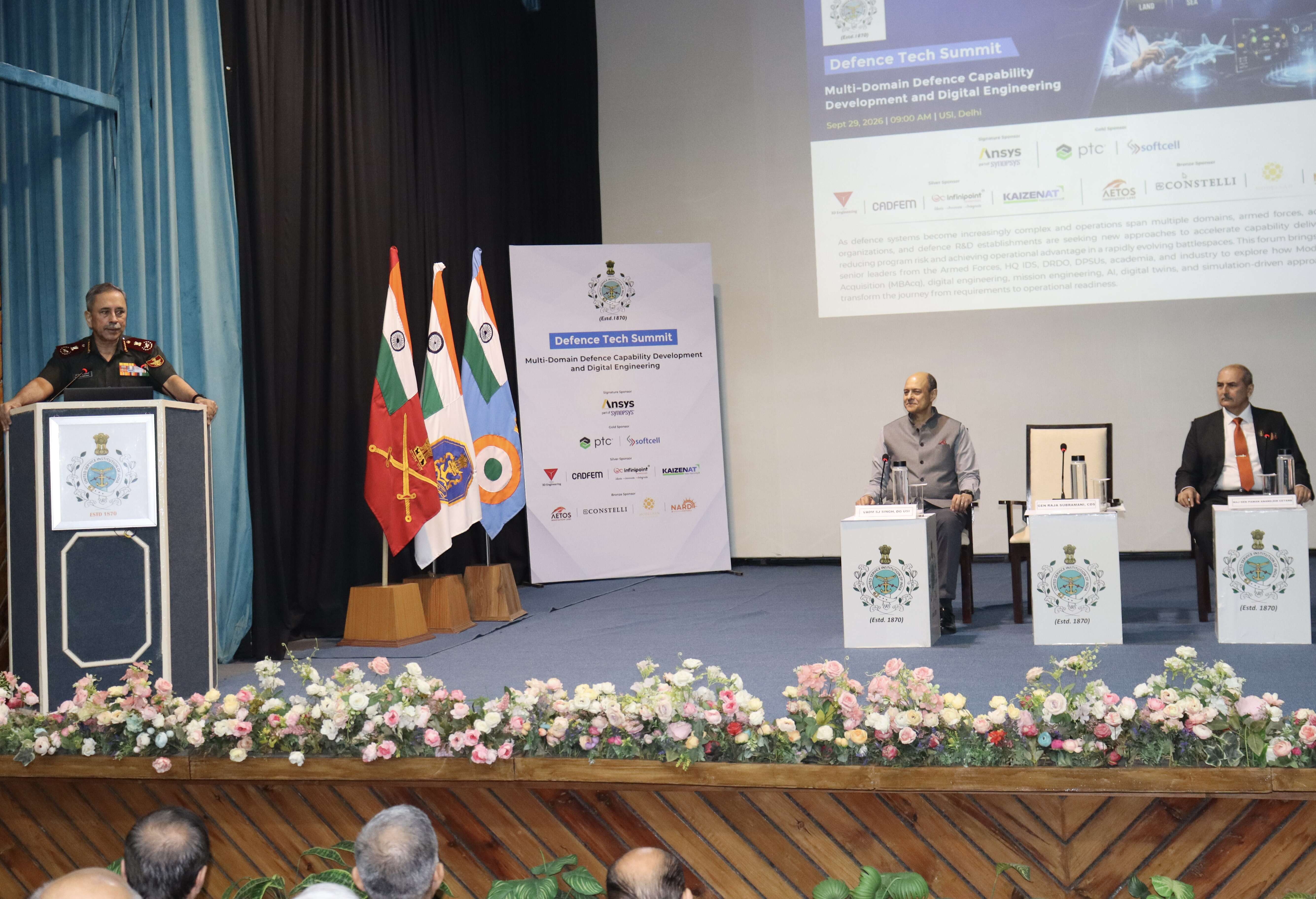
The Defence Tech Day was organised on September 29 at the auditorium of the United Service Institution of India (USI) under the stewardship of Vice Admiral Sanjay Jagjit Singh, Director General, USI, and Major General Pawan Anand, Director, Centre for Atmanirbhar Bharat and Emerging Technology at USI.
The gathering brought together senior officers of the armed forces and other government officials, both serving and retired, along with technocrats, media personalities, strategists and representatives of think tanks. The programme placed multi-domain operations within the larger framework of digital and AI transformation, autonomous capabilities, spectrum operations, digital engineering, certification and technological sovereignty.
The breadth of participation was particularly relevant to General Subramani’s central argument: the technological transformation of the armed forces cannot be undertaken by the military in isolation. It requires sustained interaction between the services, government, industry, academia, technologists and the wider strategic community. The CDS acknowledged his own association with USI and said it had contributed to his technological, strategic and geopolitical understanding.
Another major strand of his address concerned digital engineering. Traditional defence development frequently involved producing a physical model, testing it, identifying integration problems and repeatedly redesigning the system—a process that consumed both time and resources. Digital engineering, he said, offers an opportunity to model systems virtually, simulate their behaviour and examine reliability and integration before moving deeper into physical development.
Digital twins could extend this approach across the entire lifecycle of a platform. Rather than viewing a digital twin merely as a virtual replica, the military could use it to understand how an aircraft or another complex system performs over time, identify problems, anticipate upgrades and continuously improve the platform.
“Digital engineering and digital twins allow us to quickly learn, develop, iterate and improve,” General Subramani said, adding that while India has begun moving in this direction, “we need to speed up.”
His remarks also expanded the traditional definition of battlefield resilience. In an increasingly digital force, destroying a tank, aircraft or headquarters is not the only way to neutralise military capability. An adversary that disables networks, corrupts data or denies access to sensors and computing infrastructure can potentially achieve a comparable operational effect.
“You need not necessarily destroy a physical system to deprive an organisation of its ability to function,” he said.
Resilience in multi-domain operations must therefore encompass sensors, networks, computing infrastructure and data integrity. Protecting data from poisoning or manipulation could become as consequential as protecting physical platforms from kinetic attack.
Perhaps the broader message of the address was that technological modernisation cannot be reduced to procurement. New equipment inserted into old doctrines and organisational structures will not automatically generate military advantage.
“It is not the force which acquires a technology which is going to win,” General Subramani said. “It is that force which can adapt, learn quickly and utilise that technology, and again reinvent itself based on the technology that it has got, which is going to win.”
That places doctrine, training and institutional adaptability alongside AI, satellites and autonomous systems in India’s military transformation. Technology must influence how formations are organised, how commanders think, how decisions are made and how the services operate jointly.
The CDS ended on an optimistic assessment of India’s position. He described the armed forces as being “on the cusp of transformation,” supported by a generation of technically competent officers willing to experiment and collaborate with industry and academia.
For the defence industry, however, his message was demanding: move beyond successful demonstrations and prototypes to industrial-scale delivery. He summed up the requirement in three words—“volume, scale and speed.”
The armed forces, he said, would increasingly articulate operational problems and the effects they seek rather than prescribing technological solutions. Industry and innovators would then be expected to design the answers, with greater exposure to operational requirements and field conditions.
That could represent an important shift in the military-industry relationship. If implemented effectively, capability development would increasingly begin with a battlefield problem rather than a predetermined platform. The larger transformation envisaged by the CDS is therefore not simply digital. It is conceptual: connecting sensors to shooters, data to decisions, technology to doctrine, and operational requirements to India’s expanding defence innovation ecosystem.
In the multi-domain battlefield General Subramani described, technological superiority will matter—but the decisive advantage may belong to the force that can integrate, learn and adapt faster than its adversary.