


If you look at almost any product page for an LMS, you will see the phrase ‘AI-powered’. The problem is that it doesn’t always have the same meaning.
For instance, one system applies machine learning to detect patterns from thousands of learner interactions, while another displays an ‘AI’ badge on a recommendation list that hasn’t changed since launch. Whether or not you are assessing the AI features of LMS platforms, this difference determines exactly what you are paying for.
You can run a simple mechanism test. What kind of data is input? What happens to that data? Does the output change in a significant way from one learner or one situation to the next? And can you measure the result?
Where AI Can Materially Change What an LMS Can Do
It was never impossible to have any of the capabilities listed below; AI increases scale, improves inference, and adds the ability to respond to context.
Predictive Learning Analytics, Not Just Dashboards
Most learning analytics tells you what has already happened: completion rates, average scores, and time spent. Useful, sure. But what if you could spot learners at risk of dropping out? Predictive analytics brings together grades, login patterns, and assignment submissions to flag early warning signs.
A Finnish study of 8,813 students found that LMS activity had helped predict outcomes when combined with earned credits and failed courses.
There’s a catch, though. Your predictions will only be useful if you’ve collected enough relevant data, validated the model, and accounted for differences between learner groups. You’ll also need to decide how many false alarms your support team can handle.
Adaptive Experiences, Not Just Rule-Based Gamification
Not all e-learning gamification uses AI. “Complete five lessons and earn a badge” follows a simple, useful rule.
Adaptive learning adjusts challenges, content, and support based on learner behavior. AI adds value when it detects patterns designers haven’t programmed.
In corporate training, skill gap analysis can update employee profiles and recommend modules. Yet without sufficient learner data, AI may offer little advantage over static rules.
Contextual AI Assistants for Learners and Admins
A useful AI teaching assistant operates within a well-defined context, within the scope of a particular course, using only approved materials, following established policies, handling assessments, and accounting for learners’ progress.
Under these constraints, it can answer ordinary questions, explain a difficult idea in a different way, bring up relevant content, and remove repetitive tasks from instructors’ duties.
Grounding can also mean criteria set by the instructor. Raccoon Gang’s AI Assistant for Open edX, for example, evaluates open-response assignments against the instructor’s rubric and generates feedback for learners, so every result can be checked against a standard the course team has already defined. A general AI chatbot for education bolted onto the platform has no such reference point. The narrower and better grounded the assistant, the easier it is to verify its output and see whether it actually saves instructors time.
Where “AI-Powered” Is Mostly a Label
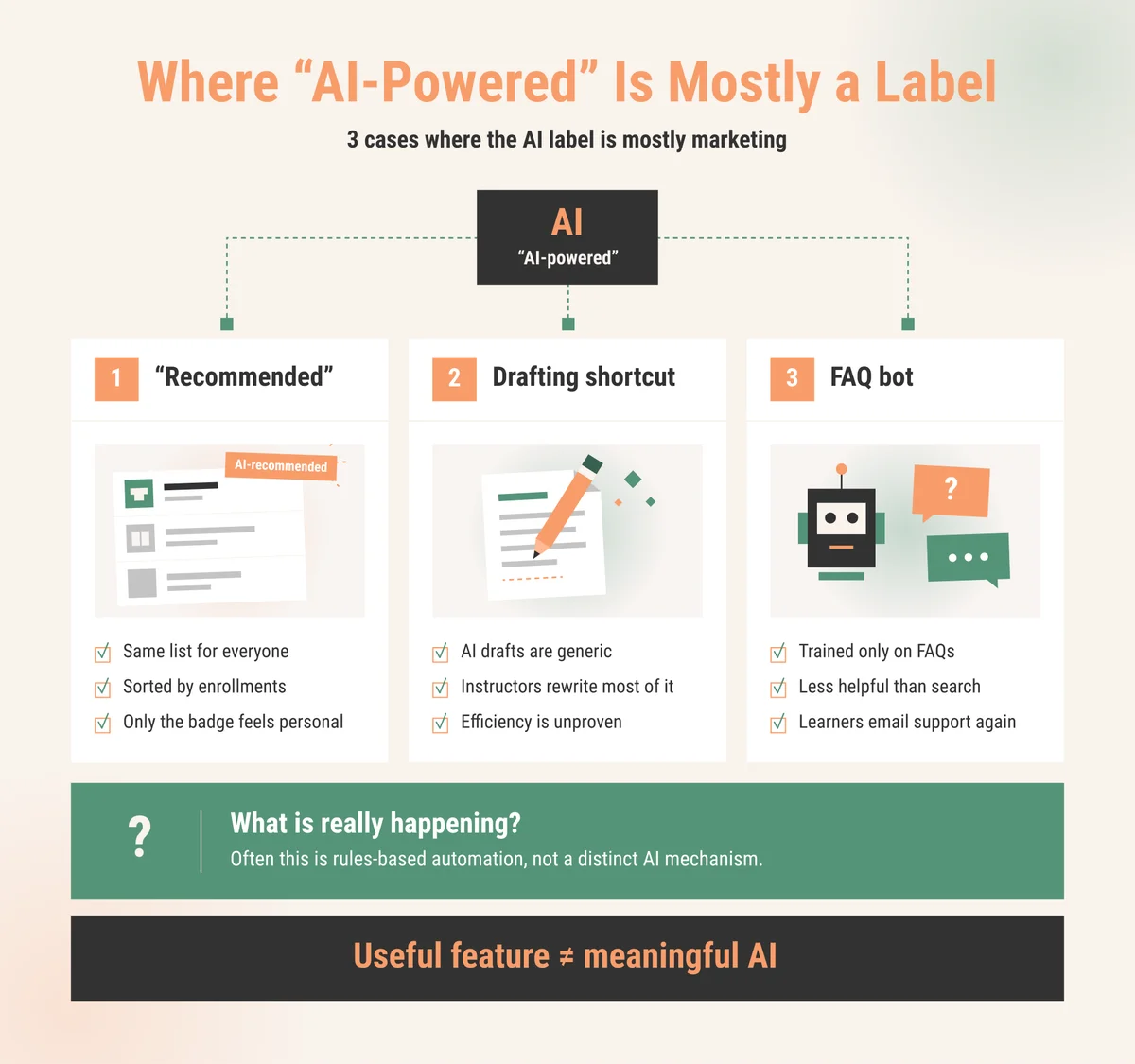
There are some features that bear the AI label even though they lack a specific mechanism. Three common situations:
The one labeled “recommended”. The course catalog has a tag that says “AI-recommended”. In reality, it’s simply a list that has been sorted according to enrollment figures. All learners see the same courses, so the only personalized element is the badge.
The drafting shortcut involves a vendor offering AI-generated content for use in creating courses. Because the drafts are rather generic, instructors have to rewrite most of them.
The time savings are never compared with the additional work required by the reviews, so the claim regarding efficiency has never been tested. The advantages and disadvantages of using AI in learning and development often boil down to costs such as this one.
The FAQ bot. The AI chatbot, which has been trained solely on the help-center FAQ, provides fewer useful answers than the search bar it had replaced; as a result, learners once again choose to email support.
The situation is similar with a great deal of LMS automation, for example, with scheduled reminders or alerts that trigger when a threshold is reached. Such features are useful, but they are essentially rules. In all these cases, “AI” is merely a marketing term added to functionality that was already there. This doesn’t mean the feature is inferior; it just means the label gives you no additional information.
Questions to Ask Before You Buy an “AI-Powered” LMS Feature
- What data does the feature actually use? Ask which fields, events, or xAPI learning data it reads, and how much history it needs before results become reliable.
- What is the model actually doing? Is it predicting, generating, classifying, or recommending? If the straightforward answer is that it’s applying a rule, then that is merely automation.
- How is quality measured? The way in which quality is assessed should be by asking about accuracy, the rate of false positives, or feedback from actual deployments. A 2026 review of research into dropout prediction points out that most models were tested using data from a single institution, so the results may not apply to your situation.
- Does it actually reduce the workload or merely shift it? An alert that generates three further tasks has not cut down on anyone’s working time.
- What becomes of learner data? Data privacy in the edtech sector raises concerns about storage, how long data is retained, third-party model providers, and whether learner data is used to train systems outside your organization.
Conclusion
AI features in learning management systems should be included only if they are narrowly focused, based on suitable data, linked to a clear method, and measurable. This standard does not oppose the use of AI, and it doesn’t require every feature to involve complicated technology. A basic rule-based alert that consistently reaches the right learner can perform better than a complex model no one trusts. The person who is buying should ask the vendors to show them the method and the results, not just be given an ‘AI-powered’ label.
Exploring AI features for your learning platform?
FAQ
What does “AI-powered LMS” actually mean?
It depends on the vendor. True AI-powered features use learner data to predict, generate, or adapt outputs to context, such as risk scores or answers grounded in course materials. Many “AI” features are rule-based automation.
Can predictive analytics reliably forecast learner dropout?
It can flag learners who are more likely to disengage, but it can’t guarantee a result. Reliability depends on historical data, similar cohorts, validation, and acceptable error rates, so predictions should trigger a human follow-up, not an automatic decision.
Is it safe to use AI-generated course content without review?
No. AI can speed up first drafts, but outputs may include factual errors, generic examples, or off-target material. A subject-matter expert should check every draft, and teams should track review time to confirm real savings.
How can you tell whether an LMS AI feature is useful or mostly marketing?
Ask the vendor to show the mechanism: what data the feature uses, what the model does with it, and how it measures quality. If removing the “AI” label changes nothing, it’s automation.
