

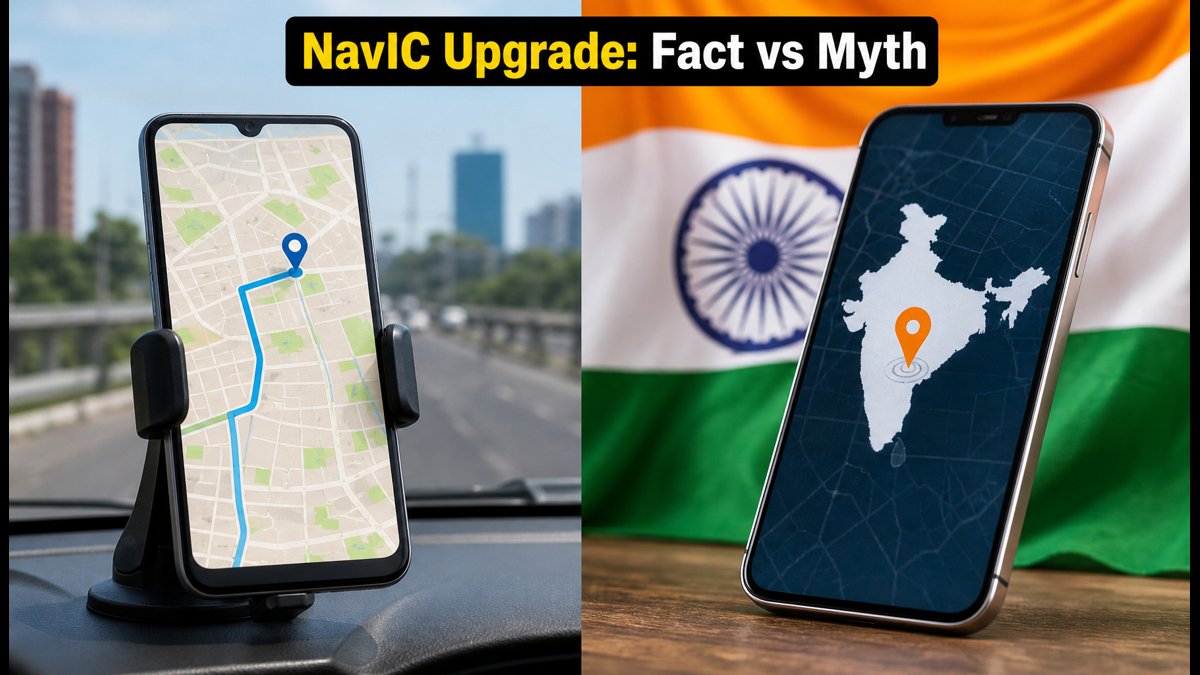
ISRO’s GSLV‑F18 will loft the NavIC NVS‑03 satellite tonight, October 30. For students and professionals, this launch matters beyond headlines. NVS‑03 adds the popular L1 signal. It strengthens smartphone availability and urban accuracy across India and nearby regions. That’s why myths about GPS versus NavIC on phones need urgent clearing.
First, check your phone. Update Android, enable Location Accuracy, and stand near open sky. Install the GPSTest app and watch for IRNSS or NavIC, and L1 or L5 signals. Many recent Qualcomm and MediaTek chipsets support NavIC, though activation depends on each manufacturer’s software and antenna design.

NavIC launch tonight: what NVS‑03 actually changes
NVS‑03 broadcasts L1 in addition to L5 and S, improving smartphone compatibility and resilience. ISRO informed Parliament in July 2026 that only three NavIC satellites then supported positioning, with timing active. NVS‑03 restores constellation depth, while NVS‑04 and NVS‑05 advance toward readiness.
GPS vs NavIC support: myths Indian users ask about
Android usually fuses signals from every constellation available on your device. There isn’t a map‑app toggle for NavIC. Battery impact is managed by the fused location stack. NavIC is regional; phones still use other constellations when needed. Here are quick clarifications students keep asking.
| Myth | Fact |
|---|---|
| “NavIC drains battery.” | Android’s fused provider optimizes power while combining sensors and GNSS. |
| “NavIC replaces GPS worldwide.” | NavIC covers India and about 1,500 km beyond; multi‑constellation remains best. |
| “Enable NavIC inside Maps.” | No user toggle; the OS picks satellites automatically for each fix. |
Do Indian apps actually use NavIC signals?
Apps like Google Maps call Android’s fused location provider, which picks satellites automatically. If hardware and software expose NavIC, those measurements feed the fix without extra settings. During emergencies, Android Emergency Location Service computes location on‑device and shares it only with responders.
NavIC mandates, coverage and offline limits in India
Vehicle trackers for public service and hazardous‑goods vehicles must be AIS‑140 compliant, including IRNSS or NavIC capability. There is no nationwide mandate yet for NavIC in all smartphones. NavIC covers India and roughly 1,500 km around it. GNSS works outdoors without data; indoors needs network aid.
NavIC careers in PNT: skills students can build now
Build depth in radio frequency basics, multi‑band antennas, sensor fusion, and Kalman filters. Practice with Android raw GNSS measurements and open logs. Track ISRO updates across transport, mapping, and timing to spot projects and internships. These skills map directly to fast‑growing positioning, navigation and timing roles.
Before tonight’s window, do a quick self‑audit. Update your phone, enable Location Accuracy, and test NavIC outdoors using GPSTest. Keep Maps updated for the best fused fixes. Students should bookmark ISRO and Android resources, then plan mini‑projects that turn new NavIC signals into career‑ready skills.
