

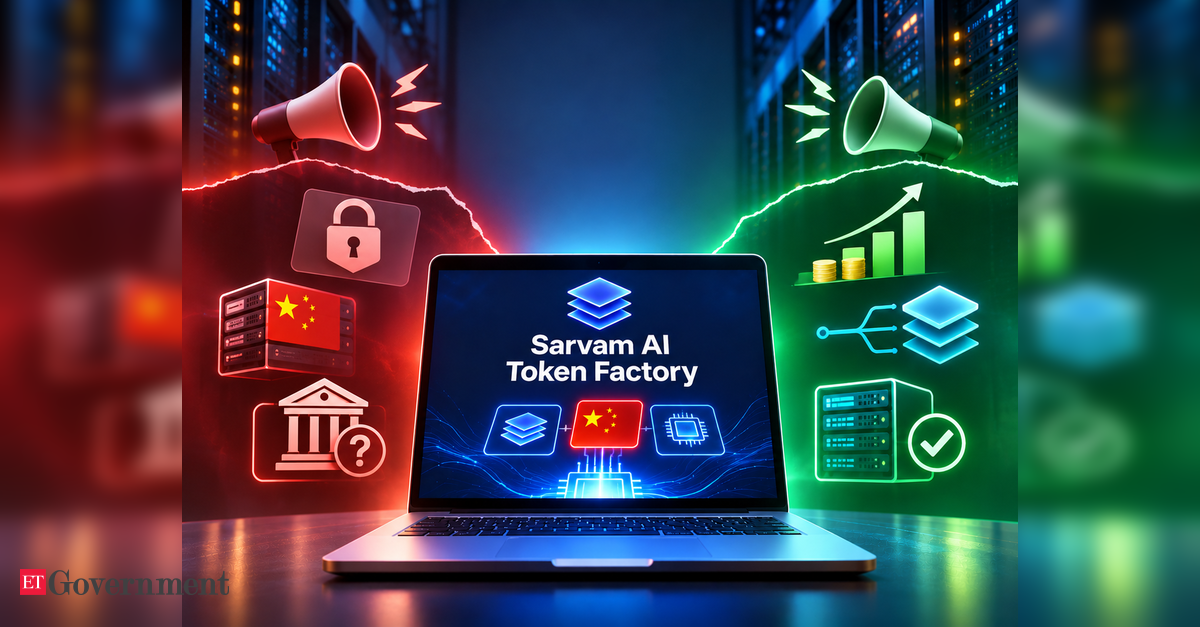

An artificial intelligence model developed in China, running on graphics processing units (GPUs) installed in India and serving Indian enterprises through an Indian technology company presents an interesting policy question: which part of this technological arrangement qualifies as sovereign AI?The location of the computing infrastructure, the ownership of the intellectual property, the jurisdiction under which data is processed, or the source of capital that finances the infrastructure?These distinctions have acquired significance following the controversy surrounding Sarvam AI’s Token Factory, a commercial inference platform launched on November 16 that provides access to Indian and foreign open-weight AI models, including those developed in China. On November 23, Sarvam clarified that the platform operates on privately procured GPUs and does not utilise the subsidised computing capacity allocated under the government’s IndiaAI Mission.According to the company, the subsidised computing resources were used to train its own 105-billion-parameter model, with the allocation ending in March 2026. The clarification addresses the immediate question of whether public subsidies are supporting the commercial deployment of foreign models. However, the separation of computing resources remains a company-reported claim that has not been independently audited or publicly confirmed by IndiaAI.The issue is not whether an Indian technology company should be permitted to commercially deploy foreign AI models. Rather, it is whether the government has established sufficiently transparent mechanisms to distinguish between publicly supported indigenous technology development and privately financed commercial operations.Approved in March 2024 with an outlay of ₹10,371.92 crore, the IndiaAI Mission seeks to address several structural weaknesses in India’s AI ecosystem, including inadequate access to computing infrastructure, dependence on foreign foundational models and the shortage of high-quality Indian datasets. Sarvam was among the companies selected by the government to develop indigenous foundational models.In a written reply to the Rajya Sabha on March 20, 2026, Minister of State for Electronics and Information Technology Jitin Prasada stated, “The focus is on large frontier models as well as smaller, specialised models.” The government envisages indigenous models being deployed across healthcare, education, agriculture, governance and other sectors requiring an understanding of Indian languages and socioeconomic conditions.Training foundational models and providing inference services are fundamentally different businesses. Training involves developing a model’s capabilities through extensive computational processing of datasets. Inference involves deploying a trained model to generate responses, analyse documents, write software or perform other computational tasks. While training requires substantial upfront investment, inference offers opportunities for recurring commercial revenues.Sarvam’s decision to operate a multi-model inference platform is, therefore, commercially understandable. Indian enterprises require access to models with different capabilities, computational requirements and pricing structures. Hosting foreign open-weight models domestically can reduce dependence on overseas application programming interfaces (APIs), improve latency and provide greater control over data processing.However, domestic hosting does not automatically establish technological sovereignty. An open-weight model may allow an Indian company to download, deploy and modify its parameters without relying on the original developer’s servers. But access to model weights does not necessarily provide access to the original training datasets, training methodologies or the complete intellectual property underlying its development. Nor does it guarantee access to subsequent generations of the technology.Sarvam’s technical documentation states that inference is processed on its India-based computing infrastructure rather than through the overseas APIs of the original model developers. Its catalogue includes models developed by DeepSeek, Alibaba and Moonshot AI, alongside its own foundational models. This arrangement addresses certain data residency concerns but does not eliminate risks associated with model vulnerabilities, embedded biases, licensing restrictions and technological dependence.On November 25, Electronics and IT Secretary S Krishnan defended Sarvam’s commercial strategy, indicating that the government saw no contradiction between its indigenous model development programme and its foreign-model offerings. “After all, AI companies also require a revenue model,” Krishnan told reporters. He indicated that the government did not see misuse of IndiaAI support, based on the information available to it.The government has itself recognised the strategic importance of democratising access to computing infrastructure. In an official statement in March 2026, the Ministry of Electronics and Information Technology stated, “The Government recognises compute as a public good for inclusive AI development.” More than 38,000 GPUs had been empanelled through 14 AI service providers at the time.As this publicly supported computing ecosystem expands, IndiaAI could introduce mandatory disclosures covering subsidised GPU hours, project-specific expenditure, commercially funded computing infrastructure and the technological outcomes achieved by beneficiaries. Independent verification of resource utilisation would strengthen accountability without requiring companies to disclose commercially sensitive technical information.There are also implications for government procurement. An AI platform hosted in India cannot necessarily be classified as indigenous merely because its servers are located within the country. Procurement frameworks for defence, intelligence, financial institutions and critical infrastructure must assess model provenance, licensing arrangements, cybersecurity vulnerabilities, operational control and the ability to maintain services independently of foreign developers.India must avoid imposing restrictions that deprive domestic businesses of access to competitive global technologies. Commercial inference services can generate revenues, develop engineering expertise and potentially finance subsequent investments in indigenous foundational models. However, the success of government-supported AI companies must also be evaluated through measurable advances in original research, model performance, intellectual property creation and technological independence.The Sarvam controversy presents an opportunity to establish a more precise definition of sovereign AI and corresponding standards of public accountability. India needs domestic computing infrastructure, competitive inference services and indigenous foundational models. Each serves a distinct economic and strategic purpose. Government policy must recognise these distinctions and ensure that public investment in AI produces technological capabilities that Indian institutions can own, develop and control.
