As India’s financial inclusion agenda moves from access to active usage, State Bank of India continues to occupy a central role in shaping the country’s banking landscape at scale.
With the largest branch network, the widest Customer Service Points footprint, and a dominant presence across Jan Dhan accounts, Social Security Schemes, MSME credit, and agricultural finance, SBI’s approach offers a revealing lens into how inclusion is being operationalised on the ground—quietly, systematically, and with long-term intent.
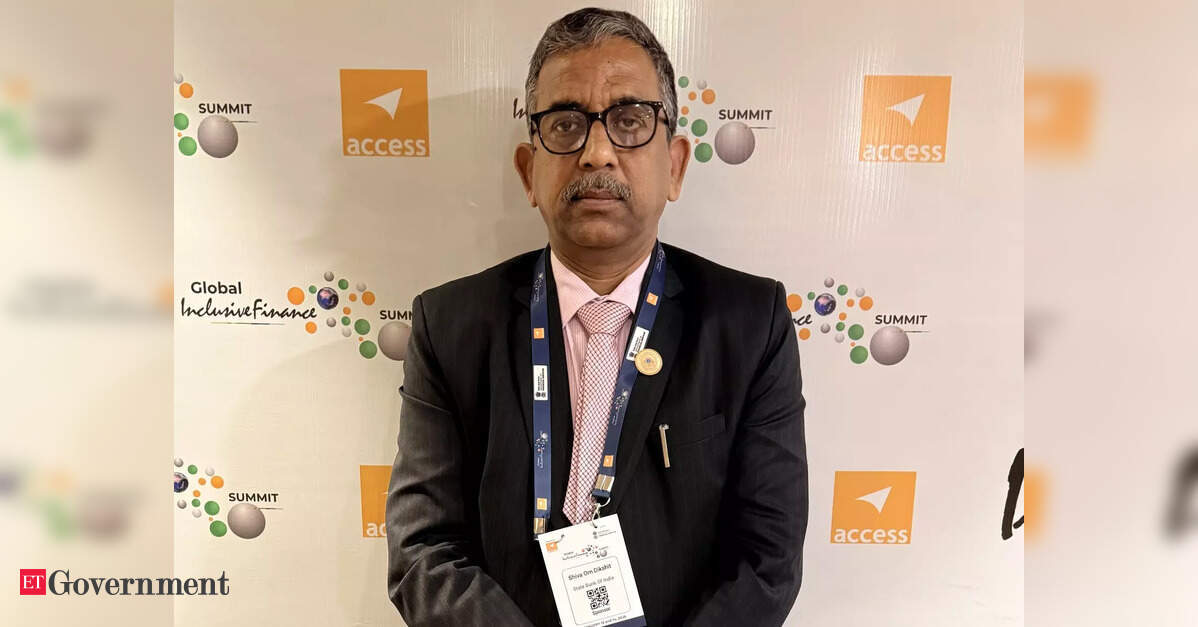
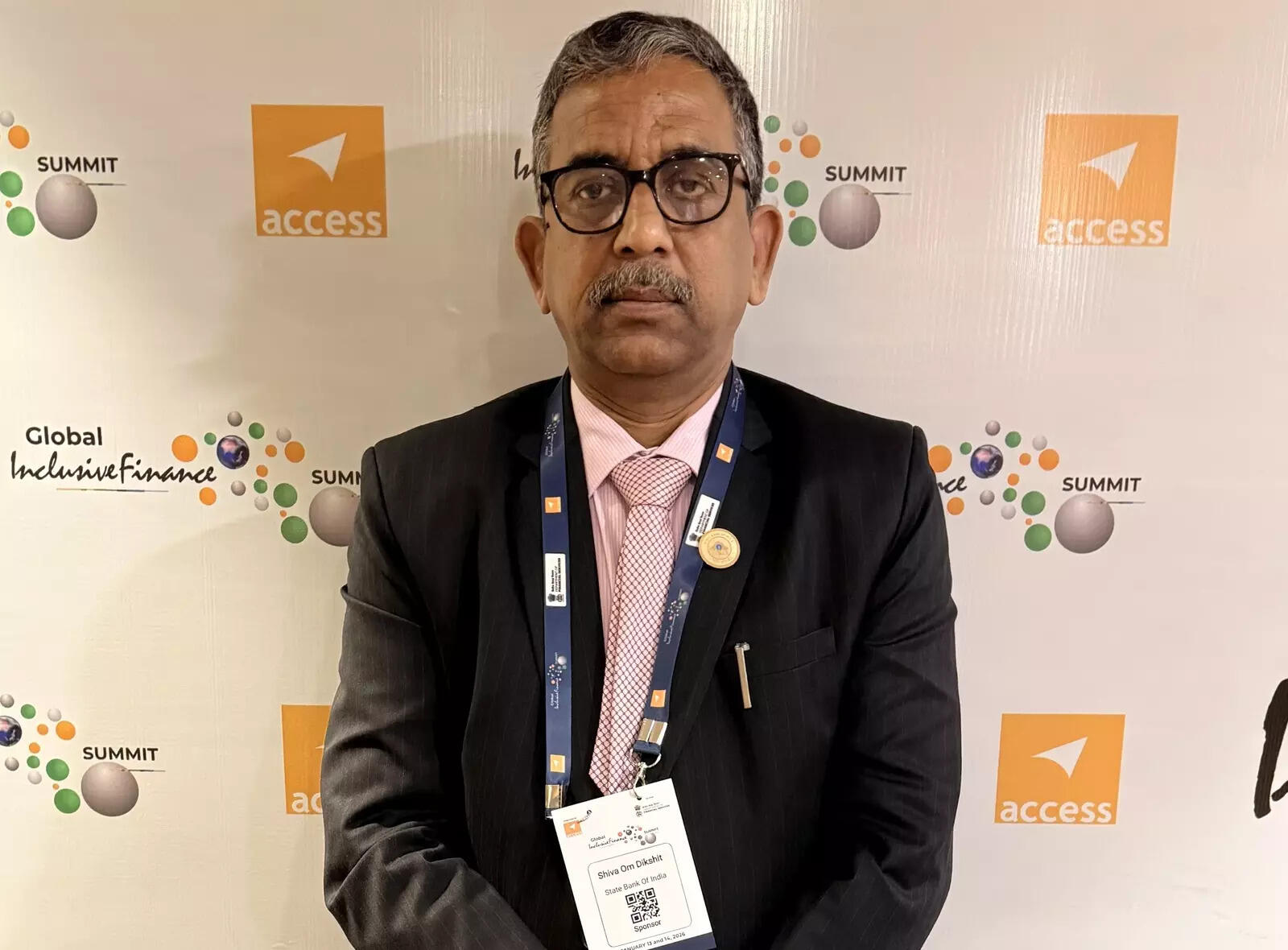
In this conversation with Anoop Verma, conducted on the sidelines of Global Financial Inclusion Summit, Shiva Om Dikshit, Deputy Managing Director, State Bank of India, reflects on SBI’s leadership in financial inclusion, its extensive use of Customer Service Points, the business logic behind inclusion-led banking, the role of digital payments and financial literacy, and the institution’s priorities as India moves toward universal and meaningful financial participation.
Edited excerpts
State Bank of India is the largest bank in the country and a key pillar of India’s financial system. How do you see SBI’s role in advancing financial inclusion?
State Bank of India has been at the forefront of financial inclusion in India, and that leadership is reflected in both scale and reach. If we look at the total number of bank accounts opened under the financial inclusion drive, SBI accounts for around 35 percent of the overall numbers. Out of around 57 crore Jan Dhan accounts nationwide, more than 15 crore have been opened by SBI alone.
Importantly, around 26 crore of citizens have been also enrolled by SBI alone under social security schemes such as Pradhan Mantri Jeevan Jyoti Bima Yojana (PMJJBY), Pradhan Mantri Suraksha Bima Yojana (PMSBY), and Atal Pension Yojana (APY). In fact, SBI commands nearly 47% share amongst all Public Sector Banks in PMJJBY, 39% in PMSBY and 32 % in APY.
This outreach is enabled by our extensive physical and human infrastructure. SBI operates through more than 23,000 branches and around 80,000 Customer Service Points across the country. Together, this creates more than one lakh touchpoints, allowing us to go far beyond basic account opening.
Through Customer Service Points, we provide nearly 44 different banking services, including deposits, withdrawals, KYC updates, account activation, and Aadhaar seeding. Financial inclusion at SBI is therefore not just a policy objective, it is embedded into our everyday operations.
Much of India’s financial inclusion story is often associated with microfinance institutions. What role does SBI play in this ecosystem?
Microfinance institutions have indeed played a significant role, particularly in last-mile credit delivery. SBI’s approach, however, is broader and more structural. While we may not always lend directly through microfinance institutions, we provide the banking backbone that supports the ecosystem.
At the same time, SBI’s direct lending to priority sectors is substantial. Our SME loan book is approximately ₹5.5 lakh crore, and agricultural lending is close to ₹4 lakh crore. Together, this means nearly ₹9.5 lakh crore has been deployed toward SMEs and agriculture. In the self-help group space, SBI has financed close to 1.3 million SHGs, benefiting nearly 13 million members. Our SHG loan book alone is about ₹ 64,000 crore.
Additionally, under government-sponsored schemes such as Mudra, PM SVANidhi, and PM Vishwakarma, nearly 35 percent of the total lending is accounted for by SBI. Much of this work is done quietly, without publicity, but at a scale that few institutions can match.
With the Union Budget approaching, should we expect new initiatives from SBI to further deepen financial inclusion?
Our focus is less on budget announcements and more on execution. One area we are actively strengthening is the customer service point network. Currently, about 22 percent of our CSPs are operated by women, and we are working to increase this share to around 25 percent. We also plan to expand the total number of CSPs to one lakh.
A key innovation we are pursuing is the mobile CSP model. In difficult or underserved geographies where fixed banking infrastructure is not viable, mobile CSPs will operate through a hub-and-spoke model, using two-wheelers to reach remote habitations. The idea is to take banking services to places where people cannot easily come to the bank, rather than expecting the opposite.
From a business perspective, are financial inclusion activities viable, or are they essentially non-profit obligations subsidised by large corporate lending?
Our philosophy has evolved over time. What was once seen purely as an obligation has now become an opportunity. Financial inclusion is not evaluated by us primarily through the lens of profit and loss.
To give you one indicator, of the total deposits generated through financial inclusion initiatives (PMJDY), nearly 25 percent are with SBI. This has helped us build a deposit base of roughly ₹70,000 crore from these segments alone. More importantly, we are instilling a culture of savings among first-time account holders. That behavioural change has long-term value for both the individual and the banking system.
We do not assess financial inclusion programmes purely on profitability. If deposits generated through these accounts are used for lending, there is notional income, but income is never the primary objective. The commitment comes first, the financial outcome is secondary.
Is SBI moving toward more targeted or segment-specific lending, such as gender-sensitive finance or community-based credit models?
Yes, and much of this is driven by ground-level insights. With more than 23,000 branches across India, supported by regional and local head offices, we continuously study local economic patterns and credit needs.
Cluster-based financing is a major focus area for us. Under this approach, we design lending products that address the specific needs of clusters—whether they are artisans, small manufacturers, or service providers. The “One District One Product” initiative is being taken very seriously by SBI, as it helps us tailor credit to local strengths while expanding our customer base.
Sector-specific finance is not new to us. SBI has been financing activities such as cattle rearing, barber shops, small iron works, and rural trades for decades—long before the term “financial inclusion” became popular. What has changed is the scale and the policy framework, which now allows us to do this more systematically.
Digital payments have transformed inclusion, but there are concerns about fraud and cyber risks, especially for first-time users. How is SBI addressing this?
Digital platforms such as UPI have been transformative. Today, nearly 98.6 percent of SBI’s transactions are on Alternate Channel and about 90 percent of total transactions happen through digital, especially UPI. That said, cyber risks are real, especially for vulnerable users.
Our primary response is Financial literacy and awareness. Through customer service points and literacy centres, we conduct regular education campaigns on safe digital practices. Demonstrations are given at the time of account opening, especially in rural areas. When we issue QR codes to merchants, we also provide hands-on training on how to use them securely.
Cyber risks cannot be eliminated entirely, but that can be significantly mitigated through continuous awareness and handholding, which is what we are focused on.
Looking ahead, what are SBI’s financial inclusion goals over the next five years?
Our first goal is universal coverage. Every eligible citizen should have a bank account, and we are aiming for 100 percent saturation under schemes such as PM Jan Dhan Yojana. The second goal is usage. Accounts must be actively used, not just opened.
We are upgrading the range and quality of services delivered through Customer Service Points and ensuring that digital transactions become the norm. When we open accounts for merchants, QR codes are issued by default, and demonstrations are conducted on the spot. This approach is already changing transaction behaviour.
We believe that India is moving steadily toward a predominantly digital banking system. The remaining challenge is the issue of inoperative accounts, many of which exist due to multiple accounts opened by the citizens during the early years of Jan Dhan. These are mostly zero-balance accounts, and SBI does not impose penalties on them. We have also corrected legacy issues related to charges and protocols to ensure that no customer is unfairly penalised.
With greater interoperability, better data sharing, and continued awareness, we are confident that financial inclusion in India will not only be universal but also meaningful and sustainable.