

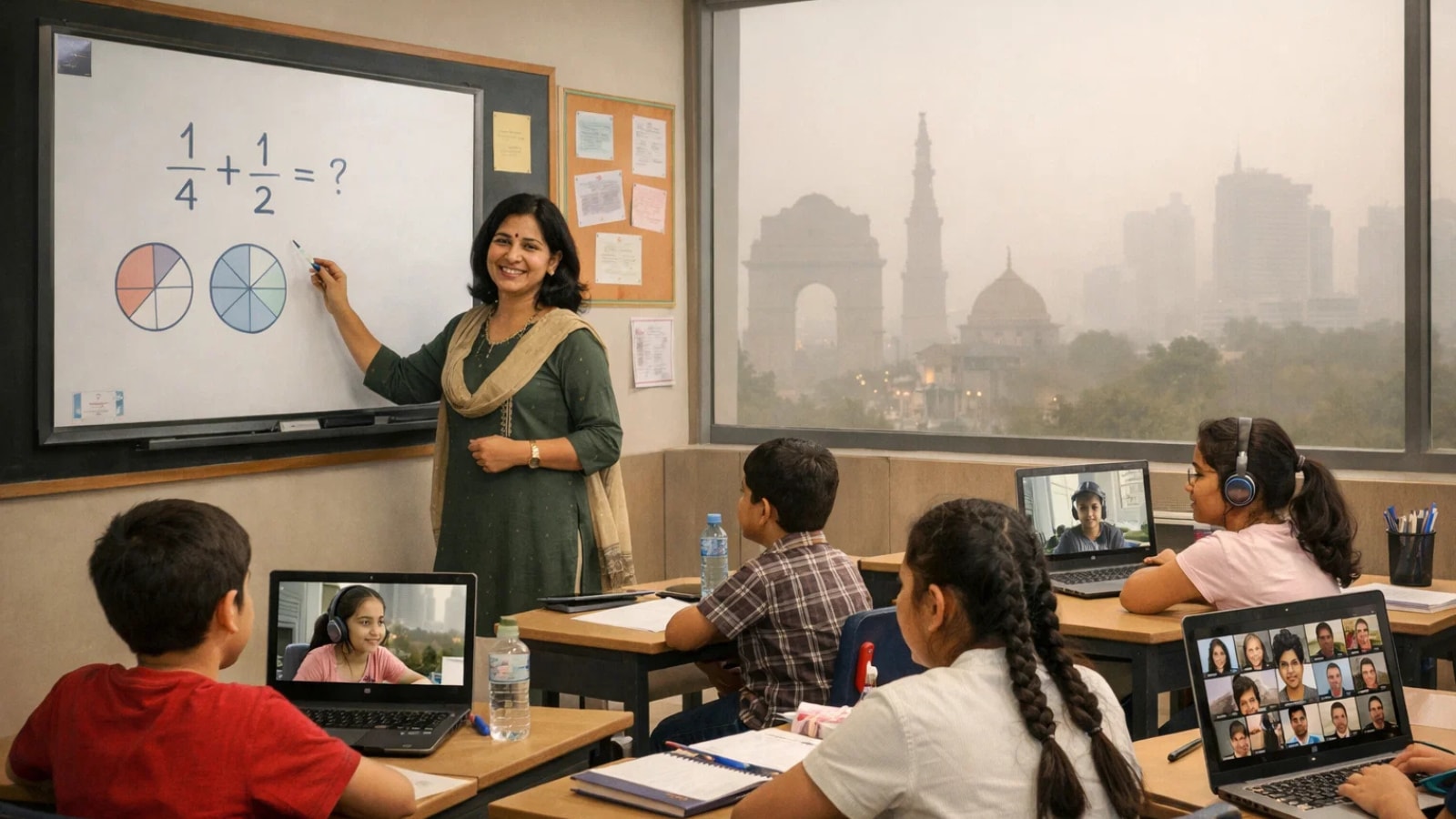
In response to the deteriorating air quality in the National Capital Region (NCR), the Office of the District Inspector of Schools (DIOS), Gautam Budh Nagar, has mandated a shift to hybrid learning for schools across Delhi and neighbouring districts. The new directives, falling under Stages 3 and 4 of the Graded Response Action Plan (GRAP), aim to minimise children’s exposure to toxic smog while ensuring educational continuity.
Read | School time changed: Delhi-NCR parents on sporadic school closures, time change

Under stage 3 of the GRAP, state governments in the NCR and the Government of the National Capital Territory of Delhi (GNCTD) have to mandatorily implement hybrid classes (simultaneous physical and online modes) for children up to Class 5. This order is strictly enforceable in the following jurisdictions:
–NCT of Delhi
–Gurugram
–Faridabad
–Ghaziabad
–Gautam Budha Nagar (Noida/Greater Noida)
As pollution levels hit the severe+ category, stage 4 protocols extend these mandatory hybrid requirements to older students. Classes 6 through 9 and Class 11 must also transition to the hybrid model within the same territorial jurisdictions.
In both stages, the CAQM has clarified that the choice to opt for online education — wherever available — rests entirely with the students and their parents. Schools cannot compel physical attendance if a parent chooses the remote option due to health concerns.
| GRAP Stage | Affected Classes | Mode of Education |
| Stage III | Nursery to Class 5 | Mandatory Hybrid (Physical + Online) |
| Stage IV | Classes 6–9 and 11 | Mandatory Hybrid (Physical + Online) |
Additionally, schools in UP’s Gautam Buddha Nagar, including Noida, Greater Noida, Dadri, and other localities, will remain functional from 10 am to 3 pm. This will be applicable for all government-run and non-government schools, including CBSE, UP Board, IB, ICSE, and others.
Classes for 10 and 12 will generally continue in physical mode to accommodate board exam preparations, subject to further departmental notifications. The authorities have urged schools to ensure that the necessary digital infrastructure is active so that students opting for the online mode are not academically disadvantaged.
Story continues below this ad
Schools in Delhi-NCR had remained closed earlier this week due to extreme cold conditions and were scheduled to reopen in the week of January 16. However, the sudden spike in pollution and the imposition of GRAP Stage IV will likely prompt authorities in the region to reassess the continuation of physical classes, especially for younger students.
GRAP, or the Graded Response Action Plan, is a structured set of emergency measures enforced in Delhi-NCR to control rising air pollution. It lays down stage-wise restrictions based on AQI levels, with stricter curbs coming into effect as pollution worsens.
What’s happening in other states?
Punjab
The Punjab government had revised school timings across the state in view of prevailing winter conditions. As per an official notice issued by the state education authorities, all government, aided, and private schools in Punjab will function with reduced hours from January 16 to January 21, 2026.
According to the notice, primary schools will operate from 10 am to 3 pm, while upper primary, secondary and senior secondary schools will function from 10 am to 3.30 pm during the revised schedule. The order also directs school heads to strictly adhere to the modified timings and ensure that students are not required to report to school before the stipulated hours.
Story continues below this ad
Jammu and Kashmir
In the winter zone of the Kashmir Valley, including Srinagar, as well as the Jammu region, the government has announced the winter vacation schedule for schools amid plunging temperatures. Schools up to Class 8 will reopen on March 1, 2026, while higher classes will resume a week earlier on February 22, 2026, as temperatures across Kashmir continue to fall several degrees below freezing.
© IE Online Media Services Pvt Ltd
