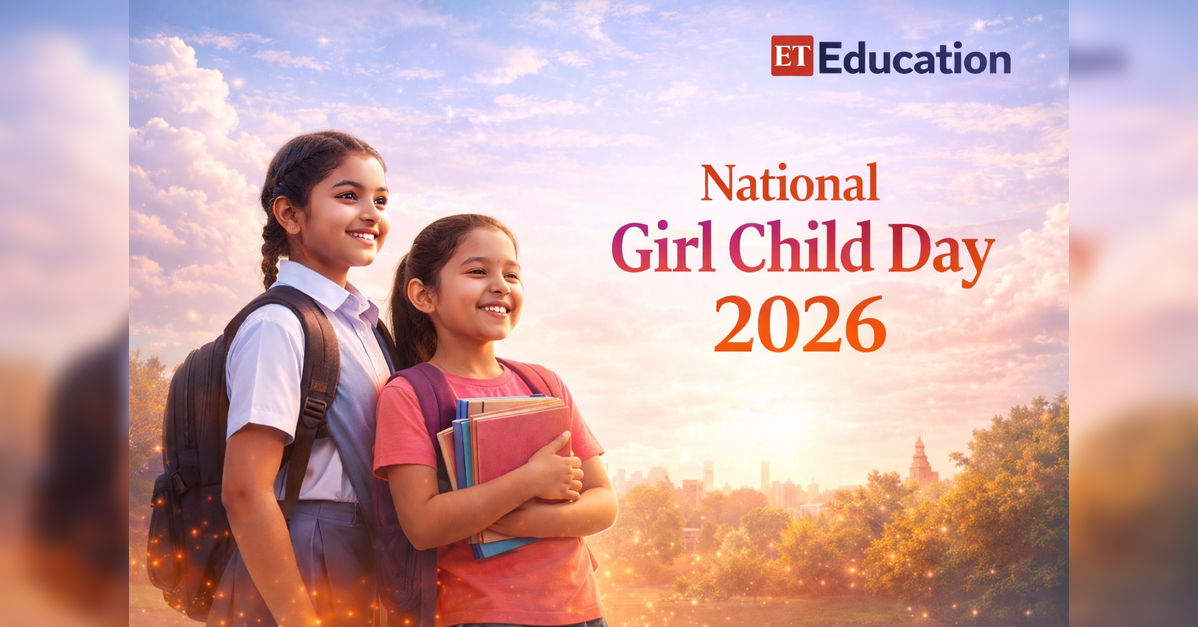
When confidence is taught, courage follows
Every generation of India’s girls carries a quiet revolution within it. Some raise their hands in classrooms that once silenced them. Some walk into laboratories, boardrooms, sports arenas, and public offices where women were once rare. And some, still very young, are simply learning to believe that they belong.
On National Girl Child Day 2026, the spotlight is not just on achievement, but on the beliefs that make achievement possible. Because before a girl leads, invents, or breaks records, she must first be told and shown that her voice matters.
India has seen this truth unfold across centuries. Savitribai Phule, India’s first female teacher, challenged social orthodoxy in the 19th century by opening schools for girls and marginalised communities, proving that education itself is an act of courage. Rani Lakshmibai of Jhansi led with battlefield strategy and fearlessness, rewriting the idea of leadership for women. Sarojini Naidu used poetry and oratory to awaken a nation, while Indira Gandhi demonstrated decisive governance on the global stage. From Kalpana Chawla, who expanded the frontiers of space science, to Lata Mangeshkar, whose voice shaped India’s cultural soul, belief has always preceded greatness.
In modern India, that legacy continues through women who mastered institutions and industries. Kiran Mazumdar Shaw built Biocon into a global biopharmaceutical powerhouse. Indra Nooyi, Former PepsiCo CEO and Board Member Amazon, redefined corporate leadership by blending purpose with performance. Sudha Murty showed how compassion, education, and philanthropy can quietly transform millions of lives.
It is this continuum of belief, from classrooms to boardrooms, that education leaders today are shaping with intent.
Reflecting on the foundational role institutions play in shaping this belief, Dr Rajul K Gajjar, Vice Chancellor, Gujarat Technical University, emphasised that confidence must be cultivated through relevance and practice.
“Institutions must consistently foster self-confidence and self-worth in girls, through real world problems and their solutions. This will enable the students to believe in their abilities, express their perspective with assurance, and engage in society with clarity and purpose.”
Echoing this sentiment, Dr Vishal Dahiya, Director, Sardar Vallabhai Global University, highlighted that belief grows strongest when opportunity is truly equal and voices are genuinely heard.
“Institutions must reinforce the value of self-belief by giving equal opportunities .When girls are assured that their voices matter and their ambitions & dreams are valid, they feel trusted and gain the confidence to challenge limitations, learn fearlessly and move forward with clarity, resilience and a strong sense of purpose in every field they choose.”
From school ecosystems, Reema Dewan, Director, DPS Chandigarh & Mohali, reflected on how empowerment must move beyond access to intent and action.
“Celebrating the National Girl Child Day 2026 (24 January) indeed echoes the vibe of the rising confidence, capability and ambition of India’s girls. By fostering a culture of psychological safety and intellectual risk-taking, we must move beyond mere enrollment to true empowerment. When we in schools validate a girl’s voice as inherently strong and assertive, we equip her to dismantle stereotypes and lead in every field.
Our Women’s Cricket Team’s winning the World Cup 2025, proves realising destiny through action, focussing on passive hope to active certainty. For our Bharat ki Beti, I manifest that not just one day, but each day is her Day, in every way!!”
At the higher education level, the idea of belonging emerged as a critical pillar. Prof Sanjeev Prashar, Director, Indian Institute of Management Raipur, spoke about how supportive environments shape ambition.
“Institutions must help girls truly believe that they belong and that their voice counts. When learning spaces are supportive, respectful, and encouraging, girls gain the courage to speak up, take risks, and dream bigger. Confidence grows when effort is appreciated, mistakes are accepted, and guidance is always available.”
From the lens of science, innovation, and leadership, Prof KK Pant, Director, IIT Roorkee, reinforced that aspiration must be affirmed consistently.
“The most important belief institutions must reinforce is that every girl belongs at the forefront of knowledge, innovation, and leadership. When education consistently affirms girls’ agency, aspirations, and voice, it transforms confidence into capability, enabling them to lead with purpose, resilience, and a global outlook.”
At the school level, entrepreneurship and relevance emerged as key enablers. Anju Mehta, Founder Principal, Dass and Brown School, underlined the need to rethink curriculum and mindset.
“All institutions should consciusly instill confidence in all K-12 girls and beyond to have an entrepreneurial mindset so as to become leaders and agents of social mobility. This can only happen when all are willing to move out of the head-heavy curriculum and grade- centric approach to relevant learning by adapting to the changing times and shifting our mindsets from local to global. Women comprise over 48% of India’s 1.45 billion population, and our efforts should resonate with the Viksit Bharat 2047 mission that will enable a shift from women development to women led development.”
Before leadership became a headline and empowerment a policy goal, India had women who fought their battles with books and blackboards. In the 19th century, Savitribai Phule transformed education into an act of defiance, opening school doors to girls when society insisted they remain closed. Her conviction still echoes. Her conviction still echoes.
“Awake, arise and educate, smash traditions, liberate.”
Her legacy reminds us that every confident girl today stands on the courage of women who first insisted that education itself was non negotiable.
Empowering girls, empowering communities
From the grassroots, Santanu Mishra, Co-founder, Smile Foundation, highlighted that empowerment is most effective when it includes the family and community.
“Our experience at the grassroots has underscored the significance of a life cycle approach. We firmly believe that institutions must champion one core value: comprehensive education and empowerment for the girl child and her family. This approach will enable her as well as her family to support every step of her journey.”
Adding a deeply human perspective, Dr Apoorva Haree, Executive Director, Rajalakshmi Group Of Institutions, Chennai, spoke about solidarity and mentorship.
“While encouraging women to dream big and break glass ceilings is important, real progress happens when women learn to lean on one another. Strong support systems; at home, at work, and through mentorship; make ambition sustainable. Women uplifting women, sharing responsibility, and being each other’s cheerleaders is the strongest foundation for lasting success.”
Bringing the conversation full circle, Dhananjay Ganjoo, Chief Resource Mobilisation and Communication Officer, The Akshaya Patra Foundation, reinforced that equity must be embedded into everyday practice.
“Institutions must consistently reinforce the belief that gender equity is not a concession but a foundation for progress. Given the right support, every girl can rise beyond limitations and shape her own future. We must embed empathy, inclusion and structural support in daily practice to provide every girl a safe and empowering environment for holistic development, starting from the classroom. Just as flexible work policies and equal opportunities for growth ensure that women thrive, classrooms that encourage participation and leadership ensure that girls flourish. We should create a culture where girls feel empowered to dream, lead and contribute meaningfully. When you educate a boy, you impact a family. But when you educate a girl, you impact generations.”
As classrooms become more inclusive, aspirations more ambitious, and institutions more intentional, India’s girls are not waiting to be empowered. They are already stepping forward, equipped with belief, backed by opportunity, and guided by voices that affirm their worth. Their stories are not exceptions. They are signals of what is possible.
From dreams to destiny
Perhaps Kalpana Chawla, whose journey from a small Indian town to the vastness of space continues to inspire generations of girls, captured it best.
“The path from dreams to success does exist. May you have the vision to find it, the courage to get on to it, and the perseverance to follow it.”
On National Girl Child Day 2026, India is reminded that when confidence is taught early and consistently, courage does not ask permission. It rises, it leads, and it changes the world.