

3 min readNew DelhiUpdated: Feb 11, 2026 06:33 PM IST
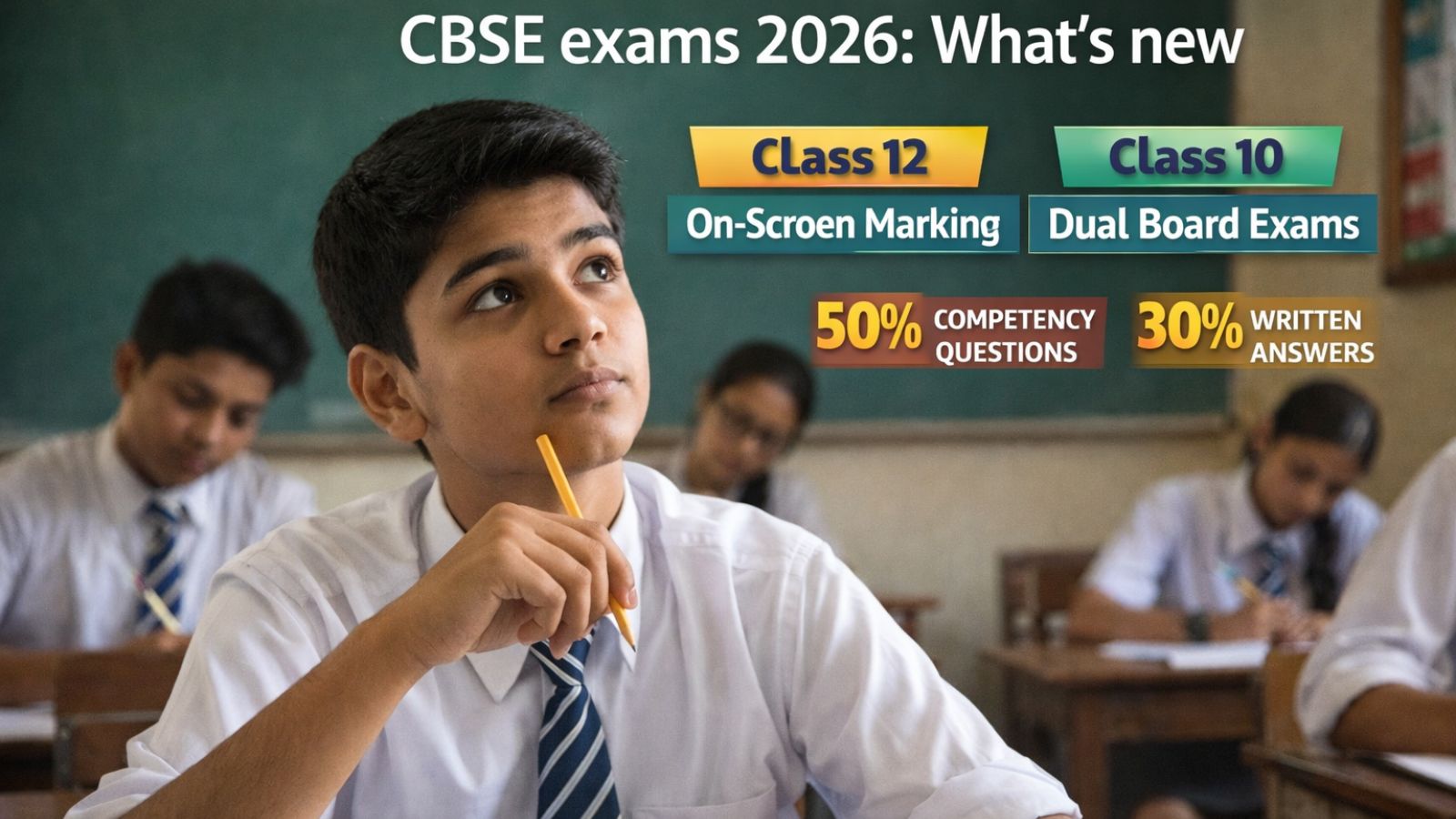
The Central Board of Secondary Education (CBSE) has rolled out a series of structural changes for the 2026 board examinations, impacting both Class 10 and Class 12 students. The reforms span three key areas — exam pattern alignment under NEP 2020, introduction of two board exams for Class 10, and the launch of On-Screen Marking (OSM) for Class 12 answer sheets.
Here’s a list of changes to help students, parents, and schools understand what’s new for 2026 exams.

On-Screen Marking (OSM) for Class 12
In a major reform, CBSE has announced the introduction of On-Screen Marking (OSM) for the evaluation of Class 12 answer books beginning with the 2026 examinations.
The Board conducts annual Board examinations for Classes 10, 12 for nearly 46 lakh students across India and 26 countries. With this shift, Class 12 answer scripts will now be evaluated digitally instead of the traditional physical mode. However, Class 10 answer books will continue to be evaluated physically in 2026.
Read | ‘How the two Class 10 Board exam sessions will be structured’: CBSE exam controller answers
According to the official circular dated February 9, 2026, the Board has outlined several advantages:
–Elimination of totalling errors
–Automated coordination, reducing manual intervention
–Faster evaluation with wider teacher participation
–Savings in transportation time and costs
–Teachers can remain in their schools and continue regular duties
–Post-result verification of marks will no longer be required
–Reduced manpower requirement for verification
–Opportunity for all schools to contribute to evaluation
–Involvement of teachers from affiliated schools globally
–Environmentally sustainable digital evaluation
Story continues below this ad
Although details from the CBSE are awaited, this effectively means that answer sheets will be digitised, and teachers will mark them online instead of physically travelling to evaluation centres.
Dual Board Examinations for Class 10
CBSE has also issued a notification dated June 25, 2025 regarding two board examinations for Class 10 starting 2026.
While detailed operational guidelines are issued separately, the notification formally confirms that Class 10 students will have the option of appearing in two board examinations beginning 2026.
This reform is in line with NEP 2020’s recommendation to reduce high-stakes pressure associated with single-board exams and provide students with an opportunity to improve performance. The dual-exam structure is expected to:
–Reduce exam stress
–Offer flexibility
–Provide improvement opportunities within the same academic cycle
Story continues below this ad
Revised question paper composition (Classes 10 & 12)
One of the most significant structural changes shaping the 2026 board exams is not new in announcement — but new in impact. Through Circular No. Acad-30/2024 dated April 3, 2024.
CBSE formally aligned its question paper design with the National Education Policy (NEP) 2020, accelerating its transition from rote-heavy examinations to competency-driven assessment.
While the circular came into effect from the 2024–25 academic session, the 2026 board exams will be among the first full cycles where students have prepared entirely under this restructured format.
What does the paper now look like?
For both Class 10 and Class 12 theory exams, the structure is now clearly defined:
Story continues below this ad
- 50% Competency-Focused Questions: These include case-based questions, source-based integrated questions, application-driven MCQs, and other formats that test understanding in real-life contexts rather than memory recall.
- 20% Select Response Type Questions (MCQs): Standard objective questions designed to assess conceptual clarity quickly and precisely.
- 30% Constructed Response Questions: Traditional short- and long-answer questions — now reduced in weightage.
This effectively means that long-answer writing — once accounting for nearly half the paper — now carries significantly less weight.
