

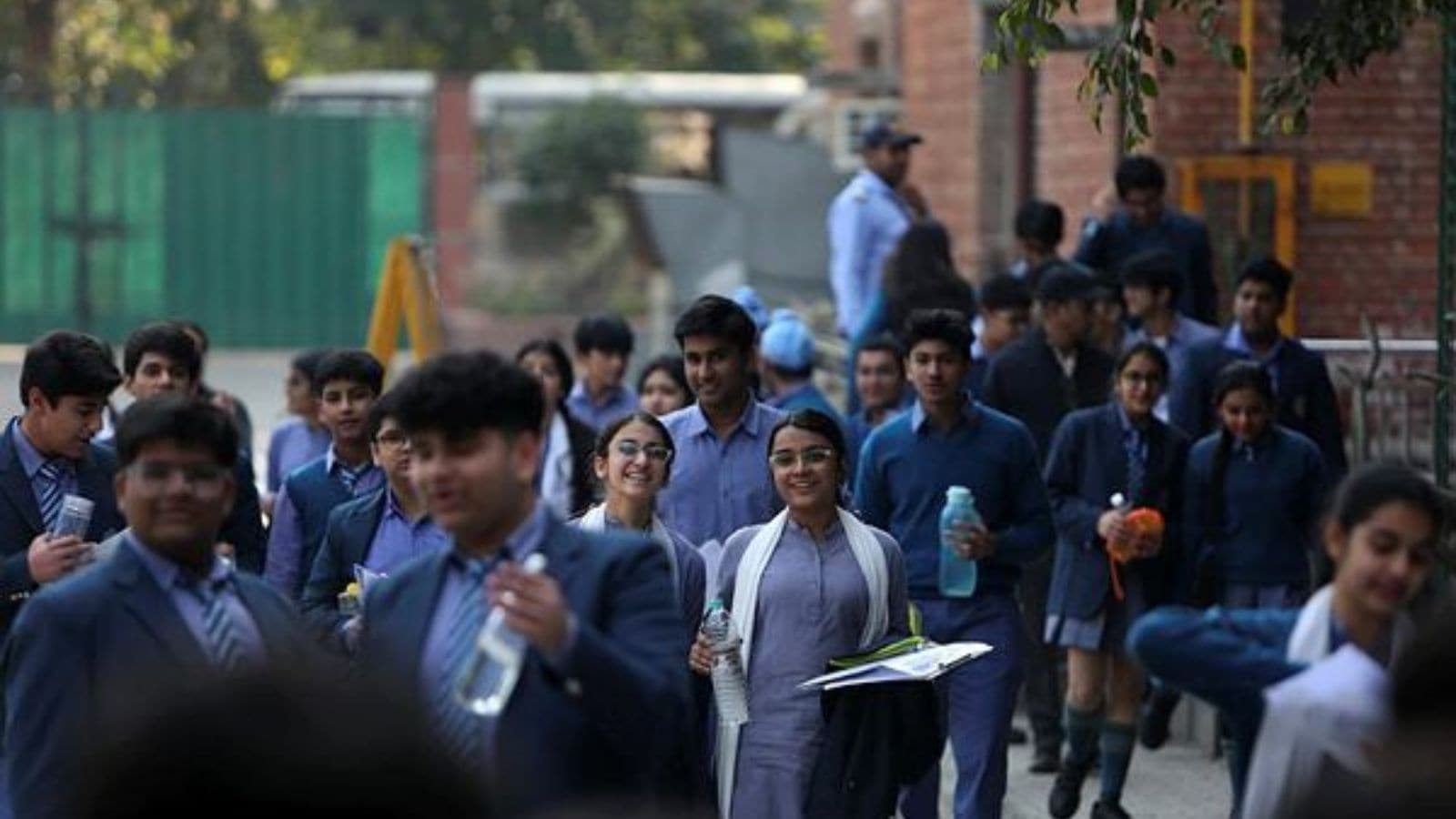
The Central Board of Secondary Education (CBSE) on February 17 held the standard mathematics and basic mathematics papers of Class 10. Experts and students who appeared for the exam on the first day of Class 10 CBSE 2026 board exams said that the papers were easy to comprehend and well-balanced across sections. The difficulty level of the CBSE 2026 Math Class 10 questions was easy to moderate, the experts say.
According to Tanmoy Das, PGT Mathematics, Modern English School, Kahilipara, Guwahati, Assam, the recent Basic Mathematics examination is generally perceived as being of a moderate difficulty level, offering a fair balance between foundational concepts and critical thinking.

Read More | CBSE Class 10th, 12th Boards 2026: Type of pen, water-bottle, admit card, and other instructions for students
While the paper followed a familiar structure, the Multiple-Choice Questions (MCQs) stood out for being notably lengthy, Das added, saying that the initial questions required students to invest significant time in analysis and calculation, demanding more than just a surface-level understanding to navigate the options effectively.
The maximum marks in the Basic Mathematics paper are 80, and the time allowed is three hours. The question paper contained 38 questions, and all questions were compulsory. The paper was divided into five sections: A, B, C, D, and E.
In Section A, question numbers 1 to 18 were multiple choice questions (MCQs), and question numbers 19 and 20 were Assertion-Reason based questions of one mark each.
In Section B, question numbers 21 to 25 were very short answer (VSA) type questions carrying two marks each.
Story continues below this ad
In Section C, question numbers 26 to 31 were short answer (SA) type questions carrying three marks each.
In Section D, question numbers 32 to 35 are long answer (LA) type questions carrying five marks each.
In Section E, question numbers 36 to 38 are case study-based questions carrying four marks each, with sub-parts of 1, 1, and 2 marks, respectively.
There was no overall choice in the Math Basic paper. However, an internal choice was provided in two questions of Section B, two questions of Section C, and two questions of Section D. An internal choice was also provided in all the two-mark questions of Section E.
Story continues below this ad
In contrast, the case study questions, the Assam PGT teacher said, were lauded for their directness and clarity. Since many of these problems reflected scenarios that students had repeatedly practised, they were considered common and highly approachable, he added.
The 5-mark section also featured straightforward, “good” questions that allowed students to demonstrate their depth of knowledge, although a specific problem regarding circles introduced a “tricky” element that tested higher-order thinking skills. The short-answer sections maintained this balanced tone, with 3-mark questions falling into the moderate category and 2-mark questions being described as easy and direct.
However, examiners cleverly embedded a probability question in the 2-mark section that, while seemingly simple, served as a tool to evaluate the students’ ability to apply mathematical concepts to practical scenarios. Overall, the paper rewarded students who had focused on consistent practice and application-based learning, the teacher added.
The maximum mark for the Standard Math paper was also 80, and the time allowed was three hours. The question paper contained 38 questions, and all questions were compulsory. The paper was divided into five sections: A, B, C, D, and E.
Story continues below this ad
In Section A, question numbers 1 to 18 were multiple choice questions (MCQs), and question numbers 19 and 20 were Assertion-Reason based questions of one mark each.
In Section B, question numbers 21 to 25 were very short answer (VSA) type questions carrying two marks each.
In Section C, question numbers 26 to 31 were short answer (SA) type questions carrying three marks each.
In Section D, question numbers 32 to 35 were long answer (LA) type questions carrying five marks each.
Story continues below this ad
In Section E, question numbers 36 to 38 were case study-based questions carrying four marks each, with sub-parts of one, one, and two marks respectively.
There was no overall choice in the paper. However, an internal choice is provided in two questions of Section B, two questions of Section C, and two questions of Section D. An internal choice was also provided in all the 2-mark questions of Section E.
