

The SEBI Grade A phase 2 exam has been scheduled to be held on 21st February 2026, based on the feedback that will be share by the candidates we will update the details related to the SEBI Grade A phase 2 exam.
In this blog, we have provided details related to the types of questions, the difficulty level, and the topics from which questions have been asked, along with information about the types of questions that were previously asked in the SEBI Grade A Phase 2 exam, the exam trend, and more.
SEBI Grade A Phase 2 Difficulty Level, 21st February 2026
The Securities and Exchange Board of India (SEBI) Grade A Phase 2 Exam has been held on 21st February 2026. The overall and section-wise difficulty level will be updated shortly based on the detailed feedback and exam reviews shared by candidates who appeared for the exam on 21st February 2026.
| Paper | Number of Questions | Difficulty Level |
| Paper 1: Common for All Streams | English (Descriptive Test) – Essay (30), Precis (30), Comprehension (40) | TBA |
| Paper 2: General Stream | 100 MCQs on Commerce, Accountancy, Management, Finance, Costing, Companies Act & Economics | TBA |
| Paper 2: Legal Stream | 70 Stream Specific Objective Questions 3 Descriptive Questions (10 marks each) | TBA |
| Paper 2: Information Technology Stream | 100 MCQs (Logic flow, debugging, syntax, dry run outputs, data analysis etc.) | TBA |
| Paper 2: Research Stream | 5 Stream Specific Descriptive Questions | TBA |
| Paper 2: Official Language Stream | 8 Stream Specific Descriptive Questions | TBA |
| Paper 2: Engineering Stream (Electrical & Civil) | 50 Stream Specific MCQs | TBA |
SEBI Grade A Phase 2 Good Attempt, 21st February 2026
The good attempt for the SEBI Grade A Phase 2 Exam scheduled for 21st February 2026 will be determined after analyzing candidates’ responses and review inputs. The stream-wise good attempt range will be provided once detailed feedback is collected from candidates who appeared for the exam on 21st February 2026.
| Paper | Number of Questions | Good Attempt |
| Paper 1: Common for All Streams | 30 Descriptive | TBA |
| Paper 2: General Stream | 100 MCQs | TBA |
| Paper 2: Legal Stream | 70 MCQ + 3 Descriptive | TBA |
| Paper 2: Information Technology Stream | 100 MCQs | TBA |
| Paper 2: Research Stream | 5 Descriptive | TBA |
| Paper 2: Official Language Stream | 8 Descriptive | TBA |
| Paper 2: Engineering Stream (Electrical & Civil) | 50 MCQs | TBA |
What are the topics from which questions were asked?
The Securities and Exchange Board of India (SEBI) Grade A Phase 2 Exam is a crucial stage in the selection process and focuses heavily on stream-specific professional knowledge along with English writing skills. While the SEBI Grade A Phase 2 Exam 2026 is scheduled for 21st February 2026, the exact topic-wise distribution of questions will be confirmed only after candidates share their reviews. Based on the official pattern and previous years’ trends, questions are expected from the core subjects mentioned in the notification. A detailed topic-wise analysis will be updated after 21st February 2026 based on candidate feedback.
What topics are asked in paper 1 (English descriptive)?
Paper 1 is common for all streams and tests candidates’ writing clarity, analytical ability, and comprehension skills. The questions are expected from Essay writing (financial, economic, social, or regulatory themes), Precis writing, and Reading Comprehension. The exact themes and difficulty level will be shared after the exam based on candidates’ reviews.
Also Check: SEBI Grade A Phase Analysis
What topics are asked in paper 2 for the General stream?
Paper 2 for the General Stream is expected to include objective questions from Commerce, Accountancy, Management, Finance, Costing, Companies Act, and Economics. Within these subjects, questions generally cover financial management, financial markets, macroeconomics, microeconomics, corporate governance, accounting standards, and company law provisions. The detailed topic-wise weightage will be updated after 21st February 2026.
What topics are asked in paper 2 for the Legal stream?
The Legal Stream Paper 2 is expected to include objective and descriptive questions from core legal subjects such as Securities Laws, Companies Law, Constitutional Law, Administrative Law, and Contract Law. Descriptive questions may test case analysis and application-based understanding. A precise topic breakdown will be available after candidates share their exam experience.
What topics are asked in paper 2 for the Information Technology stream?
The IT Stream Paper 2 is expected to test technical knowledge through objective questions on programming concepts, logic flow, debugging, syntax analysis, database management, networking, cybersecurity, and data structures. Questions may also include dry runs and output-based coding logic. The exact areas covered will be confirmed after the exam.
What topics are asked in paper 2 for the Research stream?
The Research Stream Paper 2 is expected to be descriptive in nature, focusing on Economics, Statistics, Econometrics, Research Methodology, and Data Analysis. Questions may test analytical interpretation, research design, and application of statistical tools. Detailed insights will be updated after 21st February 2026.
What topics are asked in paper 2 for the Official Language stream?
The Official Language Stream Paper 2 is expected to include descriptive questions related to translation, drafting, précis writing, and language proficiency. The paper assesses command over the official language along with clarity and accuracy. Topic-level feedback will be shared once the exam is conducted.
What topics are asked in paper 2 for the engineering stream (Electrical & Civil)?
The Engineering Stream (Electrical & Civil) Paper 2 is expected to contain objective questions from core engineering subjects relevant to the respective discipline. Topics may include power systems, electrical machines, circuits (for Electrical), and structural engineering, geotechnical engineering, environmental engineering (for Civil). A detailed question-wise review will be updated after the exam.
What was the overall difficulty level and trend of the SEBI Grade A phase 2 exam 2024?
The SEBI Grade A Phase 2 Exam, conducted by the Securities and Exchange Board of India, checks candidates’ understanding, thinking skills, and ability to apply knowledge. Last year, the overall difficulty of the exam was from moderate to hard, especially in Paper 2 (the stream-specific paper). The exam is now moving from simple theory questions to case studies, practical questions, and questions related to current events.
Candidates found that the paper tested understanding more than memorization. Questions were long, based on statements, and needed careful reading. Managing time was important because many questions required calculations, interpreting data, or choosing the best answer from similar options.
SEBI Grade A Phase 2 Exam Analysis 2024 – 31st August 2024
The SEBI Grade A Phase 2 Exam Analysis is updated here after the successful conduction of the exam. The paper 1 is common for all the streams and is descriptive in nature. The paper 2 is different for different streams but consists of 100 marks only.
| Paper | Difficulty Level | Remarks |
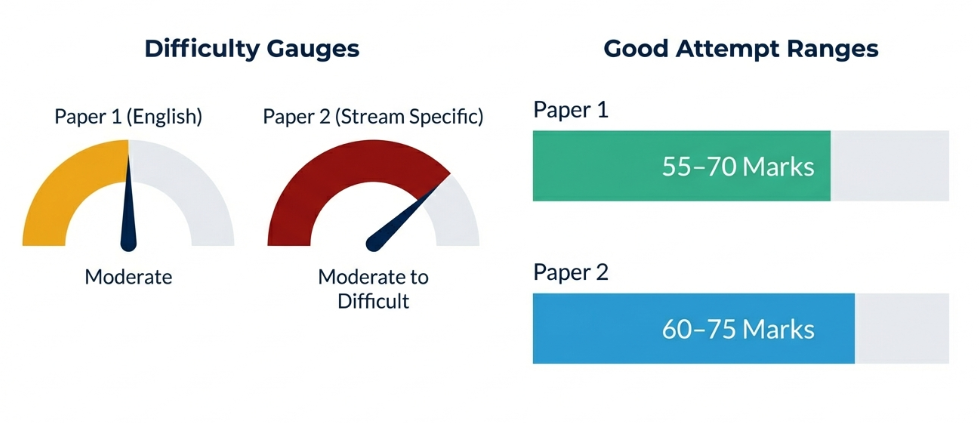
| Paper 1 | Moderate | Required structured writing and clarity |
| Paper 2 | Moderate to Slightly Difficult | Concept-based and calculation-oriented in Finance |
What was considered a good attempt?
Based on the candidate responses:
| Paper | Good Attempt Range |
| Paper 1 | 55–70 Marks |
| Paper 2 | 60–75 Marks |
What was the difficulty level and topic-wise weightage of English Descriptive paper in SEBI Grade A 2024?
The Descriptive English paper of SEBI Grade A 2024, conducted by the Securities and Exchange Board of India, was overall moderate in difficulty. All three sections Essay, Precis, and Reading Comprehension were rated moderate by candidates. The paper had a total of 100 marks and tested not just language skills but also clarity of thought, structure, and time management within strict word limits.
What was the section-wise difficulty level?
All three sections were balanced in terms of complexity, but the strict word limits made the paper slightly more demanding.
| Type of Questions | Difficulty Level |
| Essay | Moderate |
| Precis | Moderate |
| Reading Comprehension | Moderate |
| Overall Difficulty | Moderate |
What was the topic-wise weightage in paper 1 English paper?
The paper consisted of 7 total questions for 100 marks. Essay and Precis carried equal weightage, while Reading Comprehension had the highest marks.
| Topic | Number of Questions | Marks |
| Essay | 1 (out of 4 options) | 30 |
| Precis | 1 | 30 |
| Reading Comprehension | 5 | 40 |
| Total | 7 | 100 |
What were the key highlights from the descriptive English paper in SEBI Grade A 2024?
The Descriptive English paper in SEBI Grade A 2024 was moderate in difficulty but more structured than in previous years. The strict word limits across sections made precision, clarity, and time management very important. The details of the essay, précis, and reading comprehension topics are as follows:
- How Organizations & Managers Cultivate Organizational Culture
- The Impact of Environmental, Social & Governance (ESG) Norms on Global Business
- Social Healthcare Expenditure: Banks’ Role in Embedding Social Healthcare into the Country’s Foundation
- Machine Learning vs. Human Intelligence: Will Machines Ever Replace Humans?
- Reading Comprehension: The Evolution of Social Influencers (5 questions)
| Section & Word Limit | Key Details | Important Highlights |
| Essay (250–270 words) | 1 topic to be chosen out of 4 | Topics included ESG Norms, Management, Banks & Social Healthcare, Machines vs. Humans. Focus on structured and analytical writing. Strict word limit introduced in 2024. |
| Precis (140–160 words) | Passage titled “Evolution of the Gaming Industry since 2000” | Passage was longer than previous years. Required strong summarization skills while maintaining the core idea. |
| Reading Comprehension | Passage titled “Dawn of Social Influence” | 5 questions based on the rise of social media influencers. Needed clear, direct, and concise answers. |
What was the difficulty level of Paper 2 (General Stream)?
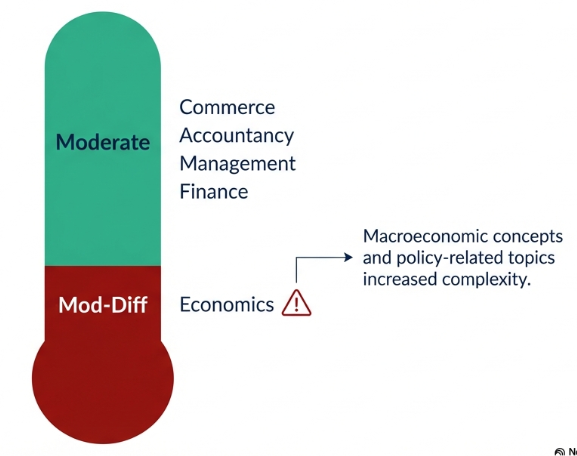
Paper 2 included objective-type questions from stream-specific subjects. The level ranged from moderate to slightly difficult depending on the subject.
| Subject | Difficulty Level |
| Commerce & Accountancy | Moderate |
| Management | Moderate |
| Economics | Moderate to Difficult |
| Securities Market | Moderate |
| Finance | Moderate |
What were the detailed topics asked in Paper 2 (General Stream)?
Paper 2 of the Phase 2 exam was objective in nature and covered Commerce, Accountancy, Management, Economics, Securities Market, and Finance. The paper was mostly concept-based. However, Finance and Accountancy included calculation-driven questions. Candidates who had strong clarity of basics found the paper manageable.
| Subjects/ Topics | Questions |
| Management (15-16 Questions) | General Management (Plans/ Different Role of Leadership/ /Different Types of Policies),Role of Manager, Chain Communication, Theory Z, Efficiency vs. Effectiveness, Synergy, Leading Function. |
| Financial Management | 15th Finance Commission, Angel tax Abolishment, Start-up: Fund of Fund – SIDBI, Bonds (with high yields), Options Trading (Number of Volumes increased) – Long Build Up, Standard Deduction, RBI Circulars, AIF, Passive Fund: Index Fund |
| Costing | Types of Costing such as Operation Costing & Process Costing, Cost Identification, 2 Questions from Lein System, 2 Questions from PV Ratio |
| Accountancy | Fund Flow Statement, Ind AS-107, Cash Flow (Operating/Financing/Investing), Foreign Exchange (Monetary/Non-Monetary), Gaining/Acquiring Stake, Ind AS-105, Right Issue (Ratio-Journal Entry) (Cum Right Price), Bonus Issue, Theory of Accounting (Going Concern Concept, Qualitative Features of Accounting). |
| Company Law | Section 186 (Loan & Investment), DIN (Intimation within 1 month), Debenture Trustee, Number of Independent Directors, Section 55 (Maximum period of Redemption of Preference Shares), Whole-time Managing Director: Age Limit (Min-21, Max- 70), Section 125 (Investor Education Protection Fund), Appeal in Supreme Days (60 days + 60 days extension), Removal of Auditor (u/s 140)- NCLT, Constitution of NCLT- Central Government (u/s 408), Section 29 (Public Offer of Securities). |
| Economics | Malthusian theory, Bank for International Settlement, Fiscal Policy, Trade Deficit, National Income, Square Factor, Philips Curve- Direction Movement, Balance of Payment, Sales Law, Monopolistic Competition, Monetary Policy, Consumption function. |
What topics were asked from Commerce & Accountancy?
Questions from Commerce & Accountancy tested conceptual clarity along with basic numerical ability. Accounting treatment and understanding of company law provisions were important. Most questions were moderate in level and focused on practical application rather than direct theory recall.
| Topics Asked | Nature of Questions |
| Accounting Standards (Revenue, Inventory, Cash Flow) | Concept-based understanding |
| Ratio Analysis & Balance Sheet adjustments | Basic calculations + concepts |
| Marginal Costing & Break-even Analysis | Numerical |
| Dividend provisions & Director duties (Companies Act) | Theory-based |
| Partnership & Company Accounts (Admission/Retirement) | Conceptual |
What topics were asked from Management?
Management questions were largely theory-based. If your concepts were clear, this section was scoring. The focus was on standard management theories and practical workplace concepts.
| Topics Asked | Nature of Questions |
| Maslow & Herzberg Motivation Theories | Direct conceptual |
| Leadership styles & Traits theory | Theory-based |
| Performance Appraisal & Training methods | Conceptual |
| Barriers to Communication | Direct |
| Attitude & Perception (Organizational Behaviour) | Conceptual |
What topics were asked from Economics?
Economics included both theory and application-based questions. Some questions required logical interpretation of economic situations. Macroeconomic concepts and policy-related topics had noticeable weightage.
| Topics Asked | Nature of Questions |
| Inflation, GDP, Monetary Policy tools | Conceptual |
| Types of Budget Deficit (Fiscal Policy) | Direct + Conceptual |
| Demand, Supply & Elasticity | Application-based |
| Monopoly & Oligopoly | Conceptual |
| Balance of Payments basics | Direct |
What topics were asked from the Securities Market section?
This section was closely linked to the regulatory role of SEBI. Questions tested understanding of market structure and regulatory provisions. Candidates reported that this section carried good weightage and required clarity of market functioning.
| Topics Asked | Nature of Questions |
| Insider Trading & LODR Regulations | Conceptual |
| NAV calculation & Types of Mutual Funds | Direct + Concept |
| Basics of Futures & Options | Conceptual |
| IPO Process & Book Building | Direct |
| Settlement Cycle in Secondary Market | Factual |
What topics were asked from Finance?
Finance had a mix of theory and numericals. Time management was important here because calculation-based questions required accuracy. Most numericals were formula-based and manageable with proper practice.
| Topics Asked | Nature of Questions |
| NPV & IRR (Capital Budgeting) | Numerical |
| Yield to Maturity (Bond Valuation) | Calculation-based |
| Present Value & Future Value (TVM) | Numerical |
| WACC (Cost of Capital) | Conceptual + Numerical |
| Beta & CAPM basics (Risk & Return) | Conceptual |
What were the topics asked in paper 2 (legal stream) over years and the level of the paper and its difficulty?
Paper 2 of the SEBI Grade A Legal Stream exam has been consistently designed to test the practical and conceptual knowledge of candidates in law. Over the years, candidates have shared that questions mainly cover Company Law, Contract Law, Criminal Law, Consumer Protection, Jurisprudence, and principles of torts. The level of the paper is generally considered moderate to difficult, with a mix of direct legal definitions, case-based questions, and application-based scenarios. Candidates need to focus both on memorizing key legal definitions and understanding practical application.
Which specific topics from criminal law and torts were asked in paper 2?
In criminal law and torts, several key concepts are often asked in Paper 2 of the SEBI Grade A Legal Stream exam. Corpus Delicti refers to the “body of crime,” meaning there must be proof that a crime has actually occurred before any investigation or legal action can proceed. Criminal Force is when a person intentionally uses force against another without their consent, causing injury, fear, or annoyance, which is punishable under law.
The Deterrent Theory of Punishment emphasizes that punishment is not just for revenge but to prevent future crimes by creating a sense of caution in others. Injurious Sin Damnum represents situations where a legal right is violated without causing actual financial loss, such as in cases of defamation or false imprisonment, and the courts may award nominal damages in such instances. These topics combine both conceptual understanding and practical application of criminal and tort laws, making them important for candidates to focus on.
| Topic | Concept Tested | Notes |
| Corpus Delicti | Body of crime | Proof that crime exists before further investigation |
| Criminal Force | Use of force without consent | Intentional act causing injury or fear |
| Deterrent Theory | Objective of punishment | Punishment to prevent repeat offenses |
| Injurious Sin Damnum | Legal injury without actual loss | Leads to nominal damages, e.g., defamation |
What about contract law, company law, and arbitration?
In Contract Law, a contract is defined as an agreement that is enforceable by law, with common types including executed, executory, novation (substitution of an old contract), and rescission (cancellation of a contract).
Company Law has become more relevant in recent exams, especially in Phase 2, so candidates should focus on practical provisions and their application. In Arbitration, proceedings officially begin when the request for dispute is received by the respondent, marking the start of the legal process.
| Topic | Concept Tested | Notes |
| Contract Law | Enforceability, types of contracts | Executed, executory, novation, rescission |
| Company Law | Practical and legal provisions | Questions usually application-based |
| Arbitration | Commencement of proceedings | Based on receipt of dispute by respondent |
What about consumer protection and jurisprudence?
Under the Consumer Protection Act 2019, a deficiency refers to any imperfection or shortcoming in goods or services, and consumers can take legal action to claim damages. Jurisprudence is the study and knowledge of law, covering rules, procedures, and principles of justice. According to Salmond, jurisprudence is a body of principles recognized and applied by the state in the administration of justice, guiding how laws are enforced and justice is delivered.
| Topic | Concept Tested | Notes |
| Consumer Protection | Deficiency in goods/services | Shortcoming actionable by consumer |
| Jurisprudence | Study of law | Knowledge of law, justice, and its interpretation |
| Salmond’s Definition | Principles applied by state | Body of principles for administering justice |
How was the overall difficulty and approach to paper 2?
The overall difficulty of Paper 2 (Legal Stream) was moderate, with questions testing both conceptual understanding and practical application of legal principles. Candidates needed a clear understanding of definitions, legal maxims, and provisions to answer accurately, while the approach required careful reading, logical interpretation, and applying the law to given scenarios.
- Difficulty Level: Moderate to difficult; requires both memorization and application skills.
- Question Pattern: Mix of conceptual, definition-based, and scenario-based questions
What were the topics asked in paper 2 (IT stream) over years and what was the level and difficulty of the paper?
The Paper 2 for SEBI Grade A IT stream over the years has focused on both conceptual and scenario-based questions, primarily testing core IT skills, data management, networking, programming, and cybersecurity.
Candidates were asked questions from operating systems, OSI model layers, data structures and algorithms (like sorting algorithms and their time complexities), Python programming (slicing, file handling), database management systems (normalization, concurrency control, SQL operations), data warehousing (drill-down, roll-up, slicing operations), shell scripting, regular expressions, and cybersecurity principles like CIA triad and ransomware attacks.
The difficulty of the paper is considered moderate to high, with scenario-based questions adding complexity. Questions are often time-sensitive, requiring not just knowledge but also accuracy and quick problem-solving.
Which IT topics were repeatedly asked in paper 2 over the years?
The recurring topics for Paper 2 IT stream include networking (OSI model layers), data structures and algorithms (sorting algorithms), databases (normalization, SQL, concurrency control), Python programming (lists, slicing, file handling), shell scripting, regex, data warehousing operations, and cybersecurity fundamentals like ransomware and CIA triad. These topics reflect both theoretical understanding and practical application.
| Topic | Sub-topics / Focus | Type of Question | Notes / Difficulty |
| Operating Systems | OSI Model, Session Layer, Transport Layer, Data Link, Presentation Layer | Conceptual | Medium; requires understanding of which layer handles which tasks |
| Networking | OSI layers, connection establishment | Conceptual | Moderate; commonly asked in scenario questions |
| Data Structures & Algorithms | Sorting algorithms (Merge Sort, Bubble Sort, Insertion, Selection) and their worst-case complexities | Conceptual + Numerical | Medium; Merge Sort often highlighted as best worst-case complexity |
| Database Management | Normalization, Denormalization, Concurrency Control (OCC), SQL commands | Conceptual + Scenario-based | High; requires applying principles to real scenarios |
| Data Warehousing | Drill-down, Roll-up, Slicing | Scenario-based | Moderate; understanding operations across dimensions is key |
| Python Programming | List slicing, indexing, file operations (read, write, r+ mode) | Coding / Conceptual | Medium; requires careful handling of indices and modes |
| Shell Scripting | Display variable values | Conceptual / Coding | Moderate; syntax-specific |
| Regular Expressions | Pattern matching, validating strings | Conceptual / Coding | Moderate; understanding of regex operators is needed |
| Cybersecurity | Ransomware attacks, CIA triad (Confidentiality, Integrity, Availability) | Scenario-based | High; real-world scenario application of principles |
FAQs
The overall difficulty level of SEBI Grade A Phase 2 exam will be notified on 21st February 2026.
The SEBI Grade A Phase 2 Exam Analysis will be released on 21st February 2026..

Hello there! I’m a dedicated Government Job aspirant turned passionate writer & content marketer. My blogs are a one-stop destination for accurate and comprehensive information on exam categories like Regulatory Bodies, Banking, SSC, State PSCs, and more. I am on a mission to provide you with all the details you need, conveniently in one place. When I am not writing and marketing, you will find me happily experimenting in the kitchen, cooking up delightful treats. Join me on this journey of knowledge and flavors!
