

The RRB JE Exam 2026 is one of the most competitive technical recruitment exams conducted by the Railway Recruitment Board. This recruitment drive is available for posts like Junior Engineer (JE), Depot Material Superintendent (DMS), and Chemical & Metallurgical Assistant (CMA) posts. Every year, lakhs of engineering diploma and degree holders compete for limited vacancies in Indian Railways. There are 434 vacancies available for candidates in 2026. This guide provides a deep overview for the candidates who want to crack the RRB JE Exam 2026 in the first attempt.
What is the RRB JE Selection Process 2026?
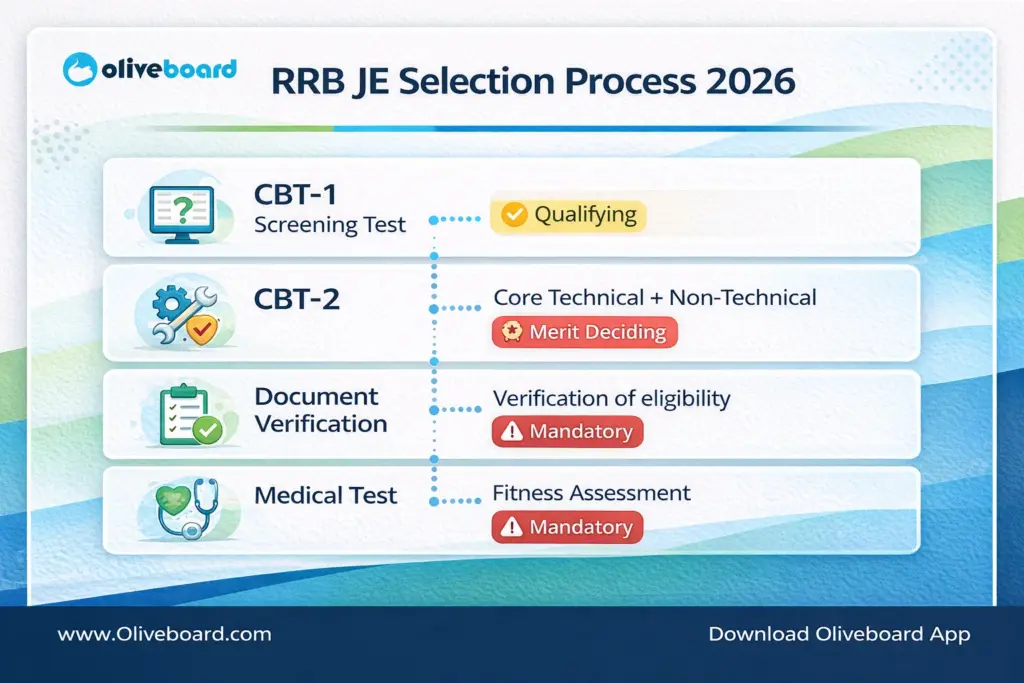
The RRB JE selection process is divided into four stages – CBT 1, CBT 2, document verification and medical test. Check out the details given below:
| Stage | Exam / Process | Mode | Key Details | Qualifying Nature |
| Stage 1 | CBT 1 (Computer Based Test 1) | Online | Screening test with 100 questions (90 minutes) | Qualifying (Marks not counted in final merit) |
| Stage 2 | CBT 2 (Computer Based Test 2) | Online | Main exam with 150 questions (120 minutes) | Merit-based (Marks counted for final selection) |
| Stage 3 | Document Verification (DV) | Offline | Verification of original certificates | Mandatory |
| Stage 4 | Medical Examination | Offline | Medical fitness as per railway standards | Mandatory |
What is the RRB JE Exam Pattern 2026?
The RRB JE exam pattern consists of sections like Mathematics, Reasoning, General Awareness, Basics of Computer Applications and more. Check out the details:
CBT 1:
| Section | Question | Marks |
| Mathematics | 30 | 30 |
| Reasoning | 25 | 25 |
| General Awareness | 15 | 15 |
| General Science | 30 | 30 |
| Total | 100 | 100 |
CBT 2:
| Section | Question | Marks |
| General Awareness | 15 | 15 |
| Physics & Chemistry | 15 | 15 |
| Basics of Computers | 10 | 10 |
| Engineering Discipline | 100 | 100 |
| Total | 140 | 140 |
How should I prepare for the RRB JE Exam 2026?
It is recommended that candidates prepare for the RRB JE Exam keeping in mind the tips and strategies shared by the toppers. We have mentioned below the strategies of Sher Bahadur Yadav, who secured Rank 1 in RRB JE 2024 examination. Check them out and try to implement them in your daily study routine:
| Strategy Area | What He Did | How It Helped |
| Study Hours & Discipline | Studied 15 -16 hours daily with a fixed routine from early morning to night. | Maintained consistency and covered the syllabus in a limited time. |
| Single Source Approach | Followed one main teacher/guidance source instead of switching between multiple platforms. | Prevented information overload and ensured conceptual clarity. |
| Concept-Based Learning | Focused on understanding fundamentals, especially in technical subjects. | Helped solve new-pattern questions even when previous-year patterns changed. |
| Screenshot Method (Instead of Notes) | Took 25,000+ screenshots of important concepts, diagrams, and formulas instead of writing traditional notes. | Improved visual memory and saved time on note-making. |
| Maximised productive study hours. | Created subject-wise folders in the phone and revised them repeatedly. | Made revision fast, structured, and accessible anytime. |
| Multiple Revisions | Watched important lectures/videos 4 – 5 times or more. | Strengthened retention and reduced mistakes in the exam. |
| Visual Learning Focus | Organised Revision System | Enhanced long-term memory and quick recall during the exam. |
| CBT-1 Priority | Did not take CBT-1 lightly and prepared seriously for basics (Maths, Science, GK, Reasoning). | Secured strong marks and a good position for further stages. |
| Pattern-Oriented Preparation | Prepared according to the latest exam trend, not relying only on previous-year questions. | Helped handle unexpected changes in CBT-2. |
| Limited Material Strategy | Avoided collecting too many books or materials; focused on revising selected content. | Reduced confusion and improved depth of preparation. |
| Motivation & Consistency | Used motivational content and maintained strong self-belief despite personal and financial challenges. | Sustained long-term preparation without burnout. |
| Time Utilization | Used free time (travel, waiting, etc.) to revise screenshots and concepts on the phone. | Maximized productive study hours. |
| Family Support & Focus | Stayed dedicated despite responsibilities and distractions. | Maintained mental stability and long-term commitment. |
Should I maintain a study schedule for the JE exam in 2026?
Yes, a structured weekly routine is essential to cover the vast syllabus of the RRB JE Exam 2026 effectively. The plan below is designed for serious aspirants preparing for both CBT 1 and CBT 2 together, with special focus on the technical section.
| Day | Total Study Time | Technical (Priority: Highest – 3 – 4 hrs daily) | Mathematics (45-60 min) | Reasoning (30-45 min) | General Science (30-40 min) | General Awareness (30 min) | Computer / Environment (20–30 min) | Tests / Revision / Targets |
| Monday | 6-8 hrs | Start a major core topic (e.g., Basic Circuits / Engineering Mechanics / Thermodynamics / Network Theory); focus on concepts | Number System / Simplification (25–30 questions) | Coding-Decoding / Analogy | – | Current affairs (last 2–3 days) | – | Daily formula revision (10 -15 min) |
| Tuesday | 6-8 hrs | Start new technical topic (Machines / SOM / Building Materials / Analogue Electronics) | Percentage / Ratio & Proportion | – | Physics: Motion, Work, Energy | Current affairs | Computer Basics (Hardware, Generations) | Maintain short notes |
| Wednesday | 6-8 hrs | Continue the same technical topic + numerical practice | Average / Profit & Loss | Blood Relations / Direction Test | – | Static GK (Polity / Railways / Economy) | – | Accuracy focus (85% target) |
| Thursday | 6-8 hrs | Start new technical topic (Machines / SOM / Building Materials / Analog Electronics) | Time & Work / Time & Distance | – | Chemistry: Acids, Bases, Metals | Current affairs | Environment: Pollution, basics | Revise previous technical formulas |
| Friday | 6-7 hrs | Mixed technical practice from all topics covered during the week | Algebra / Mensuration | Syllogism / Venn Diagram | – | Weekly current affairs revision | Computer: MS Office / Internet | Identify weak areas |
| Saturday | 6-7 hrs | Technical sectional test (topic-wise) + concept revision | Practice weak Maths topics | – | Biology: Human body, diseases | Static GK revision | – | Test analysis (1 hr) and error notebook |
| Sunday | Previous Year Questions from the studied technical topics | Technical full revision (formulas + key concepts) | Formula revision | Puzzle practice (light) | Science weekly recap | Weekly current affairs compilation | Computer/Environment quick revision | Full-length mock (alternate CBT 1 & CBT 2) + 2 hr analysis |
How to analyse your Mock Test Performance?
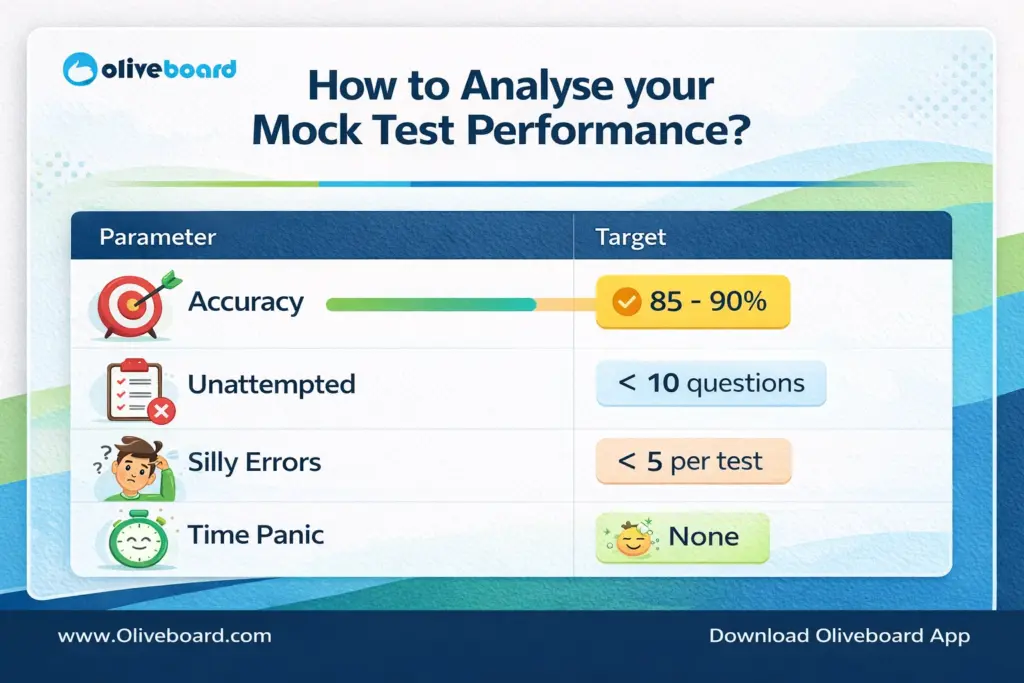
To analyse your mock test performance effectively, ask yourself certain questions like – why did I get this wrong?, was there a concept gap or time pressure?. Some of the details are given below:
What are the mistakes that should be avoided for RRB JE Exam 2026?
Certain mistakes like over-studying, improper revision, and more should be avoided to qualify for the exam in the first attempt. Check out the consequences for every mistake in the table below:
| Mistake | Consequence |
| Ignoring CBT-1 seriousness | Disqualification |
| Over-studying rare topics | Time wastage |
| Delaying mocks | Studying without a target |
| No revision cycle | Forgetting concepts |
| Studying without target | Burnout |
What books should I follow for JE examination?
The recommended books to follow for the upcoming JE examination include ” NCERT Maths Textbooks”, “A Modern Approach to Verbal & Non-Verbal Reasoning”, “Lucent’s General Knowledge” and more. Given below is the complete list:
| Book Name | Author/Publisher |
| Quantitative Aptitude for Competitive Examinations | S. Chand |
| NCERT Maths Textbooks (Std. 6 – 12) | NCERT |
| RRB Maths (General & Advance) Chapter-Wise & Type-Wise Solved Papers | Youth Competition Times |
| A Modern Approach to Verbal & Non-Verbal Reasoning | S. Chand |
| Test of Reasoning for Competitive Examinations | Edgar Thorpe, McGraw Hill Education (India) |
| New Approach to Reasoning: Verbal, Non-Verbal and Analytical | Arihant |
| 600+ General Science MCQs for RRB NTPC/ JE/ Group D/ ALP | Disha |
| NCERT (9th to 12th Std.) Science Textbooks | NCERT |
| Lucent’s General Knowledge | Lucent |
| Manorama English Yearbook | Malayala Manorama |
| General Knowledge | Arihant |
| Objective Computer Science & Information Technology | Upkar Prakashan |
| RRB JE 2nd Stage (CBT) Computer Science and Information Technology Exam Goalpost Solved Papers | Dreamtech Press |
| Environmental Studies: Multiple Choice Questions | The Energy and Resources Institute (TERI) |
| NCERT (6th to 12th Std.) EVS/EVE Textbooks | NCERT |
| Practice Sets Electronics Engineering: Useful for Railway & Other Engineering (Diploma) Exams | Upkar Prakashan |
| Kiran’s Railway (RRBs) JE CBT Stage-2 Online Exam Electrical & Allied Engineering Practice Workbook | Kiran Prakashan, Pratiyogita Kiran & KICX |
FAQs
Yes. With focused preparation, strong basics, regular mock analysis, and disciplined revision, many candidates clear the RRB JE Exam 2026 in their very first attempt.
CBT-2 is the most important stage, as it carries maximum weightage and directly decides the final merit list.
On average, 5-6 months of consistent, structured preparation is sufficient for first-time aspirants.
Previous year questions are essential but not sufficient alone. They should be combined with concept building and full-length mock tests.
Ignoring revision and mock analysis. Studying without testing and reviewing performance leads to repeated mistakes.
Hello! This is Arijit Dutta. I am a skilled Content Writer at Oliveboard with nearly 3+ years of experience in crafting engaging, informative, and exam-focused content for the Railways Domain. With a strong command of language and a keen understanding of learner needs, I contribute significantly to Oliveboard’s mission of delivering high-quality educational resources. Passionate about clear communication and continuous learning, I consistently create content that helps government job aspirants achieve their goals. Outside of work, I enjoy playing cricket and listening to music, which helps me stay balanced and creative in my professional journey.
