

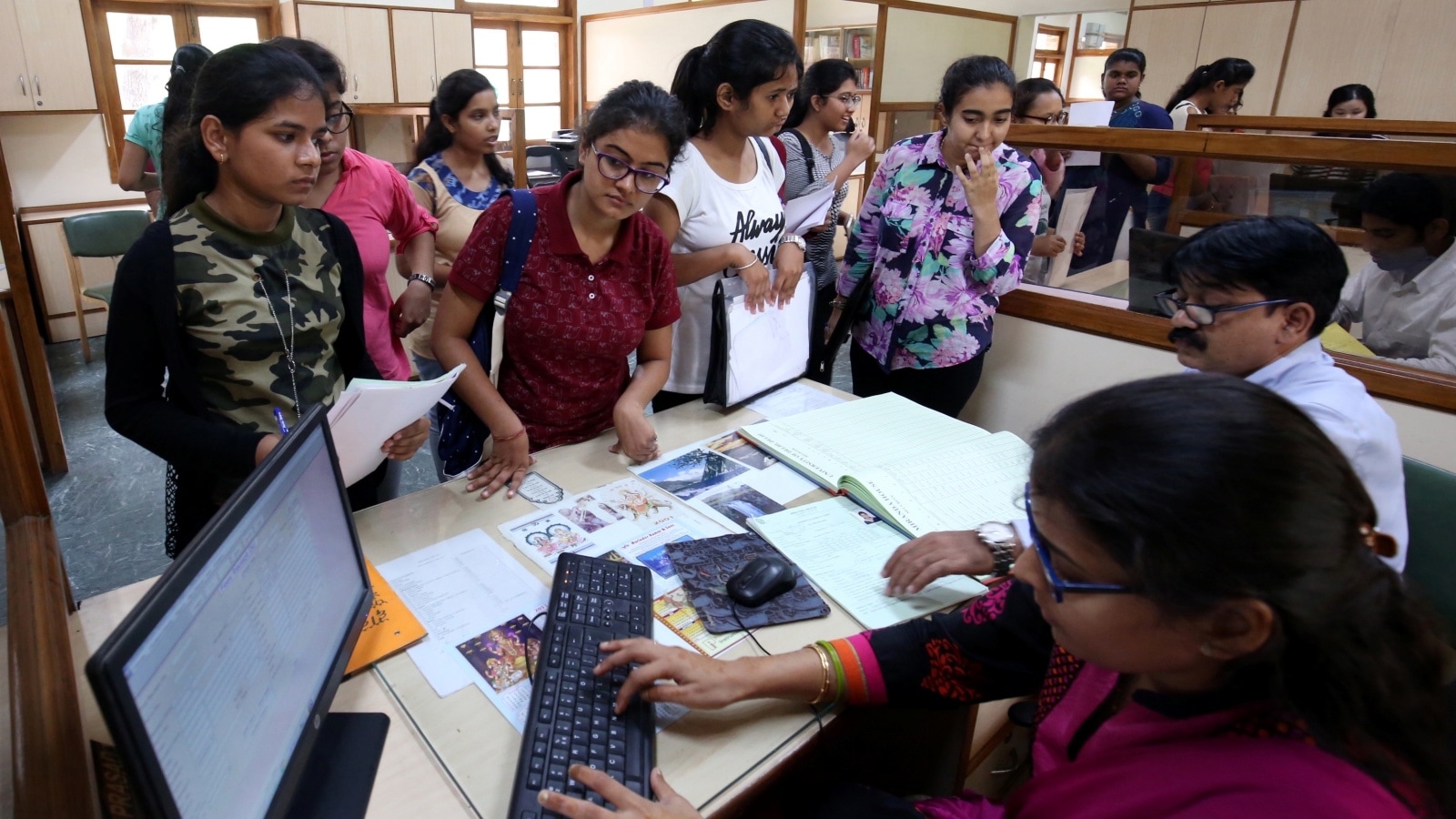
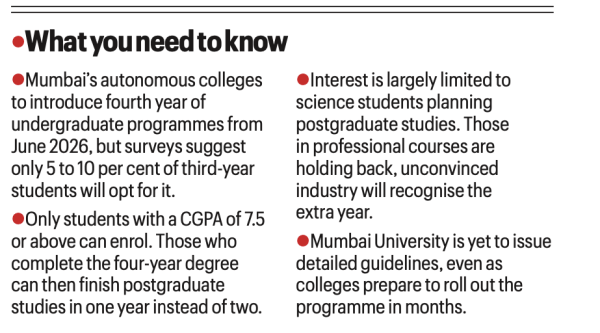
When Mumbai’s autonomous colleges roll out the fourth year of undergraduate programmes in a few months under the National Education Policy (NEP) 2020, they expect to do so to near-empty classrooms. Internal surveys at several autonomous colleges affiliated to Mumbai University show that only about 5 to 10 per cent of third-year students are inclined to opt for the additional year, The Sunday Express has learned.
Colleges attribute the lukewarm response to limited awareness about the new structure, uncertainty over its employment benefits, and the continuing preference for the traditional three-year undergraduate (UG) degree followed by a two-year postgraduate (PG) programme. The four-year format appears to be attracting mainly those already planning postgraduate studies, particularly in the sciences, while students in professional or job-oriented courses are more hesitant.

Dr. Parag Ajgaonkar, principal of NM College, said the trend was expected in the first year of implementation.
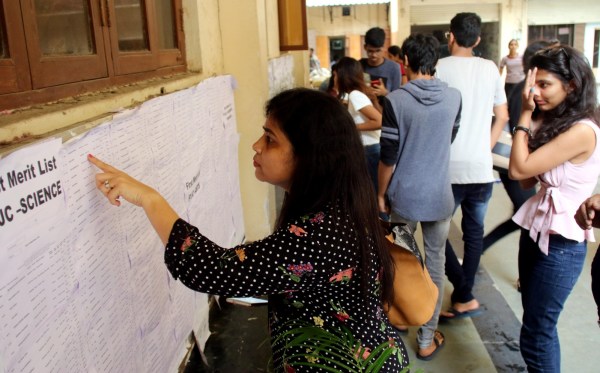 Students during the admission season
“In a set trend of multiple years where a student can seek a job after completing a three-year UG degree, it was expected that in the first year only those willing to pursue PG will opt for the fourth year of UG. It will take some time for this new format of higher education to become a new normal,” he said.
Surveys at NM College indicate about 5 to 10 per cent of third-year students are interested, which is roughly the same proportion that currently opts for M.Com after a UG degree, Ajgaonkar said, adding that the college considers the numbers sufficient to proceed with the introduction of the fourth year.
“Students and parents will make decisions based on cost-benefit analysis. Particularly in the case of professional courses, which are more popular among city students, unless industry starts recognising the fourth year of UG, students will not want to spend another academic year to obtain a UG degree,” he added.
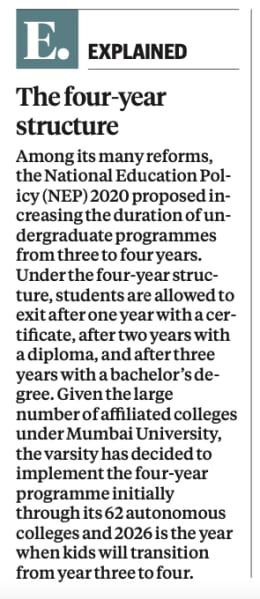
Under the NEP 2020 framework, autonomous colleges can offer the fourth year in disciplines where they run strong postgraduate programmes. Only students with a CGPA of 7.5 or above can enrol, and the additional year can include either a research component or an honours track. Students who complete the four-year programme can then pursue a one-year PG course, rather than the traditional two-year route, saving a year overall, but only if industry and institutions recognise the new structure.
Story continues below this ad
That uncertainty is precisely what is giving students pause. Many are still weighing whether the four-year UG plus one-year PG route offers any real advantage over the familiar three-year UG plus two-year PG path.
At Ramnarain Ruia College, principal Dr. Anushree Lokur said students from the science stream appear more open to the option. “Those in BSc who are sure of wanting to pursue a PG course after graduation are likely to be more positive toward studying the fourth year,” she said.
At St Xavier’s College, awareness sessions were conducted after an initial survey showed limited interest. The college plans another survey before the new academic year but intends to proceed with the fourth year from June 2026. “We are also planning to allow lateral entry to outside students who are eligible for admission to the fourth year of UG,” said principal Rajendra Shinde Gokarn. Colleges say lateral entry could help ensure adequate numbers to run the additional year viably.
Private and cluster universities are also moving ahead. At HR College under HSNC University, the academic council has approved implementation from the upcoming academic year. Principal Dr. Pooja Ramchandani noted that students planning an MBA may prefer to graduate after three years and gain work experience first.
Story continues below this ad
At Somaiya Vidyavihar University, around 10 per cent of third-year students have indicated interest so far. “We have not yet concluded the survey to see if more students would want to pursue it. Accordingly, we will offer the fourth year in courses where there is demand,” said Dr. Santosh Naraynkhedkar, dean of academics. He added that the science stream may see relatively higher uptake as many students there aim to pursue research.
Colleges say they are largely ready with curriculum and planning. What they are still waiting for is Mumbai University. Detailed guidelines for the fourth year are yet to be issued — and when the Vice-Chancellor Dr. Ravindra Kulkarni was asked when they would be, his response was brief: “Yes, definitely.”
For students trying to make one of the most consequential academic decisions of their lives, that is not quite enough.
