“The old division between conventional war and nuclear war is no longer sufficient.” That was perhaps the most important proposition advanced at the defence conference I attended in Delhi—a proposition that deserves to be taken seriously, because it captures the strategic condition of our age with unusual clarity.
The deliberations were conducted under the Chatham House Rule, which allows participants to use the information from the discussion but prohibits the disclosure of the identity or institutional affiliation of speakers. That format gave the conversation a degree of candour that is rare in public forums. What emerged was not a ceremonial recitation of orthodoxies, but a serious and often unsettling exchange on the state of the world and India’s place within it.
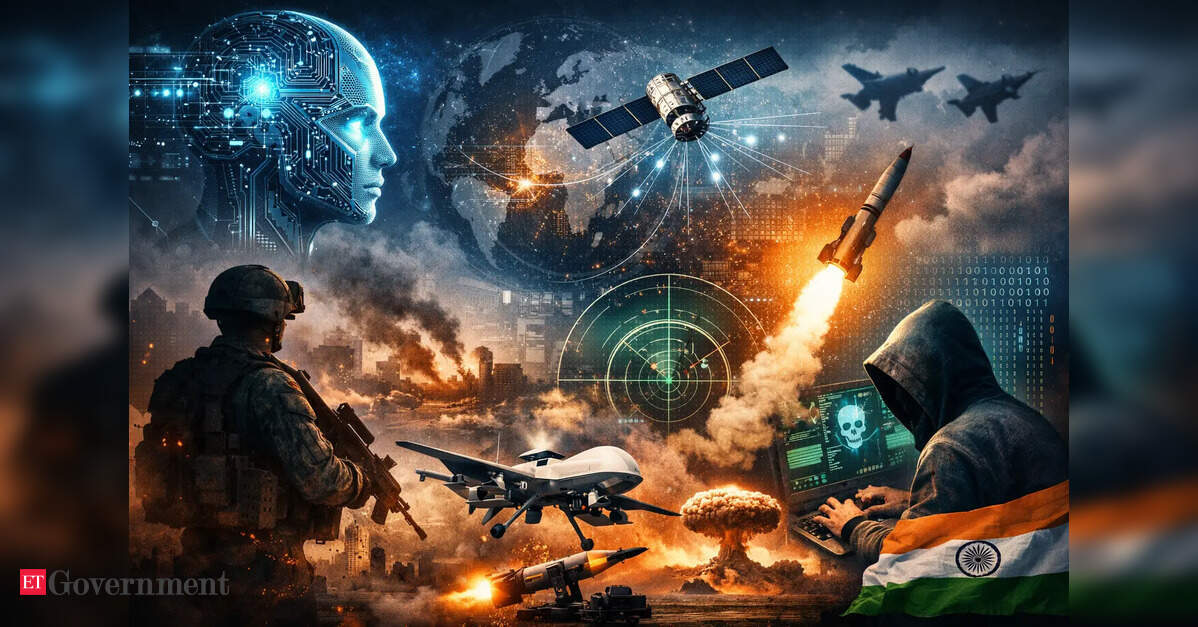
For decades, military thought was organised around a familiar ladder of escalation: conventional conflict at one end, nuclear deterrence at the other. Today, however, technological change, geopolitical turbulence, and the weaponisation of data, cyber systems, artificial intelligence, and space-based assets are creating an intermediate zone of conflict that is neither fully conventional nor explicitly nuclear, yet capable of producing strategic effects of the highest order.
This was not a semantic refinement. It was an argument about the changing ontology of war. The emerging battlespace is no longer defined only by troop movements, artillery exchanges, or the threat of atomic retaliation. It is increasingly shaped by long-range precision systems, persistent surveillance, algorithmic targeting, automation, information disruption, and attacks on decision-making networks.
The purpose of force in such a battlespace is not merely to destroy, but to disorient; not merely to seize territory, but to paralyse judgment. In that sense, the central challenge before states such as India is not simply to acquire more weapons, but to think in terms of new domains of coercion and new ladders of escalation.
One of the more compelling ideas discussed at the conference was the need to move beyond static doctrines towards what was described as a dynamic response strategy. The significance of this concept lies in its implicit recognition that future conflict may not unfold in a neat, sequential fashion. India may face multiple adversaries, multiple theatres, and multiple thresholds of hostility at the same time.
The strategic environment is no longer one in which war, no-war, and peace can be cleanly separated. Between these categories lies a vast grey expanse of coercion, signalling, calibrated pressure, technological disruption, and indirect contestation.
The older vocabulary of strategy often assumed a certain orderliness in escalation. What was being argued at the conference, by contrast, was that the strategic future will be defined by simultaneity. A conflict may begin in the cyber domain, spill into maritime intimidation, trigger space-related vulnerabilities, and only later manifest in conventional military form.
Such a scenario requires not only operational preparedness but doctrinal elasticity. A rigid strategic framework may be comforting on paper, but it may prove dangerously inadequate in practice.
This is where the discussion became especially relevant for India. The question was not whether the country should remain committed to deterrence and conventional preparedness; that is obvious. The question was whether India is conceptually prepared for an era in which non-nuclear strategic capabilities may decisively shape escalation before nuclear thresholds are even approached.
This intermediate strategic space—enabled by AI, ISR networks, data fusion, autonomous systems, and precision strike capacity—may well become the decisive theatre of competition in the years ahead. It creates new escalatory ladders, allows states to impose costs below the nuclear threshold, and alters the tempo of war by compressing time and multiplying pressure points.
At this stage, it is necessary to note that these reflections emerged from a closed-door conference organised by a prominent think tank in Delhi, attended by senior defence officers, ambassadors, officials, strategic thinkers, and domain experts.
One of the striking features of the conference was the extent to which concern over emerging technologies coexisted with anxiety about the return of nuclear instability. For some time, strategic discourse in many countries has tended to oscillate between two temptations: either to assume that nuclear deterrence has produced a durable equilibrium, or to become so absorbed in cyber and AI-led transformations that the nuclear question begins to recede into the background.
The discussions in Delhi challenged both assumptions. Far from becoming obsolete, the nuclear issue has re-entered the strategic foreground in an altered and more dangerous form.
The global environment today reveals an unsettling pattern. Nuclear powers are engaged in prolonged conventional confrontations while simultaneously using rhetoric, posture, and capability development to signal lower thresholds of nuclear use. Arms control arrangements that once provided a modicum of stability have weakened or lapsed. Strategic weapons are being modernised.
Delivery systems are becoming more sophisticated. Missile defence architectures are changing targeting calculations. In some theatres, command-and-control structures are also evolving in ways that suggest a closer integration between conventional conflict and strategic escalation.
The implication is profound. Nuclear weapons remain the ultimate guarantor of deterrence, but they no longer inhabit a sealed conceptual universe distinct from the rest of warfare. They now exist in a continuum shaped by conventional pressure, technological disruption, information warfare, and political signalling.
That is why the conference repeatedly returned to the need for stronger linkages between conventional and strategic domains. In India’s case especially, any serious conflict in the conventional realm carries at least the theoretical possibility of escalation. Strategic planning, therefore, cannot afford compartmentalisation.
This concern was situated within a wider international context that gave the discussions their urgency. The world, as one participant observed in substance, is not merely passing through another period of instability; it is undergoing a structural reordering. The rules-based order, once invoked almost ritualistically in diplomatic discourse, appears increasingly eroded by unilateral action, selective legality, and transactional alignments.
Conflicts in West Asia, Europe, and elsewhere are no longer regional episodes in isolation. They are systemic events with cascading effects on energy markets, shipping routes, alliance systems, technological governance, and strategic confidence.
The conference paid considerable attention to this larger geopolitical flux. There was sustained discussion on the changing conduct of major powers, the instrumental use of force, and the blurring of distinctions between geoeconomics and geopolitics. Resources, trade routes, energy infrastructure, sanctions, tariffs, technology controls, and military pressure are now deeply intertwined.
This has implications not only for wartime behaviour but for peacetime competition as well. It also means that strategic analysis can no longer remain confined to ministries of defence and military headquarters; it must absorb economics, supply chains, data flows, and technological sovereignty into its core reasoning.
Another important thread in the conference concerned the Indian Ocean and the broader maritime domain. Maritime dominance today is not simply about fleet numbers or port access. It is about awareness, presence, resilience, and the ability to monitor and protect the connective tissue of the modern economy.
Energy supplies, trade flows, undersea cables, and sea-lane security have all become integral to national strategy. Situational awareness in the Indian Ocean Region is therefore not a peripheral concern for India; it is central to deterrence, crisis management, and strategic signalling.
Equally notable was the anxiety around the absence of effective global governance structures for artificial intelligence and related technologies. If the nuclear age, for all its dangers, at least generated doctrines, treaties, red lines, and control mechanisms, the AI age appears to be emerging in a far more anarchic manner. Industry is moving faster than governments.
Regulation is weak. Normative architecture is underdeveloped. States are trying to absorb disruptive technologies even as they struggle to understand their second-order consequences. This asymmetry between capability development and governance may prove to be one of the defining dangers of the era.
The strategic problem, then, is not only that war is changing, but that political and institutional systems are failing to keep pace with its transformation. In classical military theory, the state claimed a monopoly over the organisation of violence.
Today, however, crucial components of strategic power—algorithms, platforms, cyber tools, satellite services, digital networks, and AI models—are often developed, owned, or controlled outside traditional state structures. This dispersal of strategic capability complicates deterrence, accountability, and escalation control in ways that remain insufficiently theorised.
For India, the cumulative lesson of the conference was clear. The country must think beyond inherited binaries and prepare for a world in which strategic competition is constant, layered, and technologically accelerated. It must retain credible conventional and nuclear capabilities, but it must also invest in the intermediate domain that now shapes escalation dynamics.
It must deepen maritime awareness, build resilient command-and-control systems, strengthen long-range precision capacities, and integrate data, AI, and surveillance into a coherent strategic framework. Above all, it must avoid the intellectual complacency of fighting the last war while the next one is already taking form.
What made the Delhi conference especially valuable was its refusal to indulge in comforting abstractions. It confronted, with unusual frankness, the possibility that the world has entered an era in which deterrence is more fragile, war more diffused, alliances more conditional, and technology more destabilising than many policymakers are willing to admit. The task before India is therefore not merely to respond to crises as they emerge, but to cultivate a strategic culture capable of anticipating discontinuity.
The most important takeaway from the conference was not a prediction, but a warning: future wars may not announce themselves with the clarity of the past. They may begin in ambiguity, intensify through invisibility, and escalate through domains that lie between the conventional and the nuclear. A nation that fails to prepare for that reality may discover, too late, that the battlefield has changed long before its doctrines did.