

Key Takeaways
- This article provides SSC CGL Polity Study Notes focusing on Writ Jurisdiction in the Indian Constitution.
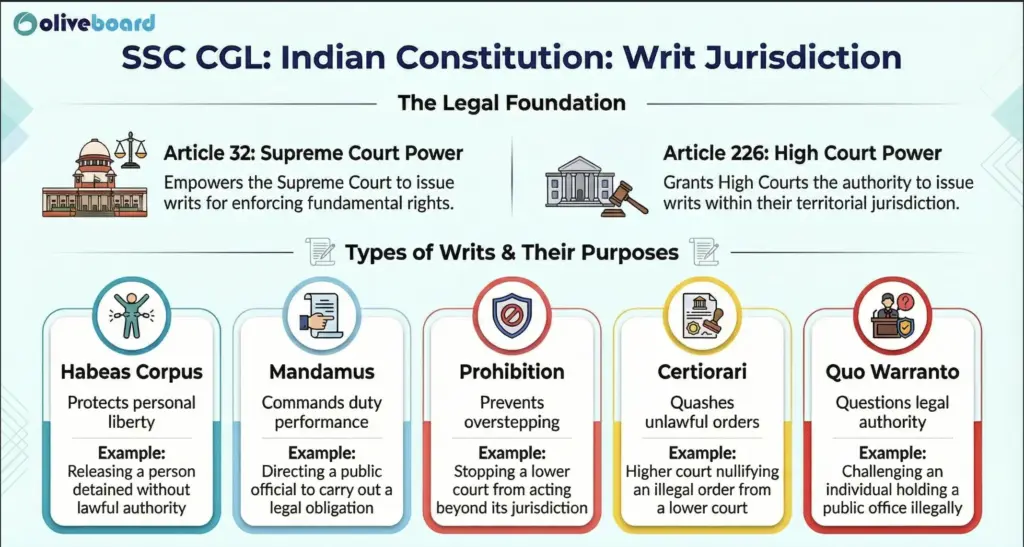
- The Supreme Court and High Courts issue five types of writs: Habeas Corpus, Mandamus, Prohibition, Certiorari, and Quo Warranto.
- Each writ serves a specific purpose, such as protecting personal liberty or commanding public authorities to perform their duties.
- Understanding writs is essential for protecting fundamental rights and performing well in the SSC CGL exam.
- The article includes a comparison table detailing the purpose and examples of each writ.
To help you prepare better, we are sharing free SSC CGL Polity Notes in this blog. In this edition, we are focusing on the topic Writ Jurisdiction in the Indian Constitution, which is often asked in the SSC CGL exam and other competitive exams. This topic is important because it explains how the courts protect fundamental rights and make sure the government works according to the Constitution.
Writs in Indian Constitution
In the Indian Constitution this special power of Jurisdiction which can issue “entitlement of writ” is given to the Supreme Court and High Court of various States. Under the Act 32 of Constitution, the Supreme Court can issue writs for enforcement of Fundamental Rights which is applicable throughout the country, and under the article 139 and similarly under Article 266 for High Courts in the respective territory of the states. The five types of entitled Writs are described as follows:
| S.NO. | Writ |
| 1 | Habeas Corpus |
| 2 | Mandamus |
| 3 | Prohibition |
| 4 | Certiorari |
| 5 | Quo Warranto |
WRIT OF PROHIBITION
The word Prohibition means “forbidding”. The Writ of Prohibition falls under the category when there is a case which does not fall under the jurisdiction of a lower court such as a tribunal or District Court, than the High Court takes the case under its jurisdiction to prevent it from exceeding over a longer period of time.
The Writ of Prohibition can only be issued on judicial authorities and not on administrative authorities, private bodies or legislative people.
WRIT OF HABEAS CORPUS
The word Habeas Corpus means “litigation of a human body”. The Writ of Habeas Corpus is issued under the circumstances when a public or private corporation has to bring the body of the person who has been illegally detained along with the cause of detention in the summoned court. The person if found not guilty due to the detention being illegal is set free to go.
WRIT OF MANDAMUS
The word Mandamus means “ to be in command”. When a lower court or any public official fails or refuses to perform his or her duty, than the Supreme Court can issue the writ of Mandamus on the concerned person. However, the Writ of Mandamus cannot be issued on any private body.
Under this writ, the authorities only ask the existing task to be completed and compel the designated person to do the work.
WRIT OF QUO WARRANTO
The word Quo Warranto means “ to issue a warrant”. This Writ of Quo Warranto can be issued by the court when a person claims to enquire the legality of a public office to prevent mishappenings or illegal use of resources of the office by the person. This writ cannot be conducted against any private body. The court wants to understand under what solid proof the person claims his issues.
WRIT OF CERTIORARI
The word Certiorari means “ to demand”. The Writ to Certiorari is one of the very important fundamental rights of the citizens. In some cases, the citizens are not satisfied with the judgements taken by the High Court or any lower court. In such cases, they can seek to go to the High Court with the intention of overruling the judgement of the High Court with proper evidence and documents.
Comparison of Writs in the Indian Constitution
Writ Jurisdiction is one of the most important powers of the Supreme Court and High Courts under Articles 32 and 226 of the Indian Constitution. Writs are issued to protect fundamental rights, enforce legal duties, and ensure that authorities act within the law. Each writ serves a specific purpose and has its own scope of application. Understanding the differences between them is crucial for SSC CGL and other competitive exams.
| Writ | Purpose | Who can issue | Example/Use |
| Habeas Corpus | Protects personal liberty; prevents illegal detention | Supreme Court / High Court | A person detained without lawful authority can be released by the court |
| Mandamus | Commands a public authority to perform its duty | Supreme Court / High Court | Directs a government officer to carry out a legal duty |
| Prohibition | Prevents lower courts or authorities from exceeding their jurisdiction | Supreme Court / High Court | Stops a lower court from hearing a case outside its power |
| Certiorari | Transfers a case from a lower court to a higher court or quashes a lower court’s order | Supreme Court / High Court | Supreme Court quashes an unlawful order passed by a lower court |
| Quo Warranto | Questions the authority of a person holding a public office | Supreme Court / High Court | Challenges if someone is holding an office illegally |

The most comprehensive online preparation portal for MBA, Banking and Government exams. Explore a range of mock tests and study material at www.oliveboard.in
