India is the forerunner of education systems since the initiation of the “Gurukul system” of education. The current enrolment is about 4.33 crore students in higher education. The Gross Enrolment Ratio has climbed from 23.7 in 2014 -15 to 28.4 in 2021-22, and the national target is 50% by 2035. By any measure, the system has scaled. But scale was never the finish line. It was the prerequisite.
The harder question is what all this enrolment actually produces. And here, the picture is considerably less reassuring.
The India Skills Report 2026 puts graduate employability at 56.35%, a real improvement. Mercer’s Graduate Skill Index 2025, which applies stricter industry-readiness benchmarks, places it at 42.6%. Neither number is wrong. Together, they tell us that progress is real but uneven, and that a significant share of graduates still enter the workforce underprepared for what awaits them.
Employers have noticed. A 2025 Indeed survey, found that 80% of Indian employers now prioritise practical skills and experience over formal degrees. Forty-two percent of hiring managers say they cannot find candidates with the right capabilities. This is not a recruitment inconvenience. It is a signal that curriculum, pedagogy and assessment across the sector need to evolve faster than they have.
And the gap is not only technical. Mercer’s research shows that recruiters increasingly value critical thinking, communication and learning agility. They want graduates who can adapt to unfamiliar problems, collaborate across disciplines and apply knowledge in contexts that a textbook never anticipated. These are not qualities that emerge from lecture halls and semester-end examinations. They are built through project-based work, industry immersion, interdisciplinary exposure and a curriculum that treats outcomes as the starting point, not an afterthought.
What makes this especially urgent is the pace of change bearing down on the workforce. The World Economic Forum’s 2025 analysis estimates that 63 out of every 100 Indian workers will need retraining by 2030, and that 12 in 100 may not be able to upskill at all. Globally, nearly 40% of existing workplace skills are expected to become obsolete in the same period. The window for incremental reform is closing.
AI accelerates all of this. It has genuine potential to personalise learning, strengthen research and widen access. But potential is not the same as responsible deployment. UNESCO’s guidance on AI in education is clear: integration must be human-centred, inclusive and built on equity. At our own institution, we are working to embed AI across programmes while maintaining rigorous academic integrity protocols thus preventing human oversight at every stage. The goal across the sector should not be to automate education. It should be to deepen it, make it versatile, applied and adoptive, to make students career-ready to take on real world challenges.
So what will a “refresh” require?
It starts with curriculum, more suitably an outcome-based education, with more of portfolio and skill-tech based courses. Programmes must be designed backwards from capability, not forwards from content. Applied learning, real-world problem solving and sustained industry collaboration belong at the core, not in an elective buried in the final semester. Assessment must follow. If we want graduates who think critically and adapt quickly, we cannot continue to evaluate them primarily through written recall. And faculty development matters as much as student outcomes. Teachers who are expected to prepare students should opt for innovative pedagogies and take account of the two ends of the class viz., the slow learners and the fast learners, furthermore the changing world needs institutional support to stay current themselves.
None of this is easy. Structural change in higher education is slow, complex and resource-intensive. But the cost of standing still is now greater than the cost of transformation. The sector as a whole must move from producing graduates who hold credentials to developing professionals who can demonstrate capability. That shift will define whether India’s demographic advantage translates into genuine economic and social value.
India has the demographic weight, the policy ambition through NEP 2020, and the talent base to lead in global higher education. What it needs now is a collective commitment from institutions, industry and policymakers to measure success not by how many students we admit, but by what those students can do when they complete the degree.
That is the “refresh”. And it cannot wait.
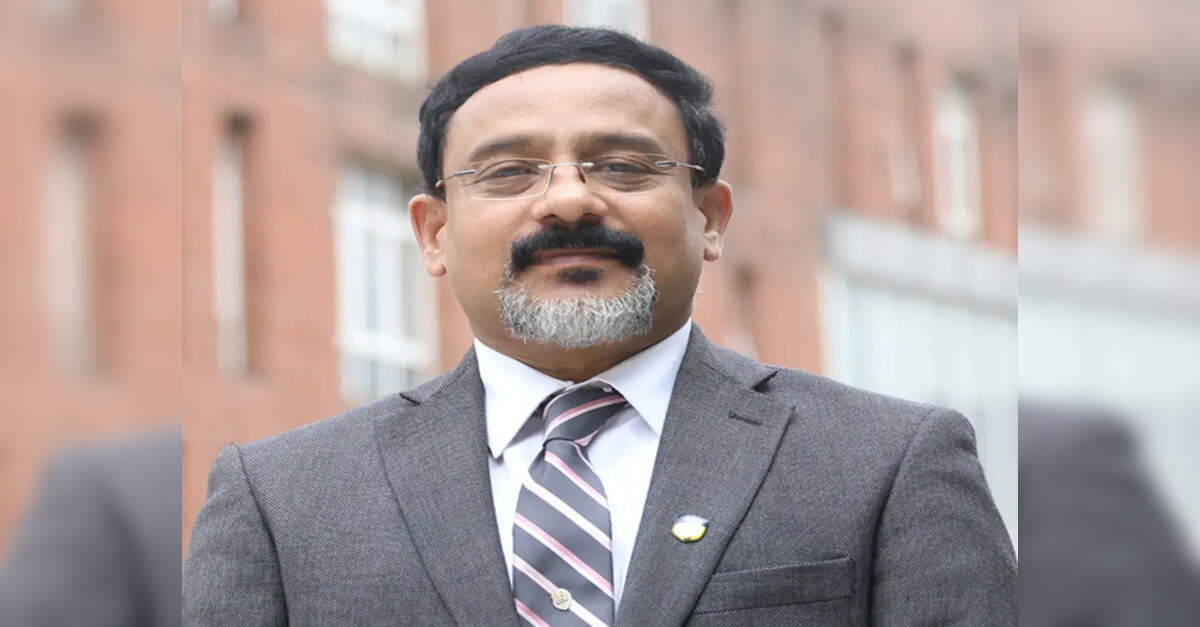
Prof A W Santhosh Kumar is the Vice Chancellor of Amity University Mumbai, with over 35 years of experience in academia and leadership. A Ph.D. from AIIMS New Delhi, he has also spent 16 years in the United States in key roles including Dean, Professor of Microbiology and Global Health, and Director of the Center for Genomics at Loma Linda University. A leading expert in microbiology and genomics, he has published 190+ research papers, holds multiple patents, and has significantly contributed to research in the human microbiome.
DISCLAIMER: The views expressed are solely of the author and ETEDUCATION does not necessarily subscribe to it. ETEDUCATION will not be responsible for any damage caused to any person or organisation directly or indirectly.