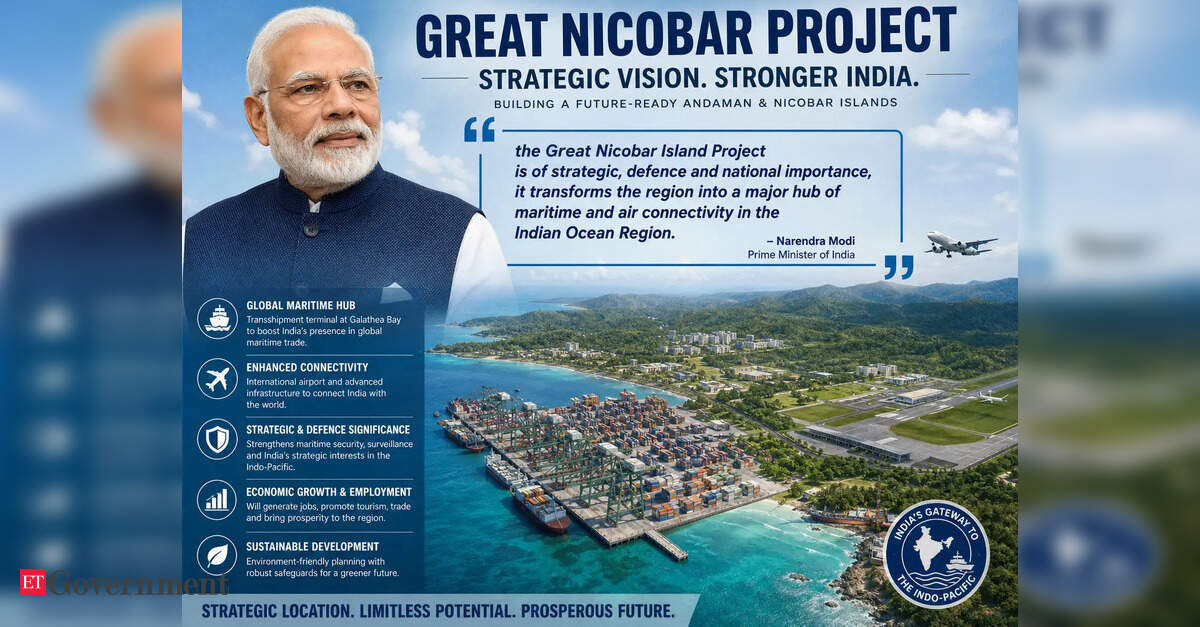
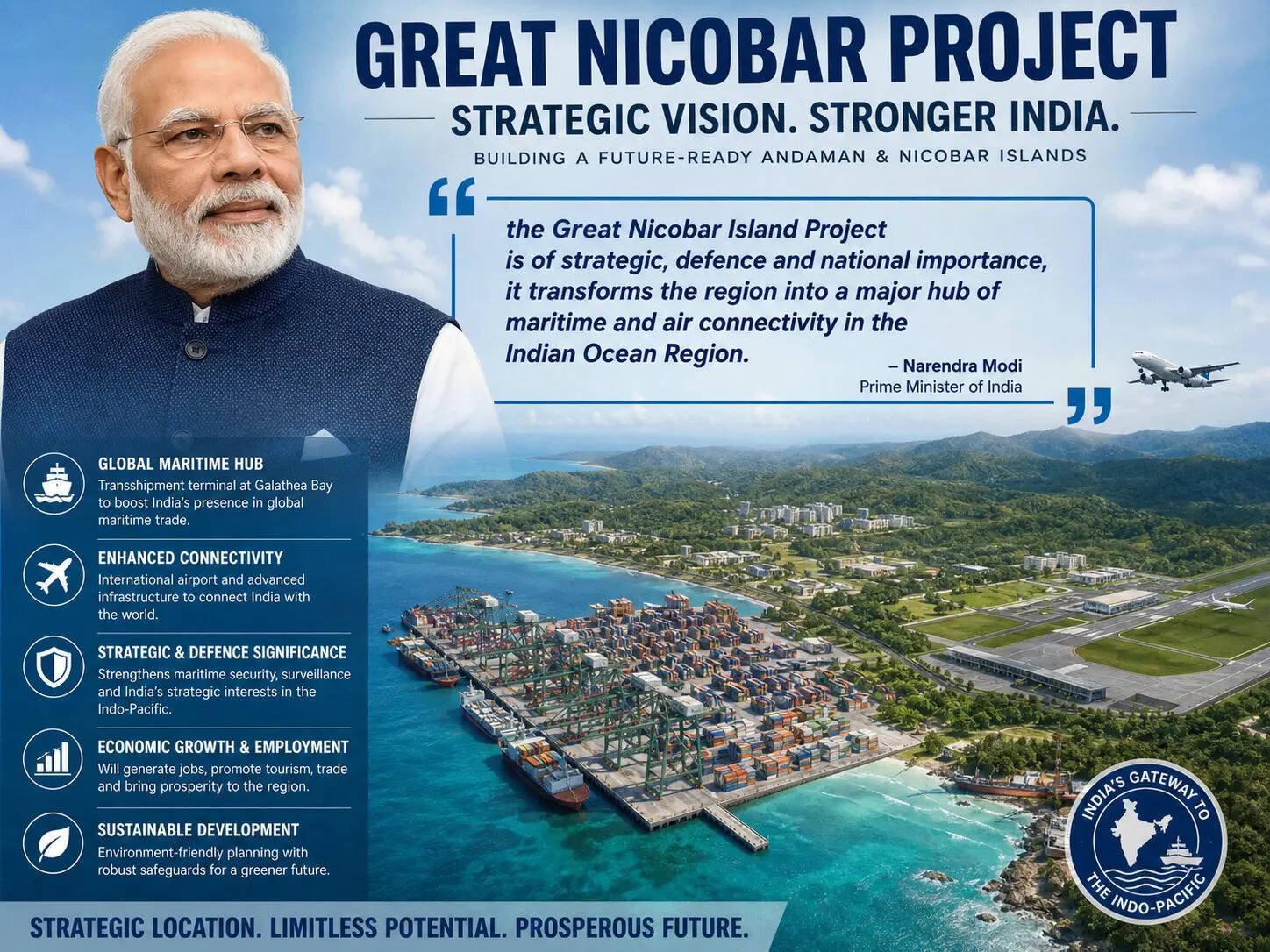
At a time when the global geopolitical order is being reshaped by maritime competition, supply chain realignments, and strategic contestation in the Indo-Pacific, India’s Great Nicobar Project stands out not merely as an infrastructure initiative, but as a long-overdue assertion of national capability and intent.
Far from being a peripheral development plan, the ₹81,000 crore project represents a decisive step toward integrating India’s island territories into the country’s economic and strategic mainstream—while positioning the nation as a serious maritime power in the 21st century.
A Strategic Asset India Can No Longer Underutilise
Great Nicobar’s geographic location is not incidental—it is transformative. Situated close to the Strait of Malacca, through which a significant portion of global trade flows, the island offers India a rare opportunity to anchor itself at one of the world’s most critical maritime chokepoints.
For decades, India has remained dependent on foreign transshipment hubs such as Singapore and Colombo. The proposed international container transshipment terminal at Galathea Bay seeks to correct this structural imbalance.
Government assessments have consistently highlighted the “strategic location and national importance” of the project, underlining its role in enhancing security and economic resilience. Judicial bodies, including the National Green Tribunal, have also acknowledged this dimension, noting the project’s strategic relevance while allowing it to proceed with safeguards.
In a region where China has aggressively expanded its port infrastructure footprint under the Belt and Road Initiative, India’s hesitation would not be neutrality—it would be strategic withdrawal.
Economic Multiplier for the Andaman & Nicobar Islands
Beyond geopolitics, the Great Nicobar Project is fundamentally about unlocking the economic potential of one of India’s most underdeveloped regions.
The Andaman & Nicobar Islands have long remained isolated from mainstream economic activity due to infrastructure deficits and logistical constraints. The proposed development—comprising a transshipment port, an international airport, power infrastructure, and an integrated township—can catalyse a structural transformation of the local economy.
The project is expected to generate employment, stimulate tourism, enable trade-led growth, and create an ecosystem for logistics and allied industries. Over time, it could transform the islands into a regional economic hub, rather than a remote outpost dependent on mainland support.
In policy terms, this aligns with the broader objective of balanced regional development, ensuring that India’s frontier territories are not left behind in the growth narrative.
Maritime Security and Long-Term Strategic Autonomy
The significance of the project extends into the domain of national security.
India’s maritime doctrine increasingly recognises the Indo-Pacific as a theatre of strategic competition. Control over logistics, surveillance capabilities, and forward-operating infrastructure is becoming central to safeguarding national interests.
Great Nicobar, often described in strategic circles as India’s forward maritime outpost, offers the potential to enhance naval reach, improve domain awareness, and support humanitarian and disaster response operations across the region.
In this context, the project is not optional—it is foundational. Without such infrastructure, India risks ceding strategic space in its own maritime neighbourhood.
Environmental Concerns: Between Legitimate Caution and Exaggeration
No large infrastructure project is without environmental impact, particularly in ecologically sensitive regions. However, the discourse around Great Nicobar has, in several instances, moved beyond evidence-based critique into the realm of exaggeration and, at times, political contestation.
Regulatory clearances for the project have been granted after detailed assessments, and oversight bodies have mandated compliance with environmental safeguards. The National Green Tribunal, while examining objections, concluded that “adequate safeguards have been provided”, allowing the project to move forward.
Government agencies have also emphasised that development will be undertaken with sustainability measures, mitigation strategies, and continuous monitoring.
It is important to recognise that India’s environmental governance framework today is far more robust than in previous decades. Mechanisms for compensatory afforestation, wildlife management, and coastal regulation are integral to project implementation.
The larger question, therefore, is not whether development should occur, but whether it can be managed responsibly. To suggest that infrastructure development must be entirely halted in ecologically sensitive zones is neither practical nor aligned with the aspirations of a growing economy.
The Politics of Resistance
Some of the opposition to the project reflects genuine environmental concerns, which merit attention and mitigation. However, there is also a discernible tendency to frame the project in absolutist terms—where development is portrayed as inherently destructive.
In certain cases, critiques have been amplified through political narratives that overlook the strategic and economic imperatives at play. This risks reducing a complex national project into a binary debate, rather than a nuanced policy discussion.
India’s development trajectory cannot be held hostage to maximalist positions that reject infrastructure expansion altogether, particularly when such expansion is tied to national security and long-term economic interests.
A Defining Test for India’s Developmental State
The Great Nicobar Project ultimately represents a critical test of India’s ability to execute large-scale, strategic infrastructure in challenging environments.
If implemented effectively—with transparency, adherence to safeguards, and continuous stakeholder engagement—it can serve as a model for integrated, security-driven, and economically viable development.
More importantly, it signals a shift in India’s strategic thinking: from a continental mindset to a maritime one, where islands are not seen as distant territories, but as pivotal assets in shaping the country’s global role.
From Peripheral Island to Strategic Nerve Centre
For too long, Great Nicobar has remained on the margins of India’s development imagination. The current project seeks to change that—transforming it into a hub of trade, connectivity, and strategic capability.
The stakes are undeniably high. But so are the opportunities. In an era defined by maritime competition and economic realignment, the Great Nicobar Project is not merely desirable—it is indispensable.