

The Global Risks Report is the World Economic Forum’s annual overview of emerging risks in five areas: economic, environmental, geopolitical, societal, and technological. It is based on the Global Risks Perception Survey (GRPS), which in 2025 collected insights from over 900+ experts. The 2025 edition (the 20th) assesses risk outlooks across short, medium, and long time horizons.
Why is the Global Risks Report important for exams?
For RBI Grade B (ESI/Descriptive), SEBI, and UPSC (GS-II/GS-III, Essays), this report provides reliable data on key macro trends: conflict, trade and geoeconomics, climate and nature risks, technology risks like AI and cyber threats, and social cohesion. Using WEF terminology and rankings can help you support your answers with a trusted source and connect current events with concepts such as growth, inflation, sustainability, governance, and technology policy.
What are the key highlights of the Global Risks Report 2025?
The Global Risks Report 2025 published by the World Economic Forum identifies the most significant threats expected to affect the world across immediate, short-term, and long-term horizons. The report highlights growing geopolitical tensions, the rise of misinformation, cyber insecurity, climate-related disasters, and environmental degradation as the major concerns shaping global stability. While state-based armed conflict has emerged as the most urgent risk in 2025, environmental risks such as extreme weather and biodiversity loss dominate the long-term outlook up to 2035. The report also warns about technological risks, including adverse outcomes from artificial intelligence.
| Time Horizon | Key Risks Highlighted | Major Observation |
| Immediate Risk (2025) | State-based armed conflict | Geopolitical fragmentation and rising international tensions make armed conflict the most urgent global threat |
| 2-Year Horizon (2026–27) | Mis/disinformation, extreme weather, armed conflict, societal polarization, cyber insecurity | Social instability, digital threats, and climate events are expected to intensify in the near future |
| 10-Year Horizon (to 2035) | Extreme weather, biodiversity loss, Earth system changes, natural resource shortages, adverse AI outcomes | Environmental risks dominate the long-term outlook, while advanced technology risks are also increasing |
| Technology Risks | Adverse AI outcomes, cyber warfare | Rapid technological advancement may create security and governance challenges |
| Environmental Concerns | Climate change, biodiversity loss, resource scarcity | Environmental degradation remains the most persistent long-term global risk |
Year wise Global Risks Reports (2010–2025)
Candidates can download the Global Risk Reports PDF provided in the table below from 2010 onwards:
Key Global Risk Categories
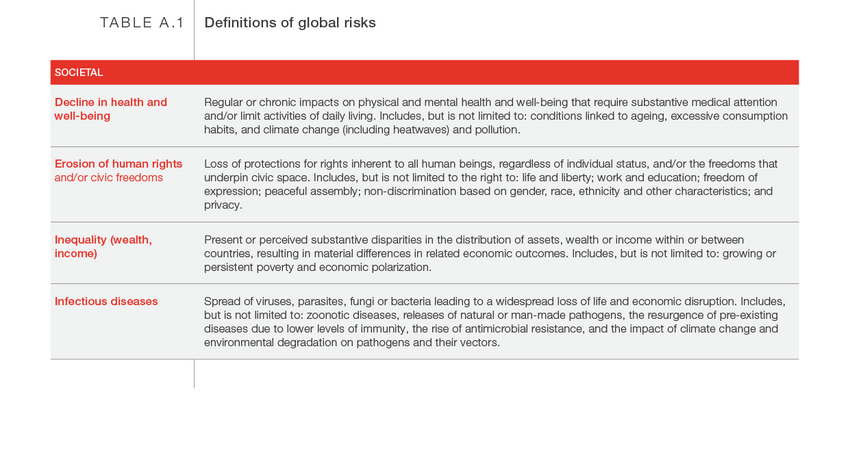
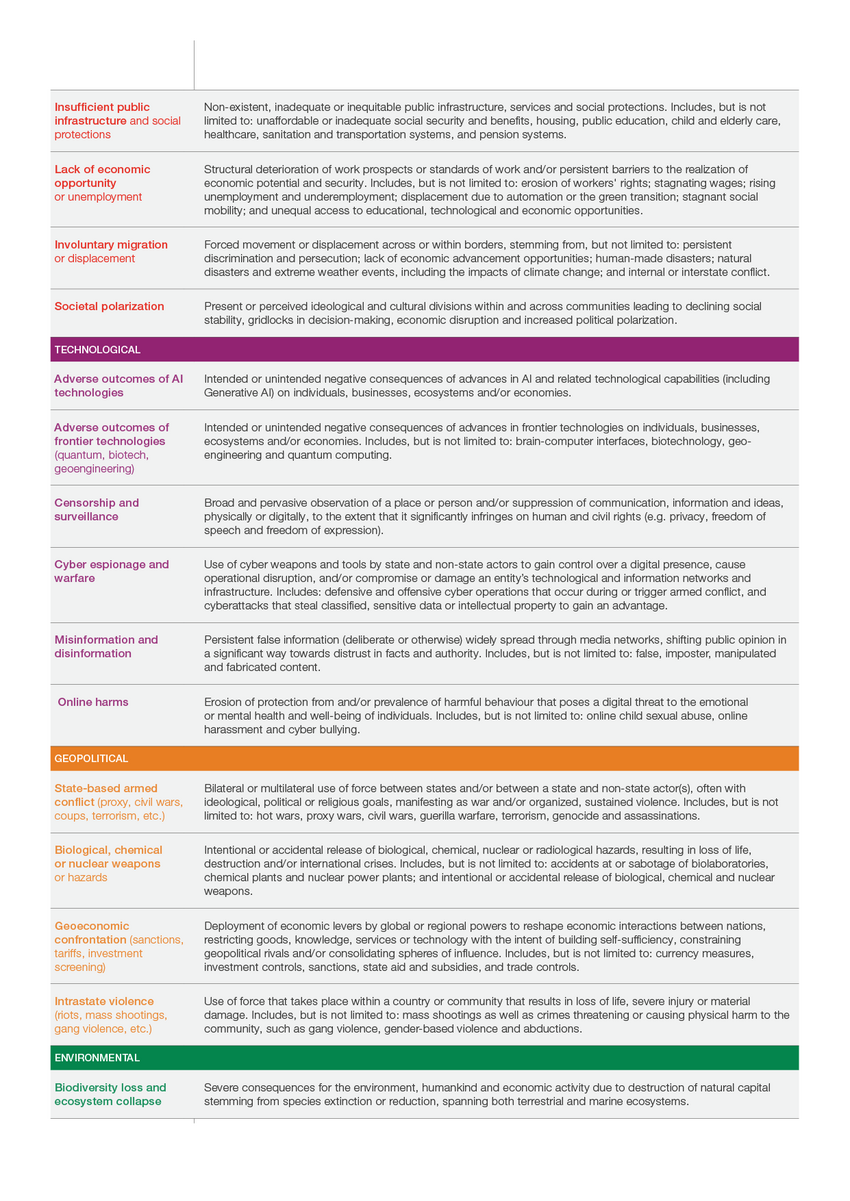
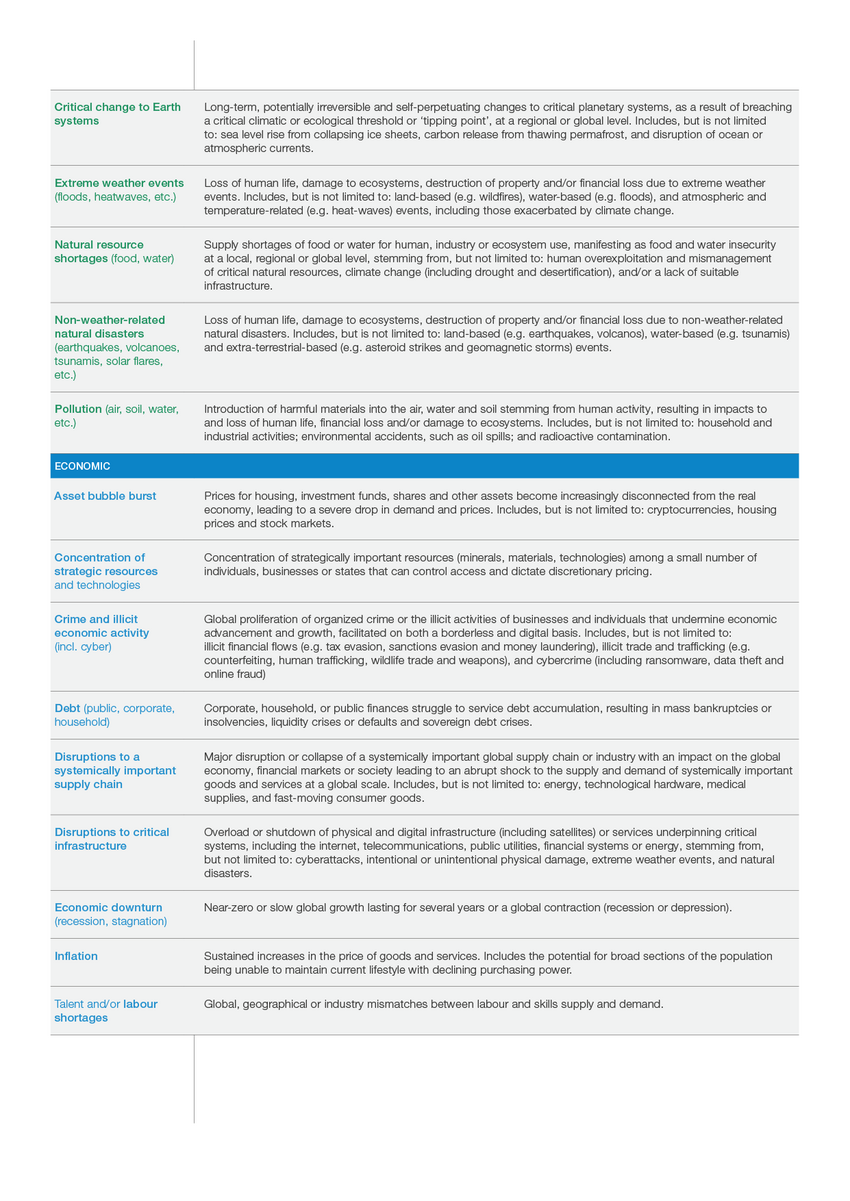
WEF evaluates 33 specific risks mapped to five categories:
- Economic (e.g., geoeconomic confrontation, economic downturn)
- Environmental (e.g., extreme weather, biodiversity loss)
- Geopolitical (e.g., state-based armed conflict)
- Societal (e.g., misinformation & disinformation, polarization)
- Technological (e.g., cyber insecurity, adverse AI outcomes)
How to use the Global Risks Report for exam preparation?
The Global Risks Report is a useful resource for exams like RBI Grade B, UPSC, and SEBI Grade A. It explains global economic, environmental, and geopolitical risks that are often asked in current affairs, essays, and interviews. Using the report wisely can give candidates an edge in preparation.
- Read strategically: Begin with the Executive Summary and “ranked risks” figures; extract 2-year vs 10-year contrasts for answers.
- Build a risk→policy map: For each top risk, jot one cause, one impact, and one policy lever (e.g., misinformation → electoral integrity → media literacy/regulation).
- Use data points carefully: Quote “WEF Global Risks Report 2025” as the source; avoid over-generalization.
- For essays/descriptive: Contrast short-term shocks vs long-term structural risks this framing scores well.
- ESI/GS integration:
- RBI Grade B (ESI): inflation/growth shocks from conflict & trade tensions; climate risk to agri/monetary transmission; tech risk & financial stability.
- UPSC GS-III: disaster management, climate adaptation/mitigation, cyber security; GS-II: governance, institutions, information integrity.
If you are preparing for exams like RBI Grade B, you can check out the detailed RBI Grade B notification released on 29th April 2026. The Phase 1 exam is scheduled for 13th and 14th May 2026.
FAQs
A: It gives insights into global challenges that are useful for current affairs and descriptive answers.
A: It helps in current affairs, economics, environment, governance, and international relations.
A: Focus on key highlights, top risks rankings, and trend analysis instead of reading everything.
A: Yes, quoting facts and rankings strengthens essays and answers in exams.
A: No, just remember the top risks, emerging issues, and notable statistics.

Priti Palit, is an accomplished edtech writer with 4+ years of experience in Regulatory Exams and other multiple government exams. With a passion for education and a keen eye for detail, she has contributed significantly to the field of online learning. Priti’s expertise and dedication continue to empower aspiring individuals in their pursuit of success in government examinations.
