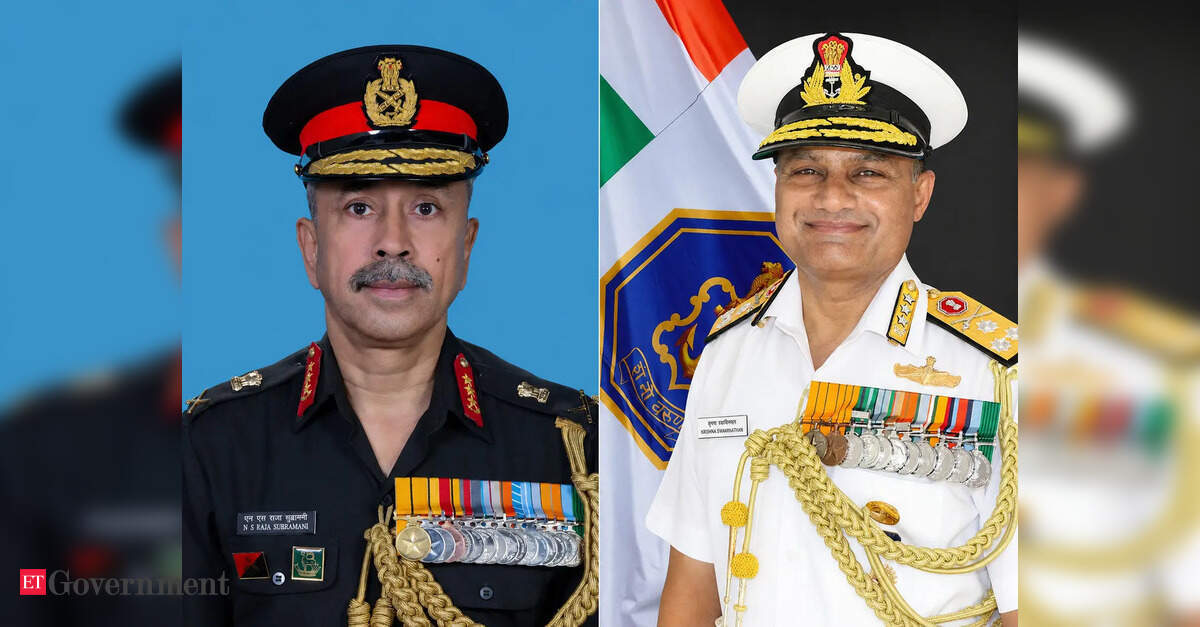
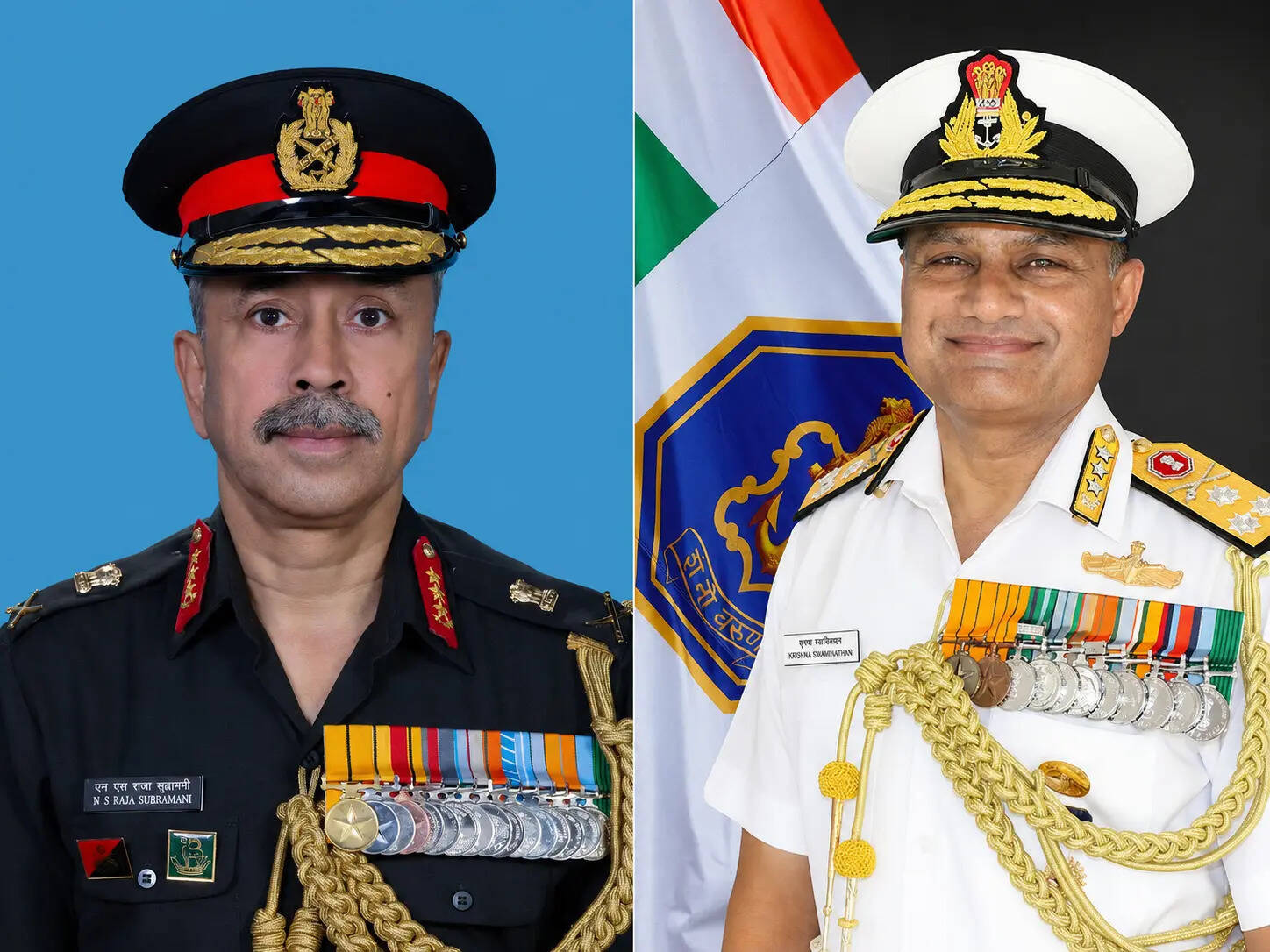
The Government of India has announced two of the most consequential appointments in the country’s higher defence architecture: Lieutenant General N. S. Raja Subramani as the next Chief of Defence Staff (CDS), and Vice Admiral Krishna Swaminathan as the next Chief of the Naval Staff.
The appointments come at a time when India is navigating an increasingly volatile geopolitical environment marked by military modernisation in Asia, intensifying maritime competition in the Indo-Pacific, the growing role of emerging technologies in warfare, and persistent tensions along its northern and western borders.
Lieutenant General Raja Subramani, a former Vice Chief of Army Staff, will succeed General Anil Chauhan after the latter completes his tenure on May 30, 2026. Simultaneously, Vice Admiral Krishna Swaminathan will take over from Admiral Dinesh K. Tripathi as Navy chief on May 31.
These appointments are not merely routine military successions. They signal the continuation of India’s long-term effort to create a more integrated, technology-driven and strategically coordinated defence structure.
The appointment of Raja Subramani as CDS carries particular significance because the office has increasingly evolved into the fulcrum of India’s military transformation agenda. Created in 2019 following the recommendations of the Kargil Review Committee and years of debate over higher defence reforms, the CDS serves as the principal military adviser to the government and also heads the Department of Military Affairs.
The office was conceived to improve jointness among the Army, Navy and Air Force, rationalise procurement priorities, and accelerate the creation of integrated theatre commands.
Raja Subramani brings to the position nearly four decades of operational and strategic experience. An alumnus of the National Defence Academy and the Indian Military Academy, he was commissioned into the Garhwal Rifles in 1985. During his career, he held several critical appointments, including General Officer Commanding-in-Chief of the Central Command and Vice Chief of Army Staff. He has also served in operational theatres ranging from Jammu & Kashmir to the northern borders and strategic formations facing China.
What makes his appointment strategically important is his blend of field command experience and institutional exposure. His tenure as Vice Chief came during a period when the Indian military was adapting to the lessons of the Galwan crisis, accelerating indigenous capability development, and recalibrating operational doctrines for multi-domain warfare. His recent role as Military Adviser at the National Security Council Secretariat further deepened his exposure to national security planning beyond conventional military command structures.
For the government, the selection also indicates continuity in the broader reform agenda initiated under the first CDS, General Bipin Rawat, and subsequently carried forward by General Anil Chauhan. The key challenge before Raja Subramani will be to push forward the politically sensitive and institutionally complex process of theatre command integration. While progress has been made in enhancing inter-service coordination, questions relating to command structures, resource allocation, operational jurisdiction, and service-specific autonomy remain unresolved.
The appointment of Vice Admiral Krishna Swaminathan as the next Navy chief also reflects India’s growing maritime priorities. Over the past decade, the Indian Ocean Region has emerged as one of the central theatres of geopolitical competition, with China expanding its naval footprint, strategic infrastructure projects, and maritime influence across the region. India’s naval modernisation and Indo-Pacific strategy are therefore no longer peripheral concerns; they are central to the country’s broader national security doctrine.
Vice Admiral Swaminathan is widely regarded as a technologically sophisticated and operationally experienced naval officer. A specialist in communication and electronic warfare, he has commanded major naval assets including the aircraft carrier INS Vikramaditya and the destroyer INS Mysore. He has also held key appointments related to personnel management, naval safety, and operational command, most recently serving as the Flag Officer Commanding-in-Chief of the Western Naval Command.
His elevation comes at a critical moment for the Navy. India is simultaneously pursuing maritime deterrence, indigenous shipbuilding, undersea capability enhancement, and strategic partnerships through frameworks such as the Quad. The Navy is also expected to play an increasingly important role in protecting sea lanes, countering grey-zone maritime threats, and ensuring strategic stability in the Indian Ocean.