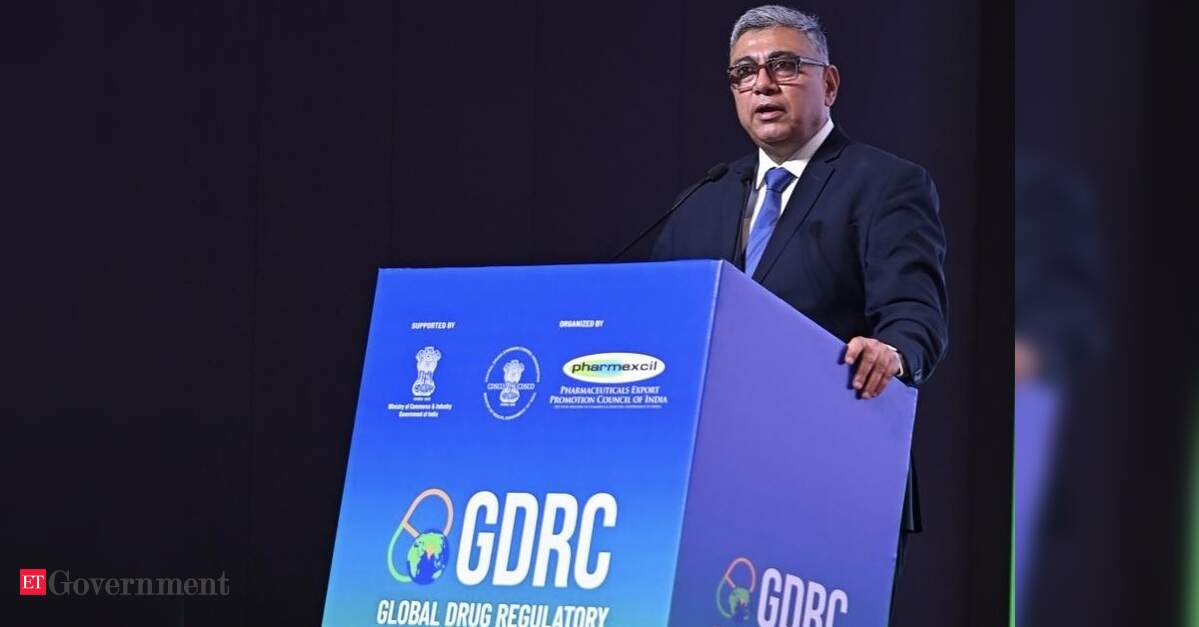
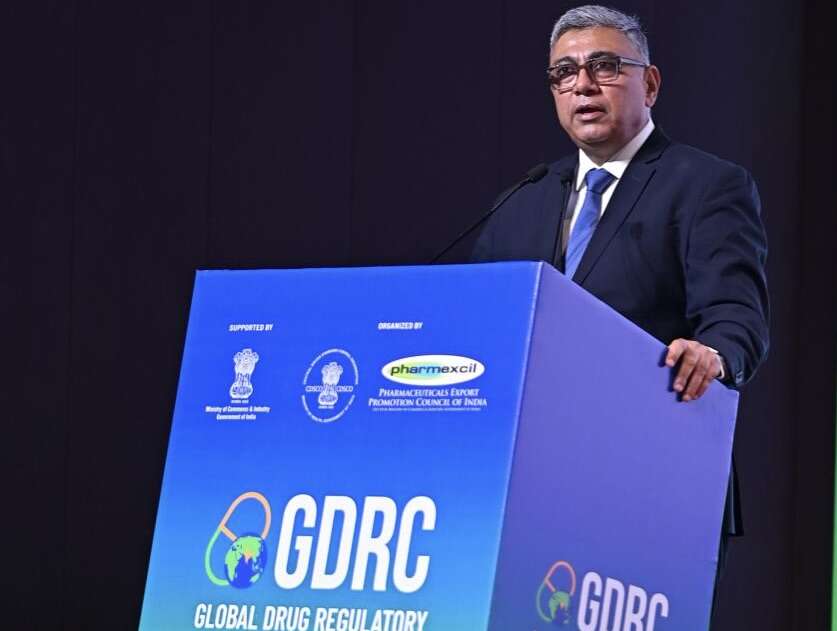
At the inaugural Global Drug Regulators’ Conference (GDRC) 2026, global health regulators, policymakers and pharmaceutical industry leaders came together to deliberate on the future of drug regulation, regulatory harmonisation and pharmaceutical innovation.
The conference marked the country’s first dedicated platform focused exclusively on global regulatory cooperation, with participation from regulators representing nearly 40 countries.
On the sidelines of the event, Anoop Verma spoke with Namit Joshi, Chairman of the Pharmaceuticals Export Promotion Council of India (PHARMEXCIL), about the significance of GDRC, India’s growing role in the global pharmaceutical industry, the opportunities and challenges facing drug exports, the push for innovation, the impact of evolving US trade policies, competition from China, and the roadmap for strengthening India’s position as a global pharmaceutical powerhouse.
Edited excerpts:
This is the first edition of the Global Drug Regulators’ Conference. What is GDRC seeking to achieve, who is attending, and what are the key issues being discussed?
This is the first time India has organised a standalone Global Drug Regulators’ Conference. Earlier, regulatory discussions were always held as an extension of larger pharmaceutical events. We felt the time had come for India to host its own dedicated platform where global regulators could come together to discuss regulatory harmonisation and the future of pharmaceutical governance.
The biggest challenge facing the pharmaceutical industry today is that every country follows its own regulatory framework. There is no universally accepted regulatory standard that allows a company to commercialise a product across multiple markets without undergoing different approval processes. Some countries require clinical studies to be conducted locally before granting approvals, while markets such as the United States and Europe recognise clinical trials conducted elsewhere, provided they meet prescribed standards.
For many small and medium-sized pharmaceutical companies, repeating clinical studies in every country is financially impossible. As a result, smaller manufacturers often struggle to enter international markets while larger companies are better positioned to absorb these costs. One of the primary objectives of GDRC is to identify ways of making global regulations more harmonised so that MSMEs can become a stronger part of the global pharmaceutical ecosystem.
We are encouraged by the response. Around 60 regulators from 40 countries have participated in this inaugural conference. This demonstrates strong international interest. We intend to organise GDRC every year and continuously refine the platform so that it becomes an important global forum for regulatory collaboration.
India’s pharmaceutical industry has emerged as one of the biggest success stories of the Make in India initiative. What has driven this success?
India’s biggest strength has always been its extensive manufacturing ecosystem. We have more than 10,000 pharmaceutical manufacturing units, supported by a robust supply chain. However, the COVID-19 pandemic exposed one important vulnerability. A significant portion of our key starting materials, intermediates and active pharmaceutical ingredients (APIs) depended on imports, particularly from China.
Recognising this challenge, the Government introduced the Production Linked Incentive (PLI) scheme in 2020 with the objective of strengthening domestic manufacturing and making India more self-reliant. The Prime Minister envisioned pharmaceuticals as one of the country’s major growth engines, and the industry has responded positively.
Today, PHARMEXCIL is among the top export promotion councils under the Ministry of Commerce. India already ranks third globally by pharmaceutical production volume. The next stage of growth, however, will come through innovation rather than manufacturing alone. Manufacturing gives us scale, but innovation creates value. That is why we are encouraging stronger collaboration between academia, research institutions and industry so that discoveries made in laboratories can be commercialised successfully.
Innovation requires significant investments and long gestation periods. How can India encourage the private sector to invest more aggressively in pharmaceutical innovation?
The government began supporting private-sector research nearly a decade ago by allocating dedicated R&D funding. However, pharmaceutical innovation requires patient capital. It often takes ten years or more before a molecule reaches the market, whereas many policy incentives operate only for three to five years.
Private companies naturally compare long-term research investments with immediate business returns. Sustaining innovation therefore becomes difficult. The example of Wockhardt illustrates this well. The company continued investing in antimicrobial resistance research despite facing financial challenges. It remained committed for over a decade before successfully developing a new antibiotic. Today, those investments are beginning to generate returns.
Government-funded research institutions should therefore play a larger role in developing molecules up to the laboratory stage. Once scientific validation has been achieved, industry can commercialise these innovations. I have personally seen promising drug-delivery technologies developed by Indian institutions being acquired by foreign companies for relatively modest amounts, only to generate enormous commercial value later. India has the scientific capability; we need stronger commercialisation mechanisms.
Should India introduce dedicated incentives for pharmaceutical innovation similar to manufacturing-linked incentives?
That is precisely the thinking behind programmes such as Bio Shakti Pharma. Government support is now being directed towards biologics, biosimilars and other advanced pharmaceutical technologies. The future of pharmaceuticals will also be shaped by environmentally sustainable manufacturing. Traditional chemical processes often involve significant solvent usage and create environmental stress. Over time, manufacturing technologies will have to become greener. Vaccines represent another major opportunity. Preventive healthcare is always preferable to treatment. India already has significant global strength in vaccine manufacturing, and we should continue building on this advantage.
India has become one of the world’s largest pharmaceutical exporters. What additional steps can further strengthen exports?
One of the motivations behind organising GDRC is to help countries that currently lack mature regulatory systems. When regulatory frameworks are weak, procurement standards often become inconsistent, creating opportunities for suppliers that may not always maintain the highest quality standards.
India has built its reputation on quality and compliance. We already have a very strong presence in highly regulated markets such as the United States and Europe. Outside the US, India has the largest number of US FDA-approved pharmaceutical manufacturing facilities in the world. Every facility undergoes regular inspections and continuous audits before products can enter these markets. Maintaining this reputation for quality and regulatory compliance is essential if we want to continue expanding our global presence.
How do you view the proposed US tariffs on pharmaceutical imports? Could they affect India’s competitiveness?
The United States sources medicines from India because we offer a unique combination of high quality and affordability. Indian medicines help the US healthcare system save nearly US$200 billion annually. When tariff discussions first began, pharmaceuticals were excluded because policymakers recognised their importance. More recently, there have been suggestions about imposing tariffs on generic medicines in the future. However, replacing India’s generic pharmaceutical ecosystem within two years is simply not practical.
Building manufacturing capacity of this scale requires at least five years. Indian manufacturers also do not have operating margins large enough to absorb such tariffs. If tariffs are imposed, the additional costs would ultimately have to be passed on to buyers. Moreover, political and policy environments evolve. There are elections in the United States before any proposed measures would take effect. Therefore, I believe it is too early to draw definitive conclusions.
China dominates several manufacturing sectors globally. How does India compete with China in pharmaceuticals?
China is extraordinarily cost-efficient, and every manufacturing sector faces competition from China. However, pharmaceutical formulations require much more than large-scale manufacturing. India has developed deep expertise in handling multiple product variants, customised batch sizes and complex regulatory requirements for different customers across different markets. This operational flexibility has become one of our greatest competitive advantages.
Another major strength is transparency. International regulators interact directly with our production teams during inspections. English-language documentation and communication significantly simplify regulatory audits. China remains extremely strong in bulk manufacturing, but India’s ability to manage complex formulation manufacturing has enabled us to become one of the world’s leading exporters. Nearly three-fourths of our pharmaceutical exports come from formulations.
What role has PHARMEXCIL played in expanding India’s pharmaceutical exports?
When PHARMEXCIL began operations in 2004, India’s pharmaceutical exports stood at approximately US$3 billion. Today, exports have crossed US$31 billion. Every year has witnessed growth. Even during COVID-19, while global supply chains experienced disruption, India’s pharmaceutical sector demonstrated resilience.
Looking ahead, we anticipate that more countries will increasingly manufacture finished formulations domestically. Consequently, India’s future growth will increasingly depend on exports of APIs, bulk drugs, intermediates and key starting materials.
That is why the PLI scheme has arrived at the right time. It encourages backward integration across the pharmaceutical value chain, reducing dependence on imports while strengthening India’s long-term competitiveness.
What do you see as the biggest opportunities for India’s pharmaceutical sector over the next five years?
The first major opportunity lies in launching generic medicines immediately after patents expire. India has consistently demonstrated that it can rapidly introduce affordable alternatives once intellectual property protections end. The second opportunity is complete backward integration of the pharmaceutical value chain. India should be capable of supplying everything—from solvents and key starting materials to intermediates, APIs and finished formulations.
The third opportunity involves skill exports. As more countries establish local pharmaceutical manufacturing facilities, India can supply not only products but also highly skilled professionals. Through the Life Sciences Sector Skill Development Council, we are developing programmes that combine pharmaceutical expertise with language training, enabling Indian professionals to work effectively in overseas markets.
What are the biggest challenges facing the sector?
Global trade policies, including tariffs, will continue to present uncertainties. Fortunately, pharmaceuticals have largely remained insulated because governments recognise their importance to healthcare. India also enjoys one significant advantage—we export to nearly 200 countries. This diversified global presence allows us to manage market-specific disruptions effectively. Whenever exports to one region slow, other markets often compensate. We recently witnessed this as stronger demand from Europe, Brazil and Latin America offset softness elsewhere. That diversification has made India’s pharmaceutical export ecosystem resilient.
You spoke about exporting skilled pharmaceutical professionals. How important is this opportunity for India?
It is an important strategic opportunity. As more countries establish local pharmaceutical manufacturing facilities, demand for experienced professionals will continue growing. At present, overseas recruitment largely operates through individual agencies without any structured national framework. We want to organise this process more systematically.
Our objective is to identify countries where pharmaceutical skills are in high demand, provide professionals with both technical training and language proficiency, and create an organised ecosystem that connects Indian talent with international opportunities. This will allow India to export not only medicines but also pharmaceutical expertise, creating an additional source of global competitiveness for the country’s life sciences sector.