

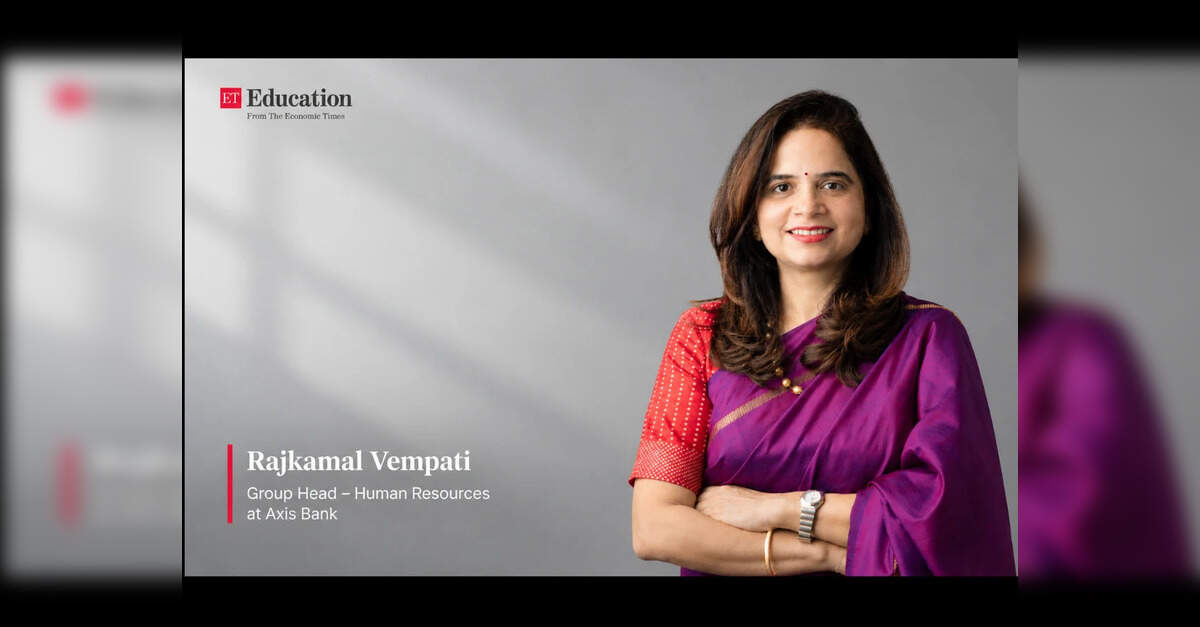
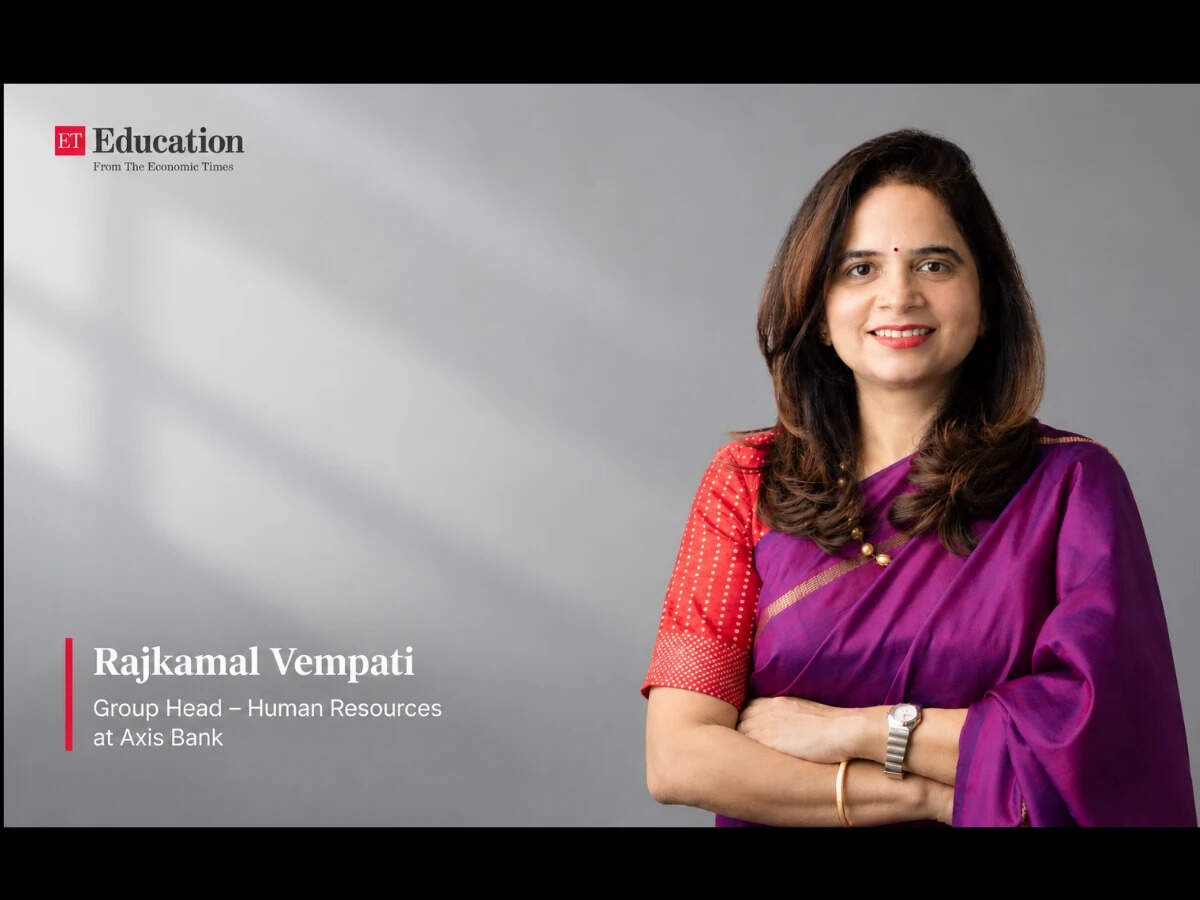
India’s graduate employability debate needs a closer look at the role employers play in preparing young people for work, says Rajkamal Vempati, Group Head – Human Resources at Axis Bank, in an exclusive conversation with ETEducation.“Whenever people say talent is scarce, you haven’t looked hard enough,” Vempati says, arguing that employers need to look beyond college pedigree and conventional hiring filters to identify talent. As technology reshapes jobs, she says, companies must also take greater responsibility for helping graduates understand business contexts and acquire the skills needed to apply their knowledge.For universities, her message is equally pointed: academic foundations need to be complemented by current business case studies, practical exposure and opportunities to solve real-world problems. The challenge is not just to produce graduates with qualifications, but to prepare them to learn and adapt as the nature of work changes.Employers are looking beyond degrees and college pedigreeVempati says graduates entering the workforce today are more confident and technologically fluent than those of previous generations. She points to summer interns from premier institutes who were developing AI agents, something she says would have been less common when she began her career.“The expectation really is the language of technology to us, we will give you the context. Apprenticeship still works, skills still work, but you need to learn differently,” she says.For employers, this means recruitment cannot rely only on the reputation of a candidate’s college or the degree they hold. Demonstrable skills, curiosity and the ability to learn are becoming more important, she says.Vempati also argues that traditional assumptions about who can succeed in a role can unnecessarily narrow the talent pool. She cites past perceptions that women could not work in sales, that only candidates from certain campuses were suitable, or that English fluency was the principal marker of talent.With learning opportunities becoming more accessible through online platforms and courses offered directly to learners, she says employers need to reconsider such boundaries.“Skill is the new currency of growth, especially the curiosity,” she says.The implication for higher education institutions is that qualifications remain important, but students also need opportunities to demonstrate what they can do, how they approach unfamiliar problems and how quickly they can acquire new capabilities.AI will change work, but productivity gains go beyond copilotsAs concerns grow that artificial intelligence could replace entry-level jobs, Vempati says organisations need to distinguish between using AI tools for individual tasks and redesigning workflows to improve productivity.She describes Indian users as experimental in their approach to new technology and says organisations are already seeing some fatigue around AI-generated material. Managers, she says, may question the quality of work when they feel an employee has relied on AI without applying independent thought.“It’s not that you make a presentation with a copilot. It is, how are you able to automate the workflows?” she says.Routine transaction processing is one area where automation could reduce the need for certain tasks, she says. Organisations that use AI to redesign processes, rather than simply generate documents or presentations, could see significant productivity gains over the next two to three years.Vempati says she has not personally seen an employee being fired because of AI or an inability to acquire a new skill. She also points out that while job-cut announcements often attract attention, new roles are being created at the same time. These are her observations, rather than a measure of AI’s overall employment impact.For universities, the challenge is to prepare graduates for workplaces in which technology is embedded in everyday tasks. That requires more than familiarity with AI tools: students need the judgement to assess their outputs, understand business problems and use technology to improve how work gets done.Banking jobs are shifting from routine operations to technology and relationshipsThe changes Vempati describes are already visible in banking, a sector that has traditionally recruited large numbers of graduates from campuses.Automation and self-service have reduced the need for some conventional operations work, she says, while relationship management roles have expanded. She expects relationship-focused work to continue growing, alongside jobs involving technology, data and AI.“Ops role will have more technology play,” she says, adding that the nature of banking work will continue to change.The shift is also changing the context in which graduates must apply what they learn. Banking customers increasingly use mobile applications rather than visiting branches for routine transactions. Yet Vempati says some educational case studies continue to reflect older business models.“Even in MBA schools, I’ve seen that. The understanding of the context is limited,” she says. “If we have 20-30 years old case studies, we won’t understand.”Her criticism is not that academic fundamentals have become irrelevant, but that students need to connect those fundamentals with how businesses operate today. In banking, that means understanding digital customer journeys, technology-led operations and the changing role of human interaction.Vempati argues that employers must also help bridge this context gap rather than simply treating it as a shortcoming in graduates.“The onus is on the employer, not the academia,” she says. Companies need to explain what they expect, identify gaps and help build the required capabilities.Axis Bank’s Homecoming initiative taps overseas-educated talentAxis Bank’s ARISE Homecoming initiative seeks to attract Indians studying abroad or recently graduated from overseas institutions to work in India. Vempati says the response has exceeded the bank’s initial expectations.“The way the response has happened, I have to look at maybe close to three-digit kind of a hiring,” she says.The figure is an estimate of the hiring the bank may undertake, not a confirmed count of completed appointments. Vempati says the initiative has attracted interest from candidates with qualifications from institutions including Columbia, Carnegie Mellon, the London School of Economics and Oxford, as well as from countries across the UK, US, Australia, Singapore, Europe and Canada.She attributes the interest partly to India’s economic growth and the roles available to returning professionals. For her, returning to India is ultimately a matter of choice, and the initiative provides candidates with access to opportunities in the domestic market.The programme also offers a view of how Indian employers can engage with global talent, including candidates who have acquired specialist knowledge or international exposure. For universities, it underlines the importance of preparing graduates for careers that may cross geographies before bringing them back into India’s evolving workforce.Real business problems can bridge the campus-to-workplace gapVempati says employers should not treat employability as a problem that universities must solve alone. Businesses understand the context in which graduates will work and have a role in helping students develop the skills needed to apply their knowledge.She points to Axis Bank’s MOVES programme, which gives students real business problems to solve. Vempati says the programme received tens of thousands of applications, although the interview transcript contains inconsistent figures and the exact number could not be established.The aim, she says, is to move beyond abstract or outdated exercises and give students problems grounded in the choices businesses actually face. Participants have brought forward specific ideas, some of which have prompted the bank to think about issues it was already considering.“I am very, very heartened with the response,” she says, referring to the students who take part and the passion shown by the winners.For higher education institutions, industry engagement need not be limited to placement drives or guest lectures. Projects based on current business problems can help students connect classroom concepts with practical decisions and give employers an opportunity to contribute to learning.Such programmes can also give employers a way to observe how candidates approach problems, while giving students a clearer understanding of business needs before they enter the workforce.Universities must prepare students for uncertaintyLooking ahead, Vempati wants universities to deepen their partnerships with industry and expand practical learning through internships, cooperative programmes and other forms of workplace exposure.She also emphasises the need to develop what she calls “unstructured problem solving”, the ability to respond when situations do not follow a fixed pattern or have an obvious answer.“Life is going to be uncertain. Life is going to be unpredictable, prepare them for that,” she says.Curiosity, she argues, needs to be nurtured by both educational institutions and employers. As roles evolve and employees move between different kinds of work, the ability to learn and adapt may matter as much as the skills acquired at the start of a career.For universities, the message is to retain strong academic foundations while making learning more connected to contemporary business realities. For employers, it is to be more active participants in developing talent rather than treating the employability gap as a problem originating entirely on campus.
