

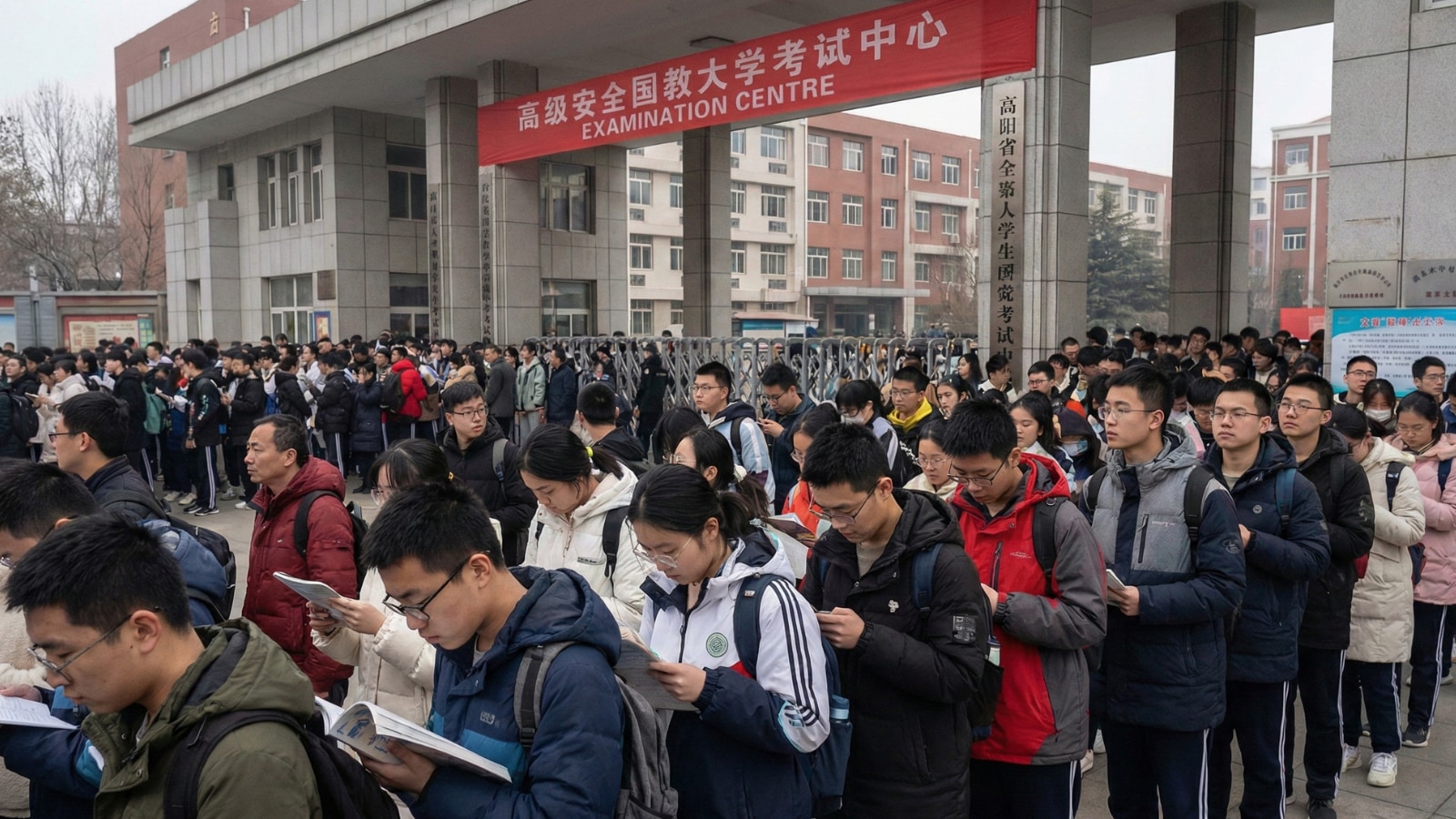
China’s civil service exam saw a record 3.7 million candidates, showing how competition for government jobs is rising as the country faces high unemployment and an uncertain job market.
The exam, which selects candidates for central government roles and their branches, saw roughly 98 applicants competing for every available post, according to official data. Authorities also disclosed that approximately 70 per cent of the vacancies are earmarked for fresh college graduates, according to a report of the China Internet Information Center.

The sweeping changes this year stem from a major policy shift: the general age cap for aspirants has been raised from 35 to 38 years, while fresh graduates holding master’s or doctoral degrees can now sit for the exam up to age 43, a considerable increase from prior limits (which were 35 and 40, respectively).
Beijing has framed the reforms as part of efforts to adjust to shifting demographic realities, including a shrinking working-age population and an increasing trend of prolonged education and delayed workforce entry. Analysts suggest the revised age limits also help counter pervasive “ageism” in the job market and harness the skills of slightly older or more experienced candidates for public service.
But the surge in applicants and stiff competition also reflects broader socioeconomic pressures. Many in China, according to a Guardian report, appear to be turning away from unstable private-sector jobs in favour of government roles that still promise the much-coveted “iron-rice-bowl” of lifetime job security, even if pay is lower and growth slower. For context, the 2026 recruitment drive aims to fill about 38,100 civil-service posts across central government institutions and their subordinate agencies.
How does this compare with India’s civil-service exam system?
In India, the Union Public Service Commission (UPSC) conducts the Civil Services Examination (CSE), the premier gateway to services such as IAS, IPS, IFS, IRS, and others. For 2025, the UPSC has announced 979 vacancies, the lowest in recent years.
Eligibility for UPSC CSE requires candidates to hold at least a bachelor’s degree. The age criteria for general-category candidates is 21–32 years (as of a specified date), with relaxations for reserved categories.
Story continues below this ad
Hence, contrary to China’s expanded age bands, India’s system currently maintains relatively stricter upper-age limits for general-category applicants. This reflects different employment-market dynamics and policy priorities.
In addition, while China’s civil-service exam appears to attract a massive crowd largely motivated by job security amid economic uncertainty, India’s UPSC continues to attract aspirants seeking prestige, influence, and a path into policymaking and administrative leadership, but with controlled intake (less than 1,000 posts per cycle) and stringent eligibility criteria.
What prompted China’s decision to raise the age limit, and what are its broader implications?
The decision to lift the “35-year ceiling” for central civil-service recruitment was announced in October 2025, when the government revised the hiring age rules in its recruitment plan.
Officials and experts argue that in an era where many young people pursue longer education (master’s or doctoral degrees) or start careers later, the old age cap unfairly excludes qualified candidates. Extending the limit to 38 (and 43 for postgraduates) makes the process more inclusive and reflective of changing social realities, according to reports by the South China Morning Post.
Story continues below this ad
With so many aspirants, including older and postgraduate-qualified ones, vying for limited seats, competition is already fierce; in some specialised postings, the application-to-post ratio reportedly runs into thousands, according to local reports.
