

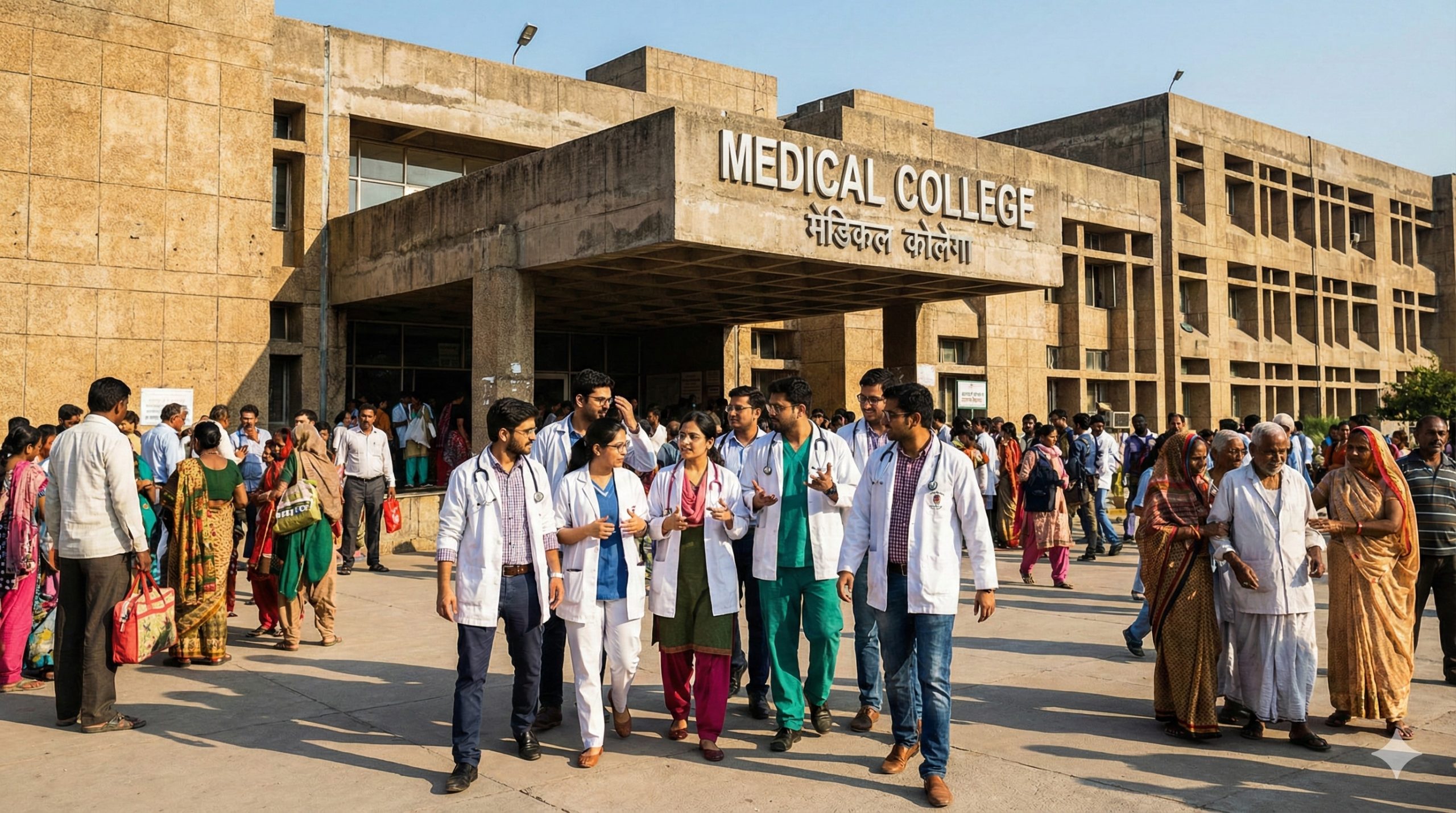
The union government has set up 118 medical colleges in the country in the last two years. The Union health ministry informed the Rajya Sabha on Tuesday, during the ongoing Winter session of Parliament. Responding to a question by MP Anupriya Patel, the ministry shared the details in a written reply, stating that 74 medical colleges were approved in AY 2024–25 and 44 in AY 2025–26, based on National Medical Commission (NMC) approvals.
The reply also included the state-wise distribution of these colleges. Uttar Pradesh saw the highest number of new colleges across the two years, followed by Maharashtra and Rajasthan. The reply further stated that the expansion of medical infrastructure is part of the government’s ongoing effort to increase the availability of medical education and healthcare services.

| State/UT | Total Colleges (2024-25) | Total Colleges (2025-26) (as on 20.11.2025) |
| Andhra Pradesh | 1 | 1 |
| Jammu and Kashmir | 0 | 1 |
| Delhi | 0 | 1 |
| Jharkhand | 0 | 1 |
| Haryana | 0 | 2 |
| Assam | 1 | 2 |
| Madhya Pradesh | 4 | 4 |
| Maharashtra | 12 | 5 |
| Orissa / Odisha | 2 | 2 |
| Rajasthan | 8 | 6 |
| Tamil Nadu | 3 | 1 |
| Telangana | 9 | 1 |
| Uttar Pradesh | 18 | 3 |
| Uttarakhand | 2 | 0 |
| Bihar | 1 | 3 |
| Chhattisgarh | 2 | 0 |
| Gujarat | 1 | 2 |
| Karnataka | 3 | 1 |
| Kerala | 1 | 3 |
| Meghalaya | 1 | 1 |
| Punjab | 1 | 1 |
| Tripura | 1 | 0 |
| West Bengal | 3 | 3 |
| Total | 74 | 44 |
(Source: Rajya Sabha UNSTARRED QUESTION NO. 268, Answered on December 2, 2025)
In a separate written reply, Union Health Minister J P Nadda informed the House that India’s doctor-population ratio is currently estimated at 1:811, assuming that 80 per cent of registered practitioners in both allopathic and AYUSH systems are available. India has 13,88,185 registered allopathic doctors and 7,51,768 AYUSH practitioners. Nadda added that the number of medical colleges has risen from 387 to 818 since 2014, while UG seats have increased from 51,348 to 1,28,875 and PG seats from 31,185 to 82,059.
The government also detailed the seat additions over the last two years. According to the response, 8,641 undergraduate seats were added in AY 2024–25 and 11,732 UG seats in AY 2025–26. Postgraduate capacity saw the addition of 4,188 PG seats in AY 2024–25 and 3,393 PG seats in AY 2025–26.
Looking ahead, the government outlined its future expansion plan. On September 24, the Union Cabinet approved Phase-III of the Centrally Sponsored Scheme for strengthening and upgrading state and central government medical colleges and standalone PG institutes. This phase, which will run from 2025-26 to 2028-29, aims to add 5,000 PG seats and 5,023 MBBS seats, with an enhanced cost ceiling of Rs 1.50 crore per seat.
Nadda also highlighted several initiatives introduced to improve the availability of doctors in underserved regions. Under the centrally sponsored scheme for establishing new medical colleges attached to district hospitals, 137 of the 157 approved colleges are already functional. The Family Adoption Programme (FAP) has been added to the MBBS curriculum, enabling medical colleges to adopt villages and MBBS students to adopt families for regular follow-up on vaccination, nutritional monitoring, menstrual hygiene, IFA supplementation, healthy lifestyle practices, and awareness of government health schemes.
Story continues below this ad
ALSO READ| West Bengal’s first private veterinary college opens in Hooghly’s Mogra, admissions through NEET
Further, under the District Residency Programme of the National Medical Commission, second- and third-year PG students are posted in district hospitals. The government also provides hard-area allowances to incentivise specialists to serve in rural and remote areas.
Under the National Health Mission, states may offer negotiable salaries under flexible models such as “You Quote We Pay” to attract specialist doctors. The NMC’s regulations on temporary registration also allow foreign-trained medical practitioners to work in India for purposes such as training, research, observership, voluntary service, and fellowship programmes.
The government said these measures are aimed at improving healthcare access in rural and tribal areas while continuing to expand medical education capacity nationwide.
(With PTI inputs)
