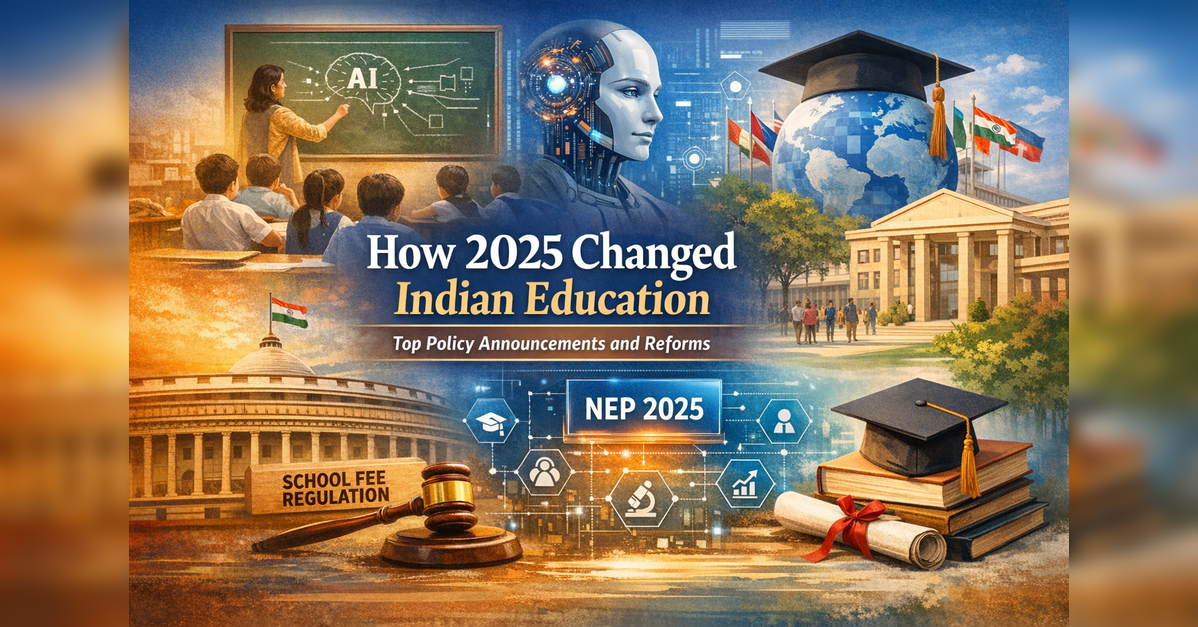
The year 2025 has emerged as a watershed moment for India’s education ecosystem. As the country accelerates its journey towards a future-ready learning landscape, policymakers, state governments and national institutions rolled out a series of significant education policy and reform initiatives. Together, these announcements signal a clear shift towards greater transparency, deeper technology integration, global engagement and outcome-oriented skill development across both school and higher education.
From landmark measures to regulate private school fees and introduce artificial intelligence literacy at the school level, to strategic roadmaps aimed at internationalising higher education and streamlining regulation, the policy actions of 2025 reflect the evolving expectations of the 21st-century learner. They also reinforce India’s long-term vision of building an education system that is inclusive, equitable, globally competitive and aligned with national development priorities.
Below, we unpack the top five education policy and reform announcements of 2025, each rooted in verified developments and carrying far-reaching implications for students, educators, institutions and families across the country.
1. Delhi School Education (Transparency in fixation and regulation of fees) Act, 2025
One of the most consequential education governance reforms in 2025 came from Delhi with the enactment of the Delhi School Education (Transparency in Fixation and Regulation of Fees) Act, 2025.
This legislation establishes a statutory framework to regulate fee determination in all recognised private unaided schools in Delhi, a domain that had long been governed by fragmented rules and court interventions.
Key provisions of the Act
- Mandatory School-Level Fee Regulation Committees, including parents, teachers, school representatives and government nominees
- Clearly defined processes for fee fixation, disclosure and justification
- Provisions to prevent arbitrary or unilateral fee increases
- Enforcement mechanisms and penalties for non-compliance
A decisive step towards fee transparency
Notified in 2025 and effective from the 2025–26 academic year, the Act introduces legally enforceable checks on fee hikes, directly addressing affordability concerns while setting a rare legislative precedent for private school governance in India.2. Union Budget 2025–26: Education and skill priorities
The Union Budget 2025–26 reinforced education as a national priority by aligning financial planning with long-term reform goals outlined under NEP 2020.
Rather than introducing a single new law, the Budget articulated policy direction through strategic emphasis areas, particularly in technology integration and skill development.
Key education-related priorities announced
- Strengthening artificial intelligence and digital capability within education systems
- Continued focus on multilingual learning and Indian-language educational resources
- Capacity building in higher education and research ecosystems
- Expansion of digital infrastructure to support blended and technology-enabled learning
Turning reform intent into fiscal direction
By aligning allocations and priorities with NEP 2020, the 2025–26 Budget sharpens the national focus on digital readiness, AI capability and future skills, giving reform ambitions operational momentum.
3. SOAR Initiative: Introducing AI literacy in school education
A notable 2025 policy initiative was the launch of SOAR (Skilling for AI Readiness), aimed at embedding artificial intelligence awareness and literacy within school education.
Key focus areas under SOAR
- AI exposure for students in Classes 6 to 12
- Foundational understanding of AI concepts, real-world applications and ethical considerations
- Parallel emphasis on teacher preparedness for emerging technologies
Preparing learners for an AI-driven future
SOAR marks a shift in thinking – positioning AI as a foundational skill for students rather than an optional add-on, and aligning school education with emerging workforce and innovation realities.
4. NITI Aayog roadmap for internationalisation of higher education
In 2025, NITI Aayog released a strategic roadmap outlining pathways to internationalise India’s higher education system.
Rather than immediate regulatory changes, the document serves as a policy blueprint guiding future decisions by ministries, regulators and institutions.
Corethemes of the roadmap
- Facilitating global academic partnerships and joint programmes
- Enabling foreign universities to collaborate more deeply with Indian institutions
- Improving student and faculty mobility
- Enhancing India’s position as a global education destination
Opening Indian campuses to the world
The roadmap lays a strategic foundation for deeper global engagement, signalling India’s intent to strengthen academic partnerships, mobility and its position in the international higher education landscape.
5. Viksit Bharat Shiksha Adhishthan Bill, 2025: Towards unified regulation of higher education
In December 2025, the Union Government introduced the Viksit Bharat Shiksha Adhishthan Bill, 2025 in Parliament, marking a significant step towards restructuring India’s higher education regulatory architecture in line with the National Education Policy (NEP) 2020.
The proposed legislation seeks to establish the Viksit Bharat Shiksha Adhishthan as an apex body for higher education, with three independent councils responsible for standards, regulation, and accreditation. Once enacted, it will subsume existing regulators including the UGC, AICTE and NCTE, replacing multiple approval systems with a unified, technology-driven, single-window regulatory framework.
Simplifying regulation, strengthening quality
By proposing a unified, technology-driven regulatory framework, the Bill seeks to reduce compliance complexity while enhancing transparency, autonomy and global alignment in higher education.
Conclusion
The education policy and reform announcements of 2025 reflect a system in transition – from reform intent to governance-driven delivery. Whether through legislation that strengthens accountability in schools, initiatives that prepare students for an AI-led future, or reforms aimed at simplifying and globalising higher education, the year marks a decisive phase in India’s education transformation.
As these policies move from announcement to implementation, their impact will depend on effective collaboration between governments, institutions, educators and communities. Together, they underscore a clear direction: India’s education system is being reshaped to be more transparent, future-ready and globally relevant.