

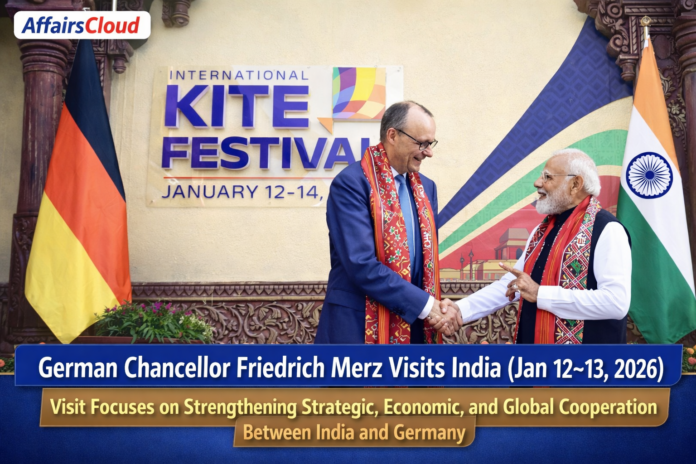
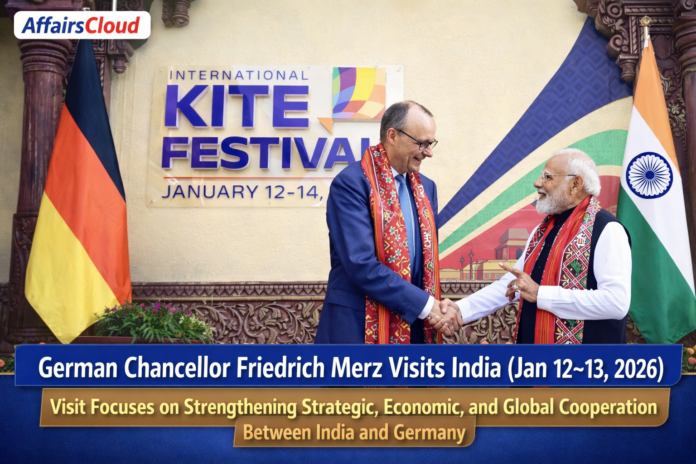
The Federal Chancellor of Germany, Friedrich Merz was on a two-day official visit to India from January 12 to 13, 2026, at the invitation of Prime Minister (PM) Narendra Modi, marking his first official visit to India and the Asian region.
Exam Hints:
- What? German Chancellor Friedrich Merz’s Visited India
- When? January 12 to 13, 2026
- Significance: First visit to India and Asia
- Visit to Gujarat:
- Sabarmati Ashram: Paid floral tributes to Mahatma Gandhi
- Inaugurated International Kite Festival 2026 at Sabarmati Riverfront
- Bilateral Meeting in Gandhinagar: Reviewed India–Germany Strategic Partnership (25 years)
- Participated in India–Germany CEO Forum
- Visit to Karnataka:
- Visited Centre for Nano Science & Engineering (CeNSE) at IISc, Bengaluru
- Visited Bosch Campus, Adugodi:
- MoUs Signed: 19 MoUs and Joint Declaration signed
- Announcement: Visa-free transit for Indian passport holders from Germany, Track 1.5 Foreign Policy and Security Dialogue establishment, Work Plan of the India-Germany Digital Dialogue (2025-2027) adoption
- Investment: 1.24 billion Euros for GSDP by Germany
Highlights of German Chancellor Friedrich’s Visit to India:
Visit to Gujarat:
Arrival: On January 12, 2026, Friedrich Merz arrived in Ahmedabad (Gujarat), where he was formally welcomed by PM Narendra Modi and other senior officials.
Sabarmati Ashram: Friedrich Merz and PM Narendra Modi visited the Sabarmati Ashram in Ahmedabad(Gujarat), the residence of Mahatma Gandhi, the father of the nation and paid floral tributes.
International Kite Festival: Friedrich Merz and PM Narendra Modi inaugurated the International Kite Festival 2026, held from January 10 to 14, 2026, at the Sabarmati Riverfront in Ahmedabad as part of Gujarat’s traditional Uttarayan or Makar Sankranti celebrations.
Bilateral Engagements: Both leaders held a high-level bilateral meeting in Gandhinagar, Gujarat, to review the India–Germany Strategic Partnership, which has recently completed 25 years.
- The discussions focused on strengthening strategic ties across trade, investment, technology, defence, security cooperation, education, climate action, and sustainable development.
India-Germany CEO Forum: During his visit, German Chancellor Friedrich Merz, along with Prime Minister Narendra Modi, attended the India–Germany Chief Executive Officer (CEO) Forum in Ahmedabad.
- The forum brought together CEOs from India and Germany to boost economic ties, trade, and collaboration in technology and Renewable Energy(RE).
- During the event, the India–Germany Centre of Excellence(CoE) was launched to promote shared knowledge and innovation.
Visit to Karnataka:
Arrival: On January 13, 2026, he arrived at the Kempegowda International Airport in Bengaluru (Karnataka), where he was received by M B Patil, Minister for Large and Medium Industries, Karnataka.
IISc: He visited the Centre for Nano Science and Engineering (CeNSE) at the Indian Institute of Science (IISc) in Bengaluru, highlighting mutual interest in scientific research and innovation.
Bosch Campus: He also visited the Bosch campus in Adugodi, Bengaluru, where he was briefed on technological innovations and sustainable mobility initiatives, including hydrogen-powered solutions.
Outcomes of the Visit:
MoUs signed: During German Chancellor Friedrich Merz’s visit to India, 19 Memorandums of Understanding (MoUs) and Joint Declarations were signed between India and Germany.
Defence & Security: A Joint Declaration of Intent (JDoI) was signed on strengthening the bilateral defence industrial cooperation.
Trade & Economy: A JDoI was signed on strengthening the bilateral economic cooperation by establishing a CEO’s Forum, integrated into, and as part of a Joint India-Germany Economic and Investment Committee.
Critical & Emerging Technologies: Three JDoI was signed on India Germany Semiconductor Ecosystem partnership and in the field of critical minerals and telecommunications.
- An MoU was signed between National Institute of Electronics & Information Technology (NIELIT), under the Ministry of Electronics and Information Technology (MeitY) and Infineon Technologies AG, German semiconductor manufacturing and design company.
Traditional Medicines: An MoU was signed between All India Institute of Ayurveda (AIIA), under the Ministry of AYUSH(Ayurveda, Yoga & Naturopathy, Unani, Siddha and Homeopathy), and Charite University, Germany.
Renewable Energy: An MoU was signed between the Petroleum and Natural Gas Regulatory Board (PNGRB), under the Ministry of Petroleum and Natural Gas (MoPNG) and the German Technical and Scientific Association for Gas and Water Industries (DVGW).
Green Hydrogen: An Offtake agreement for Green Ammonia between Indian Company, AM Green and German company, Uniper Global Commodities on Green Ammonia.
Science & Research: A JDoI was signed for cooperation in Research and Development (R&D) on Bioeconomy.
- A JDoI was signed for the extension of tenure of the Indo-German Science and Technology Centre (IGSTC).
Education: An Indo-German Roadmap on Higher Education was signed between India and Germany.
Skilling & Mobility: A JDoI was signed on the Framework conditions of Global Skill Partnerships for fair, ethical and sustainable recruitment of healthcare professionals.
- A JDoI for establishment of a National CoE (NCoE) for Skilling in Renewable Energy (RE) at National Skill Training Institute (NSTI), Hyderabad (Telangana).
Cultural & People-to-People ties: An MoU was signed between National Maritime Heritage Complex (NMHC), Lothal (Gujarat), under the Ministry of Ports, Shipping and Waterways (MoPSW), and German Maritime Museum-Leibniz Institute for Maritime History, Bremerhaven, Germany, for the development of NMHC.
- Two JDoI was signed for cooperation in the field of Sport and Postal services.
- A Letter of Intent (LoI) was signed between the Department of Posts (DoP), under the Ministry of Communications, and Deutsche Post AG.
- An MoU was signed between Hockey India and the German Hockey Federation for Youth Hockey Development.
Key Announcements:
People–to-People tie: Germany announced visa-free transit for Indian passport holders for travel through Germany, strengthening mobility and people-to-people connections.
Foreign Policy & Security: India and Germany established a Track 1.5 Foreign Policy and Security Dialogue to enhance strategic consultations and cooperation on global and regional security issues.
Indo-Pacific: India and Germany set up a bilateral dialogue mechanism on the Indo-Pacific, aiming to coordinate policies and collaboration in the Indo-Pacific.
Technology & Innovation: India and Germany adopted the Work Plan of the India-Germany Digital Dialogue (2025-2027) to promote joint initiatives in digital technology, innovation, and knowledge exchange.
Green & Sustainable Development: Germany committed new funding of 1.24 billion Euros under the Green and Sustainable Development Partnership (GSDP), supporting projects in RE, green hydrogen, Pradhan Mantri’s electric (e)-Bus Sustainable and Efficient Way of Access (PM e-Bus SEWA), and climate-resilient urban infrastructure.
- India and Germany launched a Battery Storage working group under the India-Germany platform for Investments in RE worldwide
- The projects under India-Germany Triangular Development Cooperation (TrC) will be scaled up in Ghana (Digital Technology Centre for bamboo processing), Cameroon (Climate Adaptive RAC Technology Lab for potato seed innovation), and Malawi (Technical Innovation and Entrepreneurship Hub in agro value chain for women and youth).
Cultural & People-to-People Ties: Germany opened an Honorary Consulate in Ahmedabad, enhancing cultural, economic, and people-to-people engagement between India and Germany.
About Germany:
President – Frank-Walter Steinmeier
Capital – Berlin
Currency – Euro (EUR)
AffairsCloud Recommends Oliveboard Mock Test
AffairsCloud Ebook – Support Us to Grow
