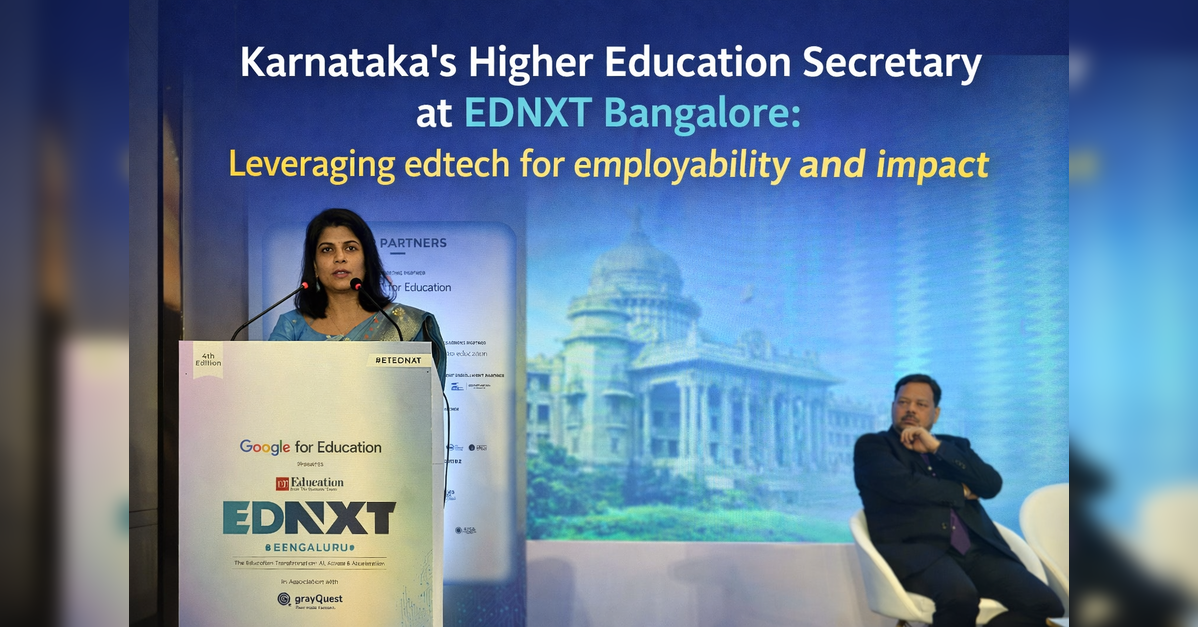
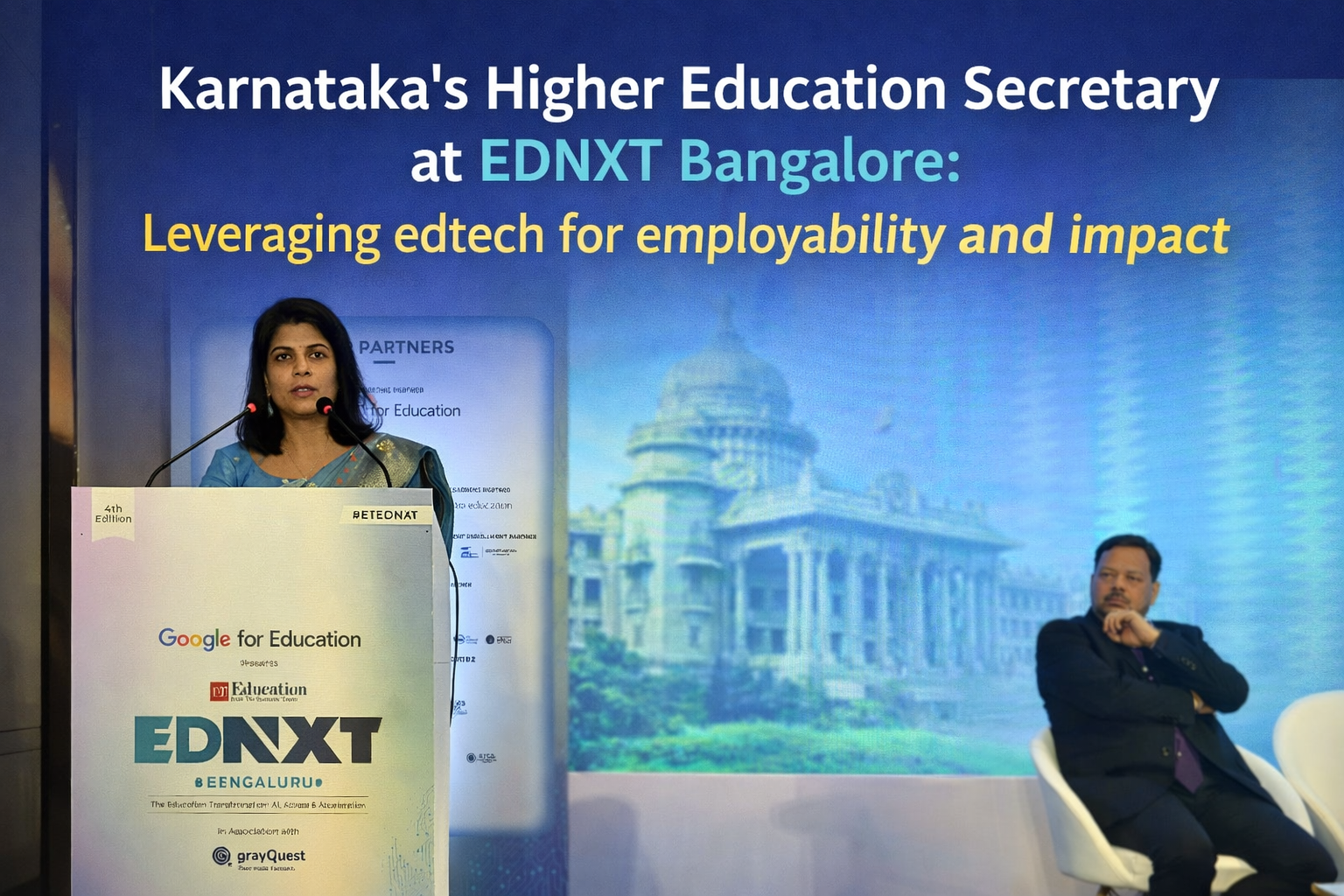
The Economic Times Education is hosting the 7th edition of the EDNXT Series today in Bangalore, bringing together some of the most influential voices from higher education, school education, and government to share their insights and vision for the future of learning.
Addressing the audience at EDNXT Bangalore, organised by The Economic Times, Khushboo Goel Chowdhary, Secretary, Higher Education Department, Government of Karnataka, spoke about the urgent need for Indian higher education to move beyond scale and focus on relevance, adaptability, and long-term student outcomes. The event brought together leading voices from higher education, school education, industry, and policy to deliberate on the future of learning in India.
Speaking as a policymaker from one of India’s most education-intensive states, Chowdhary highlighted that India has made significant progress in building scale in higher education. “Over the years, India’s higher education system has successfully built scale. Karnataka is a strong example of this—it is home to the highest number of universities in the country, across public, private, and deemed categories. For decades, the state has functioned as a national education hub, attracting students from across India and beyond,” she said.
However, she emphasised that the conversation today must move beyond numbers. The real challenge, she noted, lies in ensuring that this scale translates into relevance, adaptability, and meaningful opportunities for students.
From the government’s perspective, Chowdhary pointed out that employability remains the most pressing concern in higher education, not in the narrow sense of immediate placements after graduation, but in the broader context of preparing students for a constantly evolving world of work. Careers, she observed, are no longer linear. Professionals today undergo multiple transitions across roles, sectors, and skill domains, while skills themselves are becoming obsolete at an unprecedented pace. Many of the roles students will take up over the next two decades, she noted, do not even exist yet.
In this context, she explained, a first-year undergraduate today cannot be certain whether the job they are preparing for will still exist by the time they graduate. Higher education, therefore, cannot remain focused solely on the transmission of knowledge. Instead, it must equip students with the ability to learn, unlearn, and relearn, a capability that has become fundamental to lifelong employability.
AI as a present reality, not a future debate
Chowdhary underscored that the role of artificial intelligence in education and work can no longer be treated as a future debate. AI, she said, is already a present reality, reshaping how work is organised, how decisions are made, how value is created, and how learning itself takes place.
Higher education institutions, she stressed, must respond to this reality with clarity rather than anxiety. The critical question is no longer whether students should be exposed to AI, but how this exposure is meaningfully integrated into teaching, curricula, and learning experiences.
AI, she noted, should strengthen, not replace, the foundational skills of every student. Whether learners go on to become AI developers or informed users, AI literacy must become a foundational competency, alongside critical thinking, problem-solving, and communication. When integrated thoughtfully, technology can enhance learning outcomes; when misused or poorly integrated, it risks widening gaps and spreading misinformation.
She cautioned against the dangers of unstructured and unreliable learning, particularly through unchecked online and social media content where misinformation often passes as expertise. This, she said, underlines the need for credible, structured, and rigorous learning modules that help students engage with technology responsibly rather than relying on fragmented open-source information.
Industry as a co-creator of future talent
Chowdhary emphasised that preparing students for this complex and rapidly changing environment cannot be the responsibility of governments or educational institutions alone. Industry, she said, has an equally important role to play.
If graduates are to be truly future-ready, industry engagement must go beyond recruitment. It must extend to curriculum design, faculty exposure and training, internships, apprenticeships, and real-world problem-solving experiences. Students need opportunities to work on live challenges, understand workplace realities, and apply theory in practice.
This, she noted, calls for deeper and more consistent partnerships—ones that view talent development as a shared investment, rather than a transactional outcome. Industry–academia collaboration must become systemic, sustained, and purpose-driven.
Aligning degrees with the economy of the future
From a systems perspective, Chowdhary concluded, this moment demands closer alignment between higher education and the evolving needs of the economy. Degrees and employability, she asserted, can no longer be treated as separate objectives. Academic excellence, technological fluency, ethical grounding, and adaptability must coexist within the same learning framework.
As India aspires to emerge as a global knowledge and innovation leader, she said, higher education must evolve from a system that delivers scale to one that delivers impact, ensuring that every student graduates not just with a qualification, but with the capability to navigate and shape a future that is still unfolding.